

Diversity inclusion maturity matrix enhancing competitive advantage




Try Before you Buy Download Free Sample Product
 Impress Your
Audience
 100%
Editable
 Save Hours
of Time


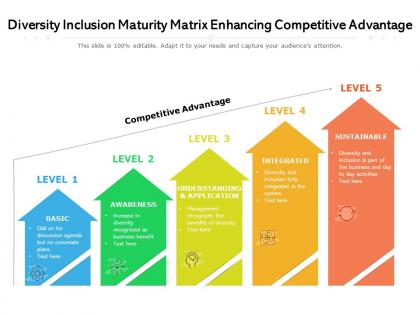
Assess the impact of your initiative with our Diversity Inclusion Maturity Matrix Enhancing Competitive Advantage. You will be an accurate judge.
People who downloaded this PowerPoint presentation also viewed the following :
Diversity inclusion maturity matrix enhancing competitive advantage with all 2 slides:
Our Diversity Inclusion Maturity Matrix Enhancing Competitive Advantage allow you to judge fairly. It guards against introduction of bias.


FAQs for Diversity inclusion maturity matrix
Key dimensions include workforce representation, inclusive leadership capabilities, equitable talent management processes, psychological safety measures, and systematic bias identification protocols. These assessment areas enable organizations to evaluate progress across recruitment, retention, and advancement practices while identifying gaps in policy effectiveness, ultimately delivering measurable improvements in employee engagement and organizational performance.
Organizations can effectively measure their diversity and inclusion maturity through comprehensive assessments that evaluate policies, representation metrics, leadership commitment, employee engagement surveys, and cultural indicators across all organizational levels. These measurement frameworks enable companies to identify specific gaps, benchmark against industry standards, and create targeted improvement strategies, with many organizations finding that regular maturity assessments ultimately deliver enhanced workplace culture and competitive advantage.
Leadership commitment serves as the foundational driver of diversity and inclusion maturity, establishing strategic priorities, allocating resources, and modeling inclusive behaviors throughout the organization. When executives actively champion D&I initiatives, organizations experience accelerated cultural transformation, improved employee engagement, and enhanced innovation, with many companies finding that visible leadership accountability ultimately delivers measurable progress across all maturity dimensions.
Organizations identify diversity and inclusion gaps through comprehensive assessments including demographic analysis, employee surveys, leadership representation reviews, pay equity audits, and retention data evaluation. These strategic diagnostic tools enable companies across sectors like financial services, healthcare, and technology to pinpoint specific areas needing improvement, ultimately delivering targeted interventions and measurable progress toward inclusive workplace cultures.
Diversity and inclusion metrics include representation ratios across demographics and leadership levels, pay equity analyses, employee engagement scores by demographic groups, retention and promotion rates, and inclusion survey results measuring psychological safety. Organizations typically track hiring pipeline diversity, mentorship program participation, and exit interview feedback, with many companies finding that combining quantitative workforce data with qualitative culture assessments delivers comprehensive insights into inclusion effectiveness.
Employee engagement significantly influences diversity inclusion maturity matrix success by driving authentic participation, fostering open dialogue, and ensuring sustainable behavioral change across organizational levels. Engaged employees actively champion inclusive practices, provide honest feedback during assessments, and serve as diversity ambassadors, while disengaged teams often resist initiatives, ultimately determining whether organizations achieve measurable progress or merely superficial compliance.
Organizations can advance through maturity levels by implementing comprehensive bias training, establishing mentorship programs, creating employee resource groups, conducting regular pay equity audits, and setting measurable diversity targets with leadership accountability. These strategic initiatives work together to embed inclusive practices across recruitment, promotion, and retention processes, with many companies finding that systematic approaches combined with transparent progress tracking ultimately deliver stronger organizational culture and enhanced competitive advantage.
Technology and data analytics support diversity and inclusion maturity assessment through automated data collection, real-time dashboard monitoring, predictive modeling, sentiment analysis, and comprehensive reporting systems. These tools enable organizations to track demographic patterns, measure engagement levels, identify bias indicators, and benchmark progress against industry standards, while many companies finding that data-driven approaches ultimately deliver more objective insights and accelerated improvement initiatives.
Common challenges include resistance to change, inadequate leadership commitment, insufficient data collection systems, lack of clear metrics, and limited employee engagement across all organizational levels. Organizations often struggle with honest self-assessment, resource allocation for sustained initiatives, and creating accountability structures, with many finding that cultural transformation requires consistent reinforcement and strategic patience to achieve measurable diversity outcomes.
Organizations ensure sustainable diversity and inclusion efforts by embedding them into core business processes, establishing clear accountability metrics, securing long-term executive commitment, and creating systematic feedback loops for continuous improvement. These strategies work by integrating D&I into performance evaluations, budget allocations, and strategic planning cycles, with many companies finding that consistent measurement, regular training refreshers, and tying outcomes to leadership compensation ultimately delivers lasting cultural transformation and sustained competitive advantage.
Training and education serve as foundational catalysts for advancing diversity and inclusion maturity by building awareness, developing inclusive leadership capabilities, addressing unconscious bias, and establishing cultural competency across all organizational levels. These strategic learning initiatives enable companies to create psychologically safe environments, improve decision-making processes, and enhance employee engagement, with many organizations finding that comprehensive D&I education programs ultimately deliver measurable improvements in retention, innovation, and overall business performance.
Benchmarking against industry peers provides organizations with critical insights into diversity best practices, performance gaps, and strategic opportunities by comparing metrics like representation rates, inclusion scores, and program effectiveness. This comparative analysis enables companies to identify competitive advantages, set realistic targets, and adopt proven strategies from industry leaders, while many organizations finding that peer benchmarking accelerates their diversity initiatives and delivers measurable improvements in workplace culture.
A diverse workforce significantly enhances innovation through varied perspectives, creative problem-solving approaches, and broader market insights, while delivering measurable improvements in financial performance, decision-making quality, and customer engagement. Companies with diverse teams consistently outperform homogeneous organizations by 35% in profitability and 70% in innovation metrics, with many finding that inclusive environments accelerate product development and market expansion.
Feedback mechanisms can be integrated through regular employee surveys, focus groups, exit interviews, and anonymous reporting systems that measure progress across each matrix stage. These continuous feedback loops enable organizations to identify gaps, track cultural shifts, and adjust diversity strategies in real-time, with many companies finding that systematic feedback collection ultimately accelerates their maturity progression and enhances inclusive workplace experiences.
Organizations should employ comprehensive communication training, leadership accountability measures, employee resource groups, bias-aware recruitment processes, and data-driven diversity metrics across all maturity levels. These strategies work synergistically by embedding inclusion into daily operations, decision-making frameworks, and performance evaluations, with many companies finding that consistent implementation ultimately delivers enhanced innovation, employee engagement, and competitive advantage in increasingly diverse markets.
No Reviews