


Diversity and inclusion management powerpoint presentation slides




Try Before you Buy Download Free Sample Product
 Impress Your
 Audience
 100%
100% Editable
 Save Hours
 of Time


Diversity and inclusion management refers to the organizational actions which aim to promote the inclusion of employees from different regions into the company structure. Check out our competently designed template on Diversity and Inclusion Management that is made to improve the companys current culture and introduce diversity and inclusion within the companys culture. We have covered recent state analysis, focusing on current company situation, workforce comparison based on gender, race, ethnicity, etc. Our focus is also on issues the company faces due to the lack of diversity and inclusion and survey results obtained by team members. Challenges faced due to diversity and inclusion have been covered here and its solutions. Different diversity and inclusion dimensions have been focused like diversity, diversity wheel, dimensions affecting the workplace, 3 dimensions of inclusion, and signature traits of inclusive management. This template evaluates the inclusion model wherein the creation of the competency model. We have depicted the strategies of the D and I. Diversity and inclusion program that focuses on types of D and I training methods, a program for employees and managers. The ways to implement D and I within the company have been shared here. Download it now.
People who downloaded this PowerPoint presentation also viewed the following :
Content of this Powerpoint Presentation
Slide 1: This slide displays the title 'Diversity and Inclusion Management'.
Slide 2: This slide presents the agenda.
Slide 3: This slide displays the table of Contents for Diversity and Inclusion Management.
Slide 4: This slide displays various topics under 'Current State Analysis' to be covered in the template.
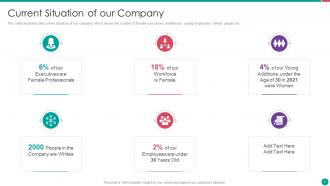
Slide 5: This slide illustrates the current situation of the company.
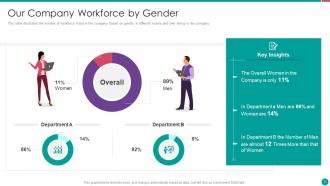
Slide 6: This slide illustrates the number of workforce in the company based on gender in different teams and over hiring.
Slide 7: This slide illustrates the workforce in the company as per the race based on Asian, black etc. for two years.
Slide 8: The slide demonstrates graphs that show the issues faced by the company like gender diversity affecting the company profitability and productivity.
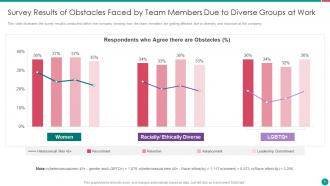
Slide 9: This slide illustrates the survey results conducted within the company showing the team members getting affected.
Slide 10: This slide displays two topics under 'Challenges and Solutions' to be covered in the template.
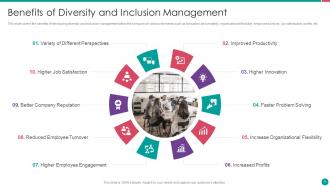
Slide 11: This slide covers the benefits of introducing diversity and inclusion management within the company on various elements.
Slide 12: This slide focuses on the challenges of diversity and inclusion at workplace such as communication issues etc.
Slide 13: This slide displays three topics under 'Dimensions of Diversity & Inclusions' to be covered in the template.
Slide 14: This slide provides the four dimensions of diversity wheel.
Slide 15: This slide provides the dimensions of diversity wheel.
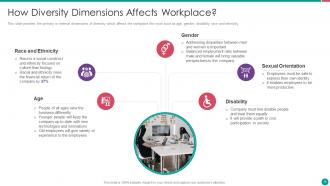
Slide 16: This slide provides the primary or internal dimensions of diversity which affects the workplace the most .
Slide 17: This slide displays topics under 'Dimensions of Diversity & Inclusions' to be covered in the template.
Slide 18: This slide provides the details of the three dimensions of inclusion important in the company.
Slide 19: This slide provides the six traits which an inclusive management team must have.
Slide 20: This sli displays two topics under 'Diversity and Inclusion Model' to be covered in the template.
Slide 21: This slide covers the levels of diversity and inclusion maturity model such as compliance, etc.
Slide 22: This slide provides the diversity and inclusion maturity model which will be the approach followed by the company.
Slide 23: This slide displays four topics under 'Diversity and Inclusion Strategies' to be covered in the template.
Slide 24: This slide provides the recruiting strategies which will be implemented by the company.
Slide 25: This slide provides the details of the workplace strategies which must be implemented within the team.
Slide 26: This slide provides the details of the retention strategies which must be implemented by the company.
Slide 27: This slide provides the details of the current concerns faced by our company such as decreasing sales, lower productivity etc.
Slide 28: This slide displays three topics under 'Diversity and Inclusion Program' to be covered in the template.
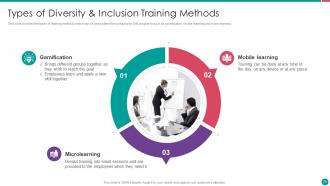
Slide 29: This slide provides the types of training methods which can be used within the company for D&I programs.
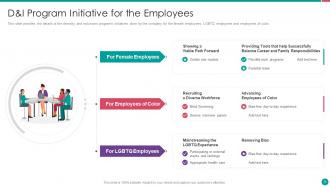
Slide 30: This slide provides the details of the diversity and inclusions programs initiatives done by the company for the female employees etc.
Slide 31: In this slide the timeline covers the training program conducted for company managers and the steps that must be considered during the session.
Slide 32: This slide displays two topics under 'Ways to Implement D&I' to be covered in the template.
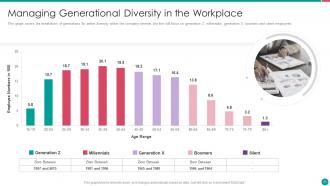
Slide 33: This slide exhibits a graph that covers the breakdown of generations for better diversity within the company focussing on generation Z etc.
Slide 34: This slide provides the company’s updated commitments.
Slide 35: This slide displays two topics under 'Impact' to be covered in the template.
Slide 36: This slide provides impact of D&I in business performance.
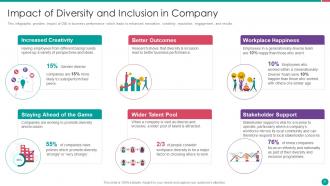
Slide 37: This slide exhibits infographics providing impact of D&I in business performance.
Slide 38: This slide displays the topic 'Diversity and Inclusion Dashboard' to be covered in the template.
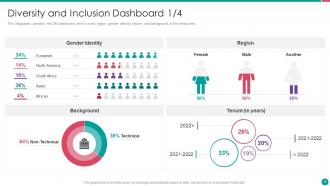
Slide 39: This slide demonstrates an infographic that provides the D&I dashboard which covers region, gender identity etc.
Slide 40: This slide presents an infographic providing the D&I dashboard which covers region, gender identity etc.
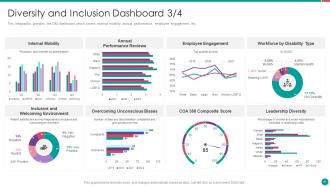
Slide 41: This slide presents an infographic that provides the D&I dashboard which covers internal mobility, annual performance etc.
Slide 42: This slide exhibits an infographic that provides the D&I dashboard which covers promotion rate, termination rate etc.
Slide 43: This is an Icons Slide.
Slide 44: This slide presents the title additional Slides.
Slide 45: This slide compares the Diversity and Inclusion Management.
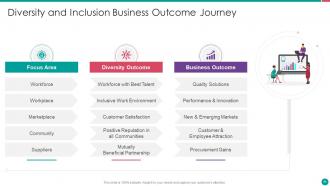
Slide 46: This slide showcases the Diversity and Inclusion Business Outcome Journey.
Slide 47: This slide shows the relationship Matrix of Diversity and Inclusion.
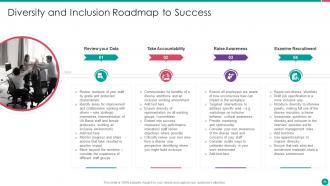
Slide 48: This slide presents the four steps involved in diversity and inclusion roadmap to sucess.
Slide 49: This slide displays the about us information.
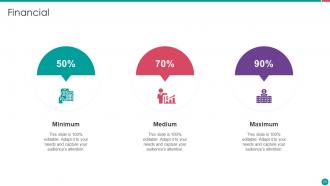
Slide 50: This slide shows the organization's financials ranging from minimum to maximum.
Slide 51: This slide displays a Venn.
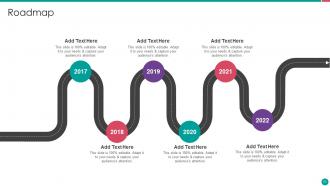
Slide 52: This slide presents the roadmap.
Slide 53: This slide displays the puzzle.
Slide 54: This slide displays post it Notes.
Slide 55: This slide carries the 'Thanks for Watching!' message with address, contact number etc.
Diversity and inclusion management powerpoint presentation slides with all 55 slides:
Use our Diversity And Inclusion Management Powerpoint Presentation Slides to effectively help you save your valuable time. They are readymade to fit into any presentation structure.

























FAQs for Diversity and inclusion management
Honestly, if your leadership isn't fully committed, you're kinda screwed from the start. Focus on inclusive hiring first, then build employee resource groups - those actually work. Regular bias training helps but don't make it feel like punishment. Set up mentorship programs that mix different backgrounds together. Oh, and track everything with real metrics so you can prove it's working (or not). The psychological safety thing is huge too - people need to feel comfortable being themselves. I'd start by figuring out where you're failing the hardest right now. That'll tell you what to tackle first.
Okay so track the obvious stuff first - hiring numbers, promotions, pay gaps, who's actually staying vs. leaving. That's your baseline. But here's the thing - you can't just live in Excel forever. Survey people about whether they feel heard, not just counted. Exit interviews are goldmines if you actually listen to them. I'd also watch who speaks up in meetings and gets leadership roles - that tells you if inclusion is real or just on paper. Oh and don't do the whole "annual diversity report" thing. Check quarterly or you'll miss problems brewing.
Honestly, leadership makes or breaks the whole thing. If they're just putting up diversity posters but not actually walking the walk, everyone sees right through it. Good leaders tie this stuff to performance reviews and budgets - like, actual money. They call out bias when they see it and make people feel safe being themselves at work. The ripple effect is huge too. When your boss genuinely cares about inclusion, suddenly everyone else starts paying attention. But yeah, it has to be real accountability, not just nice words in company emails. Check how your leadership actually invests in it - that tells you everything.
Dude, unconscious bias is such a sneaky problem in hiring. Your brain automatically gravitates toward people who seem familiar - same background, similar names, reminds you of yourself somehow. It happens during resume reviews, interviews, performance evaluations, you name it. Honestly, it's kind of scary how we don't even notice we're doing it. You'll end up with cookie-cutter teams and miss out on amazing candidates. My advice? Set up structured interview processes and get diverse people involved in decisions. Also worth tracking your hiring patterns - the data might surprise you with what it reveals.
So first off, ditch your usual recruiting spots and actually go find people in different communities. Your job posts probably sound stuffy too - focus on real skills instead of that "culture fit" BS (which honestly just means "hire someone like me"). Build teams with people who think differently, not just different demographics. That's way more valuable. Make sure everyone feels safe speaking up though, otherwise what's the point? Oh and track your hiring patterns - you might be surprised who you're actually picking. Short sentences work. Longer ones with natural flow keep things interesting and readable.
Honestly, ditch the boring PowerPoint sessions - they're useless. Get your team talking about real stuff they actually deal with at work. Bring in different people to lead discussions, not just the same voices every time. Leadership needs to show up too, can't just send an email and call it done. Oh, and don't make it a one-time thing. Set up mentoring programs or employee groups that keep the conversation going. I'd start by asking your team what they're struggling with first. Way more effective than generic training modules.
Look, it's honestly brutal out there for underrepresented folks. Microaggressions are constant. Their ideas get stolen or straight-up ignored in meetings. Meanwhile, they're stuck doing all the "diversity work" while missing actual growth opportunities - which is such BS if you ask me. Pay gaps are real, promotions harder to come by. Oh, and they're always expected to speak for their entire race/gender/whatever. The scrutiny on everything they do? Exhausting. You can help though - actually amplify their voices when they speak up. Give credit where it's due. Listen when they tell you this stuff instead of getting defensive.
Honestly, find mentors who actually care about diversity - not just doing it for appearances. Train them first on bias stuff because good intentions don't automatically translate to good mentoring, you know? Focus on real career goals like promotions and skill development instead of meaningless coffee meetings. Reverse mentoring is pretty cool too - younger diverse employees can teach leadership a thing or two. Track if people are actually getting promoted and staying at the company. The whole thing needs structure to work, but keep the relationships genuine. Otherwise it's just performative nonsense.
Honestly, mixed teams just crush it compared to everyone thinking the same way. Different backgrounds mean people attack problems from weird angles you'd never consider. I've seen it happen - someone goes "but what if we just..." and suddenly you're onto something brilliant. Short sentences hit different. Your quieter teammates often have the best ideas, so actually ask them what they think instead of letting the loud ones dominate. You'll spot issues faster too since everyone brings their own perspective. It's kinda like having backup eyes checking your work, but for creativity.
Honestly, the biggest thing is making it ongoing - not just some one-off diversity workshop that everyone forgets about. Get your leaders actually walking the walk first, because people notice that stuff. Employee resource groups work really well for giving allies actual ways to help their coworkers. Training's important too, but focus on practical skills like how to speak up when someone says something problematic. Mentoring programs are solid. Some companies do these "allyship challenges" which sounds super corporate but apparently gets people engaged? Oh, and definitely celebrate the people doing it right - public recognition goes far. Bystander intervention training is clutch too.
Okay so first thing - get your hiring sorted with salary ranges posted upfront and diverse interview panels. Pay equity audits are huge too, though honestly they can be pretty eye-opening in ways you might not expect. Make sure mentorship and leadership training isn't just going to the same people over and over. Flexible work options help a ton since everyone's got different situations. Oh and here's the thing nobody talks about enough - you actually have to enforce this stuff consistently. Doesn't matter how great your policies look on paper if managers are just ignoring them.
Honestly, you can't just ignore the pushback - be upfront about it. People get defensive when they don't understand the "why" behind changes. I'd start with your managers since they're doing the actual day-to-day work. Show them real data and stories from companies that actually made this work, not just fluffy corporate speak about doing good. Here's the thing though - if you don't tie D&I to performance reviews, it'll just be another forgotten initiative. Make those honest conversations about business impact, not just moral arguments (even though obviously that matters too). Once people see concrete results instead of just meeting talk, resistance usually drops pretty fast.
Honestly, diverse teams just get customers better. People want to see themselves reflected in the companies they buy from - it's pretty basic psychology. Your team can actually connect with different cultural backgrounds instead of guessing what works. Plus, you'll catch product issues that a homogeneous group would totally miss. Customer service gets way smoother too since your reps can navigate cultural differences naturally. Oh, and here's something concrete you can do - check your satisfaction scores by customer demographic. I bet you'll find higher ratings where your team makeup actually matches your customer base. Worth tracking for sure.
So there's actually some cool tech that can help with D&I stuff. AI tools can spot bias in job posts and screening - pretty neat honestly. Analytics let you track demographics across teams. Video interviews open up your candidate pool way beyond just local people. Anonymous feedback systems are huge too since people will actually speak up when they're not putting their name on it. One thing I've noticed though - some companies get way too caught up in the numbers game. The human side still matters most. I'd say start with just one thing, maybe bias-checking software for hiring? See how that goes first.
Community involvement matters way more than people think for diversity stuff. Your company looks legit when you're actually partnering with local organizations or backing minority businesses - not just talking about it internally. Honestly, it's probably one of the better ways to find talent you'd never reach otherwise. Different communities will also tell you straight up how they see your company, which is super valuable feedback. Oh, and make sure what you're doing outside actually matches your internal goals. Otherwise people see right through it and think you're just doing PR moves.
-
Best way of representation of the topic.
-
Wonderful templates design to use in business meetings.
-
Great experience, I would definitely use your services further.
-
Excellent work done on template design and graphics.