


Diversity metrics and scorecard powerpoint presentation slides




Try Before you Buy Download Free Sample Product
 Impress Your
 Audience
 100%
100% Editable
 Save Hours
 of Time


Diversity scorecards are used to set the targets, identify the risk areas, measure the impact of initiatives, etc. The metrics allow the organizations to track their goals and assign accountability regarding various workplace factors. Here is a professionally designed template on Diversity Metrics and Scorecard that will establish overarching goals and track the progress in meeting those goals. The PowerPoint presentation displays staffing ratio analysis using organization diversity metrics, count-by-race scorecard, department-wise metrics for diversity, etc. Our insightful template also exhibits details for different departments ethnicity diversity metric scorecards, company metric scorecards depicting joiners and leavers, gender metric diversity scorecards with turnover and hires, and more. The PPT deck even presents information for company diversity metric scorecards with age and religious beliefs, a diversity scorecard for manufacturing companies with minority and female availability, and industry metric scorecards with race and gender. Our robust and editable template showcases details for the community metric scorecard with results and percentage, the male and female scorecard for organization, race metric scorecard for marketing and production department, monthly sales metric scorecard with ethnicity, and more. Customize this 100 percent editable template based on your needs. Get access now.
People who downloaded this PowerPoint presentation also viewed the following :
Content of this Powerpoint Presentation
Slide 1: This slide displays title i.e. 'Diversity Metrics and Scorecard'.
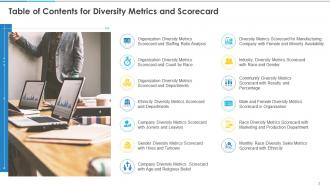
Slide 2: This slide presents table of contents.
Slide 3: This slide introduces Organization Diversity Metrics Scorecard and Staffing Ratio Analysis.
Slide 4: This slide shows Organization Diversity Metrics Scorecard and Count by Race.
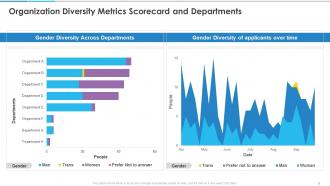
Slide 5: This slide presents Organization Diversity Metrics Scorecard and Departments.
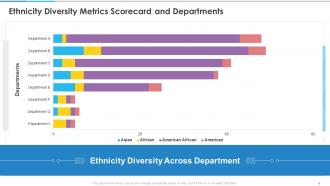
Slide 6: This slide displays Ethnicity Diversity Metrics Scorecard and Departments.
Slide 7: This slide represents Company Diversity Metrics Scorecard with Joiners and Leavers.
Slide 8: This slide showcases Gender Diversity Metrics Scorecard with Hires and Turnover.
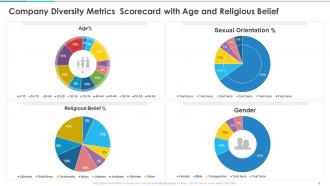
Slide 9: This slide shows Company Diversity Metrics Scorecard with Age and Religious Belief.
Slide 10: This slide presents Diversity Metrics Scorecard for Manufacturing Company with Female and Minority Availability.
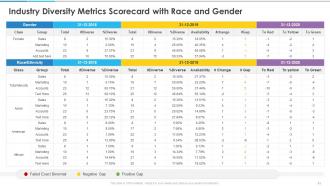
Slide 11: This slide displays Industry Diversity Metrics Scorecard with Race and Gender.
Slide 12: This slide represents Community Diversity Metrics Scorecard with Results and Percentage.
Slide 13: This slide showcases Male and Female Diversity Metrics Scorecard in Organization.
Slide 14: This slide shows Race Diversity Metrics Scorecard with Marketing and Production Department.
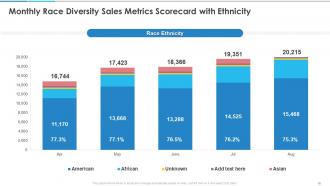
Slide 15: This slide presents Monthly Race Diversity Sales Metrics Scorecard with Ethnicity.
Slide 16: This slide displays Icons for Diversity Metrics and Scorecard.
Slide 17: This slide is titled as Additional Slides for moving forward.
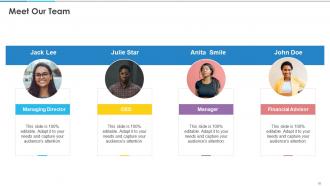
Slide 18: This is Our Team slide with names and designation.
Slide 19: This is Our Mission slide with related imagery and text.
Slide 20: This is About Us slide to show company specifications etc.
Slide 21: This is a Financial slide. Show your finance related stuff here.
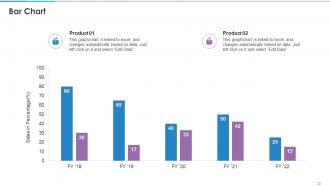
Slide 22: This slide presents Bar chart with two products comparison.
Slide 23: This slide presents Roadmap with additional textboxes.
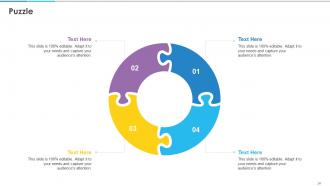
Slide 24: This slide contains Puzzle with related icons and text.
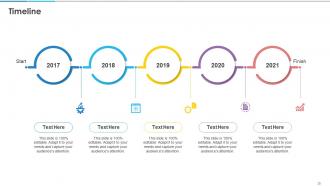
Slide 25: This is a Timeline slide. Show data related to time intervals here.
Slide 26: This is a Thank You slide with address, contact numbers and email address.
Diversity metrics and scorecard powerpoint presentation slides with all 31 slides:
Use our Diversity Metrics And Scorecard Powerpoint Presentation Slides to effectively help you save your valuable time. They are readymade to fit into any presentation structure.



















FAQs for Diversity metrics and scorecard
Start with headcount breakdowns by demographics - track that across all levels and departments. Hiring and promotion rates are next, because otherwise you're just spinning your wheels. Honestly, retention data split by identity groups is where you'll find the real tea about your workplace culture. Pay equity gaps matter too, obviously. Leadership pipeline metrics round it out. Pick maybe 5-7 max that actually connect to whatever your DEI goals are. I'd say start with the stuff you can measure well right now, then add more complex metrics later. No point tracking garbage data, you know?
Okay so first thing - get your baseline numbers down. Track the obvious stuff like representation and retention rates, but honestly most companies screw up by only looking at hiring. That's pointless if people leave right after. Set up quarterly check-ins on promotion data and run those engagement surveys - exit interviews too when people bounce. I'd build a simple dashboard your leadership actually looks at regularly. The real trick is watching year-over-year trends instead of getting hyped about random one-time improvements. Don't just celebrate hiring wins if retention sucks.
Make those surveys totally anonymous - like, don't even think about linking responses to specific people. Only share stuff in big chunks, like "40% of the marketing team said X." We learned this lesson when we got way too specific with our data once and it was awkward. Be upfront about why you're asking these questions in the first place. Let people skip whatever they want without making it weird. Honestly, the voluntary approach gets you better data anyway since people aren't just clicking random boxes to get through it. Store everything securely and maybe use a third-party tool that strips out identifying info automatically. Set minimums too - don't report on groups smaller than 5 people.
Yeah, it's all over the place depending on your industry. Tech companies obsess over gender gaps in engineering - makes sense. Healthcare orgs track racial diversity in leadership since they serve such diverse patients. Finance has to deal with regulatory stuff around ethnicity data (ugh, compliance). Manufacturing cares more about age diversity and hiring veterans, which honestly surprised me when I first learned that. The real trick is comparing yourself to similar companies, not just anyone. Figure out your top 3-4 metrics that actually matter for your sector. Don't go crazy tracking everything.
Honestly, leadership makes or breaks this whole thing. Without executives who actually give a damn, your diversity scorecard just sits there looking pretty while nothing changes. They need to put real money behind it and make managers answer for the numbers - treat it like any other metric they obsess over. The good leaders talk about this stuff publicly and build it into performance reviews. I've seen too many companies where the CEO pays lip service but then... crickets. You really need someone at the top who'll champion it consistently, not just when it's convenient or trendy.
Honestly, you've gotta connect your diversity numbers to stuff leadership already obsesses over. Don't just track who you hired - show how it impacts retention, customer satisfaction, or revenue growth in new markets. Like if you're targeting different demographics, prove that diverse teams crush those projects better. Most companies totally whiff on making this connection though. Pick maybe 2-3 business metrics your execs get judged on, then tie specific diversity data to those. Once they see it's actually moving the needle on their goals instead of just being a checkbox thing, they'll start caring way more.
So there's a bunch of ways to tackle this. Workday and BambooHR are pretty decent if you want something that pulls straight from your employee data - they've got diversity modules built right in. Tableau and Power BI are crazy powerful for custom dashboards, but honestly? Probably too much if you're just getting started. I mean, even Google Sheets works fine for basic tracking. The real trick is finding something your team will actually stick with instead of abandoning after two weeks. I'd say start simple with whatever you already have, then get fancy later once you know what you need.
Your diversity numbers only tell half the story - you need the qualitative stuff to understand what's really going on. Like, you could have amazing representation stats but people are still feeling left out or unsupported daily. The numbers show you what's happening, but employee feedback explains why. I'd definitely pair those scorecard reviews with listening sessions or quick pulse surveys. Honestly, without hearing people's actual experiences, you're just tracking outcomes instead of fixing root problems. Stories reveal what needs changing - metrics just... don't give you that depth, you know?
Figure out what's actually broken first - hiring numbers? People leaving? Promotions being weird? Whatever it is, that's where you focus. Bad hiring means new sourcing and partnering with different organizations. People quitting? You'll need better leadership training and mentorship (seriously, this stuff actually works). Pay gaps need salary audits like, yesterday. Don't try to fix everything at once though. Pick maybe 2-3 things, give someone ownership of each, and check in monthly instead of pretending annual reviews will catch problems. Concrete goals beat fluffy diversity statements every time.
Quarterly reviews are your best bet - I learned this the hard way after trying monthly updates and watching everyone get totally fried. Hit those progress targets, spot quick wins, figure out what's blocking you. Then once a year, do the deep dive stuff. Reassess your metrics, see how you stack up against others in your industry, tweak targets based on what actually worked (or didn't). Honestly, put it in your calendar right now or you'll keep saying "we'll do it next quarter" forever. Anything longer than three months and people just lose steam.
Honestly, transparency is everything here. Publish your diversity numbers publicly and be super clear about how you're actually measuring stuff - not just random percentages that mean nothing. Get third-party audits so people know you're not fudging the data. Pick maybe 4-5 key metrics and commit to quarterly updates with real talk about what's working and what isn't. Leadership needs to own this process, and employees should see how the numbers connect to actual changes happening around them. I'd start small though - don't try to track everything at once.
Honestly, I'd start with the free EEOC data - it breaks down workforce demographics by industry and it's surprisingly detailed. Catalyst and McKinsey put out solid diversity studies too. If you're in tech, just look at what Google or Microsoft publish in their annual reports since they're pretty open about their numbers. The Corporate Equality Index is another good benchmark, though I sometimes think those frameworks can get a bit overwhelming. My advice? Pick maybe 3-4 metrics you actually care about and track those consistently. Way better than trying to measure everything and getting lost in the data. You could also just set internal year-over-year targets if external benchmarks don't quite fit your situation.
Yeah, diversity and engagement scores definitely feed into each other. When people see actual representation happening, engagement usually jumps because folks feel like they belong. Engaged employees stick around longer and refer their friends - which obviously helps your diversity numbers. It's kind of a win-win cycle, honestly. But here's what I'd watch for - make sure your engagement surveys actually break down responses by different groups. That's how you'll know if you're creating real inclusion or just... I don't know, putting diverse faces in your marketing materials. The data will tell you if people are genuinely feeling included or not.
Honestly, the worst thing you can do is just track hiring numbers and ignore retention - like, what's the point if people leave right away? Don't cherry-pick the good stats either, everyone knows when you're doing that. Unrealistic timelines will bite you in the ass every time. Keep your scorecard simple - maybe 3-5 metrics max - because complex ones just collect dust. Oh, and stop comparing yourself to tech companies if you're in retail or whatever. Make sure leadership actually looks at this stuff regularly, not just when HR reminds them. That's basically it.
Think of your diversity scorecard like a map showing where the blind spots are. Low numbers in certain departments? Time to switch up your sourcing or check if those job descriptions sound too corporate-y. The retention side is where it gets interesting though - you'll spot weird patterns around promotions and pay that explain why people bail. I mean, collecting data without doing anything is pretty pointless. It's way better than just crossing your fingers and hoping your hiring gets more diverse somehow. Short version: the numbers actually tell you what to fix instead of guessing.
-
Awesomely designed templates, Easy to understand.
-
Wonderful templates design to use in business meetings.