


Employee Performance Scorecard Powerpoint Presentation Slides




Try Before you Buy Download Free Sample Product
 Impress Your
 Audience
 100%
100% Editable
 Save Hours
 of Time


Check out our efficiently designed employee performance scorecard, a supervising tool that management professionals use to review an employees work. It consists of a list of essential qualities, skills, and daily tasks related to an employees job. This PPT deck contains slides to assess employee performance from multiple perspectives financial, internal business, innovation and learning, and customer. It also includes a matrix to categorize employees into high, medium, and low based on their respective performance and potential. The PowerPoint slides also include rating charts to evaluate employees on multiple traits and competencies. Further, it contains dashboards to track the sales accomplishments and absenteeism of organization employees. Additionally, the deck includes workforce performance measurement survey forms and checklists to evaluate their work quality, job knowledge, dependability, behavior towards subordinates, etc. Download our 100 percent editable and customizable template, which is also compatible with Google Slides.
People who downloaded this PowerPoint presentation also viewed the following :
Content of this Powerpoint Presentation
Slide 1: This slide introduces Employee Performance Scorecard. State Your Company Name and begin.
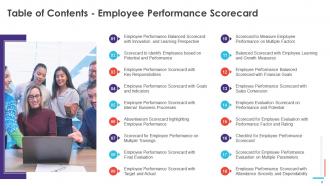
Slide 2: This slide presents Table of Content for the presentation.
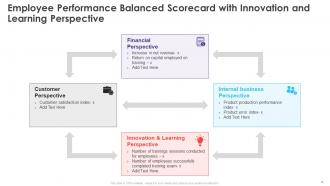
Slide 3: This slide displays Employee Performance Balanced Scorecard with Innovation and Learning Perspective.
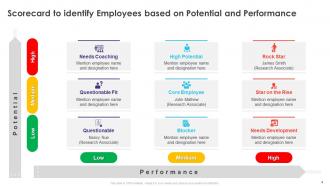
Slide 4: This slide represents Scorecard to identify Employees based on Potential and Performance.
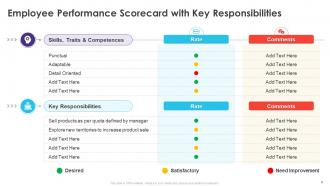
Slide 5: This slide showcases Employee Performance Scorecard with Key Responsibilities.
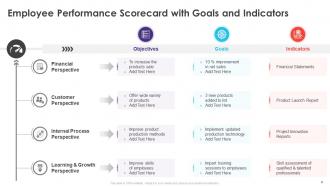
Slide 6: This slide shows Employee Performance Scorecard with Goals and Indicators.
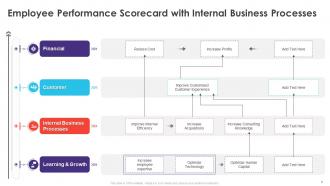
Slide 7: This slide presents Employee Performance Scorecard with Internal Business Processes.
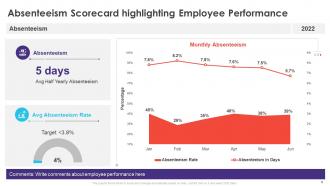
Slide 8: This slide displays Absenteeism Scorecard highlighting Employee Performance.
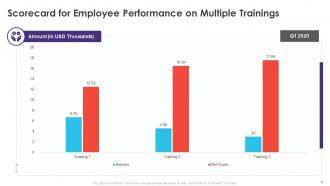
Slide 9: This slide represents Scorecard for Employee Performance on Multiple Trainings.
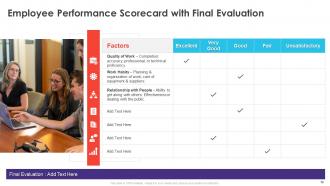
Slide 10: This slide showcases Employee Performance Scorecard with Final Evaluation.
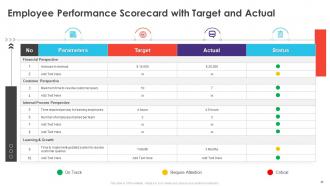
Slide 11: This slide shows Employee Performance Scorecard with Target and Actual.
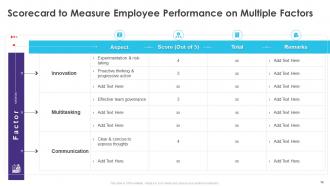
Slide 12: This slide presents Scorecard to Measure Employee Performance on Multiple Factors.
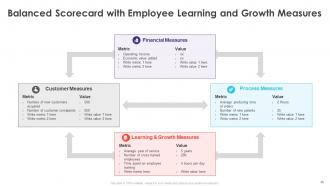
Slide 13: This slide displays Balanced Scorecard with Employee Learning and Growth Measures.
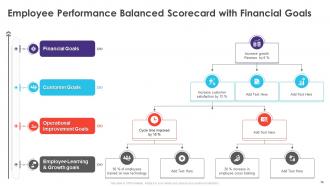
Slide 14: This slide represents Employee Performance Balanced Scorecard with Financial Goals.
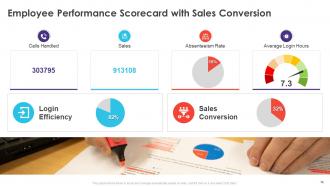
Slide 15: This slide showcases Employee Performance Scorecard with Sales Conversion.
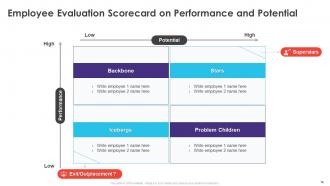
Slide 16: This slide shows Employee Evaluation Scorecard on Performance and Potential.
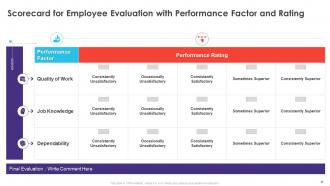
Slide 17: This slide presents Scorecard for Employee Evaluation with Performance Factor and Rating.
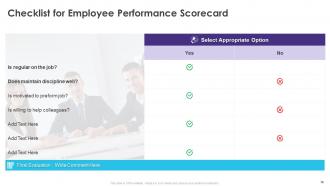
Slide 18: This slide displays Checklist for Employee Performance Scorecard.
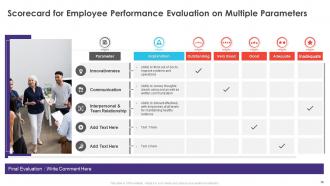
Slide 19: This slide represents Scorecard for Employee Performance Evaluation on Multiple Parameters.
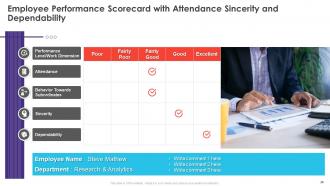
Slide 20: This slide showcases Employee Performance Scorecard with Attendance Sincerity and Dependability.
Slide 21: This slide displays Icons for Employee Performance Scorecard.
Slide 22: This slide is titled as Additional Slides for moving forward.
Slide 23: This is About Us slide to show company specifications etc.
Slide 24: This slide provides 30 60 90 Days Plan with text boxes.
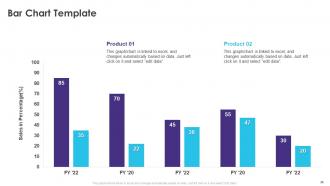
Slide 25: This slide presents Bar chart with two products comparison.
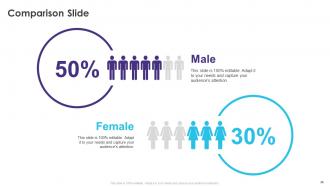
Slide 26: This is a Comparison slide to state comparison between commodities, entities etc.
Slide 27: This is Our Team slide with names and designation.
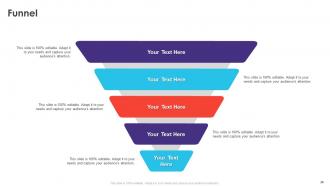
Slide 28: This slide displays Funnel with related icons and text.
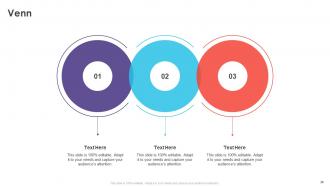
Slide 29: This slide depicts Venn diagram with text boxes.
Slide 30: This is a Thank You slide with address, contact numbers and email address.
Employee Performance Scorecard Powerpoint Presentation Slides with all 35 slides:
Use our Employee Performance Scorecard Powerpoint Presentation Slides to effectively help you save your valuable time. They are readymade to fit into any presentation structure.





FAQs for Employee Performance Scorecard
Mix quantitative stuff with the softer skills - that's key. Sales numbers, project deadlines, customer scores for the hard data. Then behavioral things like teamwork and communication. Goal achievement is huge too, plus any learning they're doing. I usually go 60/40 split favoring the measurable metrics, but honestly that depends on the role. Don't make the mistake I did last year and track like 12 different things - total nightmare. Stick to maybe 5-7 KPIs that actually matter for their specific job. The whole thing falls apart if you're drowning in data nobody cares about.
Honestly, the trick is getting each department to tell you what they actually care about instead of forcing the same metrics on everyone. Sales obviously wants revenue and conversion rates. HR's all about retention and employee happiness. IT? They're obsessing over uptime and whether projects finish on time - you know how they are. Get the department heads involved in picking their own KPIs. Most platforms let you build different templates anyway. I'd start with maybe 3 or 4 metrics that really matter for each team, not some corporate wishlist of 20 things nobody tracks.
Look, scorecards are pretty much worthless without feedback conversations. Your employees just see random numbers and have zero clue what they mean or how to get better. It's like getting a test back with no explanation - totally pointless. The real value comes when you sit down and actually talk through the data with them. Use those numbers as a starting point for discussion, not just some final judgment. Honestly, I think most managers get this backwards. They treat scorecards like report cards instead of conversation starters. Schedule regular check-ins, don't wait for annual reviews.
Quarterly minimum, but monthly's way better if you can pull it off. Annual reviews are honestly pretty worthless for helping people actually improve - like, by then it's too late to fix anything. Your team needs that regular feedback to stay on track and not feel lost. Keep it simple though - focus on maybe 2-3 key things instead of drowning them in spreadsheets. I usually just block out 15 minutes to chat about what's going well and what's not. Oh, and definitely put it on your calendar or you'll forget. Trust me on that one.
BambooHR and Workday are solid if you want the full HR package with performance stuff built in. But honestly? Don't sleep on Google Sheets or Excel - I've seen teams crush it with basic spreadsheets. Way less hassle sometimes. 15Five and Lattice are worth checking out too since they're built specifically for performance management. My advice would be start with whatever HR system you're already using (if any), then see if you need fancier features later. No point overcomplicating things from day one, you know?
Start by connecting each scorecard metric straight back to what your company actually wants to achieve. Customer retention matters? Then your sales team needs relationship metrics, not just deal-closing numbers. Most companies screw this up - they build scorecards in isolation without thinking bigger picture. Get your leadership to define success at the top level first. Then break it down role by role. Quarterly reviews are clutch here. You'll catch when you're tracking stuff that's easy to measure but doesn't actually move the needle for your business.
Honestly, data quality is your biggest headache - metrics get messy and nothing feels fair when you can't measure things consistently. People hate scorecards too because they think you're just trying to micromanage them (and let's be real, sometimes that's exactly what happens). Keeping everything updated is a nightmare since roles change constantly. But here's what actually works - get your team involved in building their own scorecards from day one. When they help design it, they'll buy into it instead of fighting you on everything.
Honestly, just have your employees rate themselves on the exact same stuff before you do their review. Super simple - create a form covering goals, skills, whatever matters most. The best part? Those gaps between what they think and what you think become perfect talking points. No awkward silence trying to figure out where to start the conversation. Just make sure they fill theirs out first so you're not accidentally swaying their answers. I've seen this work really well because people actually reflect on their performance instead of going in blind. Makes the whole review way less painful for everyone.
Honestly, when you do performance monitoring the right way, people actually get more engaged. They're not sitting around wondering how they're doing for months - that's torture. Quick feedback means they can fix things fast instead of getting slammed later. Just don't make it creepy surveillance, you know? Use the data for helpful conversations, not to catch people messing up. I'd set up scorecards that show the good stuff too, not just problems. People feel way less stressed when they actually know where they stand. Plus they can adjust course before things get bad.
Start with coaching skills before you dive into the scorecard stuff. Your managers need to learn how to actually *talk* about the data instead of just dumping numbers on people. Role-play sessions are clutch here - yeah, managers will groan about it but trust me, they work. Teach them to ask "What support do you need?" rather than just calling out what's wrong. The whole point is making scorecards feel like development tools, not some weird gotcha thing. Oh, and definitely pilot with your strongest managers first. Then let them show the others how it's done through real examples - way more effective than another training deck.
Definitely do face-to-face one-on-ones instead of just firing off scorecard emails. Talk about specific behaviors and results - not personality stuff - and always connect it back to business goals so they get why the numbers matter. Too many managers just dump data without context, which is honestly pretty useless. Make sure you're highlighting the good stuff too, not just problems. Come with real examples ready. Oh, and this should be a conversation where they can actually respond and help shape their own development plan, not just you talking at them.
Honestly, performance scorecards are perfect for this - they basically show you exactly where each person's killing it and where they're struggling. I'd start by pulling up your team's latest scorecards and picking 2-3 weak spots per person. Then build training around those gaps. What's cool is you can assign projects that target specific skills and actually track if people improve over time. Way better than just telling someone "you need to communicate better" or whatever vague feedback managers usually give. Plus people actually like seeing their progress mapped out visually - makes the whole development thing feel more real, you know?
Honestly, the trick is focusing on stuff you can actually see and measure. Like "gives helpful feedback to teammates" or "hits deadlines without me having to bug them constantly." I know measuring soft skills sounds kinda bizarre, but it works way better than those vague 1-10 scales everyone hates. Track how often someone jumps into meetings or how quickly they sort out team drama - maybe "resolves conflicts within 48 hours" or whatever makes sense. Pick 3-4 behaviors that actually matter for each job, then make simple rating systems your managers won't mess up. Way more useful than abstract "leadership potential" nonsense.
Honestly, the best ones jump out pretty fast when you're reviewing scorecards regularly. Look for people hitting targets consistently across multiple cycles AND showing growth. Don't just focus on the obvious metrics like sales numbers - watch for soft skills too. Who's helping teammates succeed? Cross-department collaboration matters way more than most managers think. I'd track both hard data (project completion rates) and leadership behaviors. The real standouts exceed their current role requirements. Oh, and definitely set up quarterly talent reviews where you actually discuss these high performers - then build development paths for them before they get poached.
So you'll want to focus on fairness and transparency first. Make your criteria objective and apply them consistently - nobody wants a discrimination lawsuit because the metrics were all over the place. Be upfront about how scores work and what they're actually used for. Watch out for unconscious bias too, especially in how you weight different performance categories. Some scorecards accidentally penalize certain work styles or groups without meaning to. Honestly, I'd test it with a diverse group before launching - way easier to catch problems early than deal with the fallout later.
-
I am extremely pleased with these PPT slides that we used for our event. They were easy to modify and came out great in all aspects!
-
I never had to worry about creating a business presentation from scratch. SlideTeam offered me professional, ready-made, and editable presentations that would have taken ages to design.