


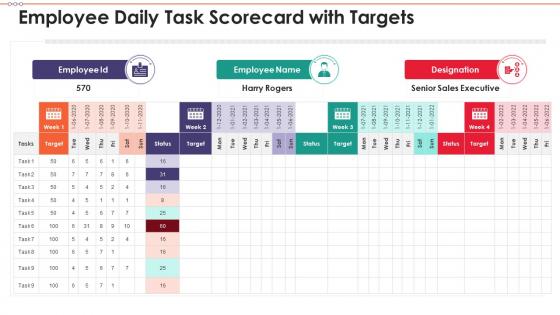
Employee scorecard daily task scorecard with targets




Try Before you Buy Download Free Sample Product
 Impress Your
 Audience
 100%
100% Editable
 Save Hours
 of Time


Our Employee Scorecard Daily Task Scorecard With Targets are topically designed to provide an attractive backdrop to any subject. Use them to look like a presentation pro.
People who downloaded this PowerPoint presentation also viewed the following :
Employee scorecard daily task scorecard with targets with all 6 slides:
Use our Employee Scorecard Daily Task Scorecard With Targets to effectively help you save your valuable time. They are readymade to fit into any presentation structure.





FAQs for Employee scorecard daily task
Effective employee scorecards include performance metrics, goal alignment indicators, competency assessments, behavioral evaluations, and development tracking components. These elements work together by measuring quantitative results, qualitative contributions, and growth potential, with many organizations finding that this comprehensive approach enhances performance visibility, streamlines review processes, and ultimately delivers better talent management outcomes.
Employee scorecards align with organizational goals by incorporating key performance indicators that directly support strategic objectives, cascading company-wide metrics to individual roles, and establishing clear connections between personal achievements and broader business outcomes. Through regular calibration sessions and performance reviews, organizations streamline goal alignment across departments, ultimately delivering enhanced accountability, improved strategic focus, and measurable progress toward collective success.
Employee scorecards should include quantitative metrics like productivity rates, quality scores, and goal achievement percentages, alongside qualitative measures such as teamwork, communication skills, and adaptability assessments. These comprehensive evaluation frameworks enable managers to identify high performers, address development needs, and make strategic decisions about promotions and resource allocation, ultimately delivering improved organizational performance.
Employee scorecards foster accountability by establishing clear performance expectations, providing regular feedback mechanisms, and creating transparent measurement systems that track individual contributions against team goals. Through consistent monitoring and open discussions about results, teams develop shared ownership of outcomes, proactive problem-solving behaviors, and collaborative improvement processes, ultimately delivering enhanced productivity and stronger collective responsibility across organizational levels.
Technology enhances employee scorecard implementation through automated data collection, real-time performance tracking, predictive analytics, cloud-based accessibility, and integrated feedback systems. These digital solutions streamline performance management by eliminating manual processes, enabling instant updates, and delivering comprehensive insights, with many organizations finding that automated scorecards reduce administrative overhead while improving accuracy and employee engagement.
Employee scorecards should be reviewed monthly or quarterly, with annual comprehensive updates to metrics and goals. This strategic frequency enables managers to provide timely feedback, track performance trends, and adjust objectives based on evolving business needs, while employees receive consistent guidance for improvement, ultimately delivering enhanced productivity and stronger alignment with organizational priorities.
Employee feedback serves as a critical foundation for scorecard development, ensuring metrics accurately reflect job realities, performance barriers, and improvement opportunities while fostering buy-in and ownership. Through surveys, interviews, and collaborative sessions, organizations can identify relevant KPIs, set realistic targets, and address potential blind spots, ultimately delivering scorecards that drive meaningful performance improvements and employee engagement.
Employee scorecards facilitate professional development by identifying skill gaps, tracking progress against career objectives, and providing data-driven feedback for targeted improvement. Through regular scorecard reviews, managers and employees collaboratively create development plans, set advancement milestones, and align individual growth with organizational needs, ultimately delivering clearer career pathways and enhanced performance outcomes.
Common pitfalls include setting too many metrics, focusing solely on quantitative measures, creating unrealistic targets, lacking employee input, and failing to align scorecards with organizational goals. These challenges can undermine effectiveness by overwhelming employees, ignoring qualitative contributions, and reducing motivation, with many organizations finding that balanced, achievable metrics drive better performance and engagement.
Organizations ensure fair scorecards by establishing clear, measurable criteria, conducting regular bias training for evaluators, and implementing multi-source feedback systems that include peer and self-assessments. Through standardized evaluation processes, diverse review panels, and consistent calibration sessions, companies minimize subjectivity while enhancing transparency, with many finding that structured frameworks ultimately deliver more equitable performance assessments and improved employee trust.
Employee scorecards significantly enhance engagement and motivation by providing clear performance visibility, regular feedback mechanisms, and transparent goal alignment with organizational objectives. Through structured tracking systems, employees gain better understanding of their contributions, recognize achievement patterns, and identify development opportunities, while managers can deliver more targeted coaching, ultimately fostering a culture of continuous improvement and professional growth.
Scorecards can be adapted for remote work by incorporating digital collaboration metrics, virtual meeting engagement, communication responsiveness, project milestone completion, and online team interaction quality. These remote-focused measurements help managers track productivity through deliverable-based assessments rather than physical presence, with many organizations finding that outcome-oriented scorecards enhance accountability while supporting flexible work arrangements.
Employee scorecards provide continuous performance tracking that feeds directly into formal performance appraisals, creating a comprehensive evaluation system. While scorecards offer real-time metrics and ongoing feedback throughout the year, they complement traditional appraisals by delivering objective data, streamlined review processes, and enhanced transparency, ultimately enabling more accurate assessments and strategic talent decisions.
Managers can effectively communicate scorecard results through transparent one-on-one discussions, team meetings that highlight both achievements and improvement areas, regular feedback sessions, and actionable development planning conversations. These approaches foster trust and accountability by providing clear context around performance metrics, celebrating successes while addressing gaps constructively, ultimately enhancing employee engagement and driving continuous performance improvement across teams.
**INPUT**: What strategies can be implemented to train managers in utilizing employee scorecards? **OUTPUT**: Effective training strategies include hands-on workshops with real scorecard scenarios, role-playing exercises for feedback conversations, data interpretation sessions, and mentorship programs pairing experienced managers with newcomers. These approaches enhance managerial confidence by teaching objective assessment techniques, constructive dialogue skills, and performance trend analysis, with many organizations finding that comprehensive training ultimately delivers more consistent evaluations and improved employee development outcomes.
-
Innovative and attractive designs.
-
Informative presentations that are easily editable.