


Project Life Cycle Management Process Flow




Try Before you Buy Download Free Sample Product
 Impress Your
 Audience
 100%
100% Editable
 Save Hours
 of Time


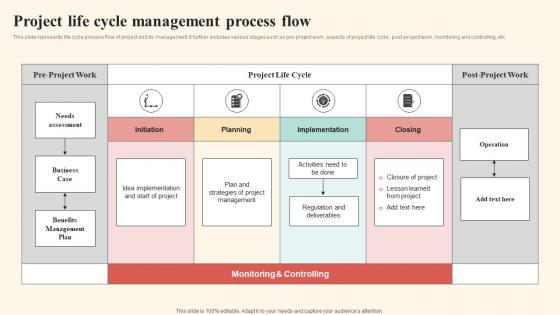
This slide represents life cycle process flow of project and its management. It further includes various stages such as pre-project work, aspects of project life cycle, post-project work, monitoring and controlling, etc
People who downloaded this PowerPoint presentation also viewed the following :
Project Life Cycle Management Process Flow with all 9 slides:
Use our Project Life Cycle Management Process Flow to effectively help you save your valuable time. They are readymade to fit into any presentation structure.








FAQs for Project Life Cycle
The key phases of the project life cycle include initiation, planning, execution, monitoring and controlling, and closure. These phases streamline project management by establishing clear objectives, allocating resources efficiently, and tracking progress systematically, with many organizations finding that this structured approach delivers improved timelines, better risk management, and enhanced stakeholder satisfaction across diverse industries.
Project life cycles vary significantly across industries due to regulatory requirements, risk tolerance, and operational complexities, with healthcare requiring extensive validation phases, construction following sequential build stages, and software development often using iterative sprints. These industry-specific adaptations streamline project delivery by aligning timelines with sector regulations, stakeholder expectations, and quality standards, ultimately enhancing efficiency and reducing costly delays.
Risk management serves as a continuous thread throughout the project life cycle, involving risk identification, assessment, mitigation planning, and monitoring across all phases from initiation to closure. This systematic approach enables project managers to anticipate potential issues, minimize disruptions, and maintain project timelines, with many organizations finding that proactive risk management significantly reduces costs and enhances project success rates.
Project managers facilitate smooth phase transitions by conducting thorough gate reviews, ensuring deliverable completeness, securing stakeholder approvals, and maintaining clear communication protocols. These practices enable seamless handoffs between initiation, planning, execution, and closure phases, with many organizations finding that structured transition checkpoints reduce project delays, minimize scope creep, and ultimately deliver better outcomes while maintaining team alignment and stakeholder confidence throughout the project journey.
Project life cycle phases utilize distinct tools and methodologies, including project charters and feasibility studies in initiation, work breakdown structures and Gantt charts in planning, agile frameworks and collaboration platforms during execution, and performance dashboards in monitoring. These strategic combinations streamline resource allocation, enhance team coordination, and deliver measurable outcomes, with many organizations finding that integrated project management software ultimately accelerates delivery timelines while maintaining quality standards.
Stakeholder needs significantly influence project life cycles by shaping scope definition, resource allocation, timeline requirements, and success criteria throughout each phase. Through continuous stakeholder engagement, project managers can adapt deliverables, adjust milestones, and refine approaches, with many organizations finding that early stakeholder alignment reduces costly changes and ultimately delivers higher satisfaction rates and project success.
Common challenges in the project initiation phase include unclear project objectives, inadequate stakeholder alignment, insufficient resource allocation, unrealistic scope definitions, and poor risk assessment. These obstacles can derail projects before they begin, with many organizations finding that investing time in thorough upfront planning, stakeholder engagement, and realistic expectation-setting ultimately delivers smoother execution and higher success rates.
Effective communication strategies enhance project lifecycle management by establishing clear channels, regular stakeholder updates, transparent progress reporting, and structured feedback mechanisms throughout each phase. These approaches streamline decision-making, minimize costly delays, and ensure alignment across teams, with many organizations finding that consistent communication protocols ultimately deliver faster project completion and improved stakeholder satisfaction.
Key metrics throughout the project life cycle include schedule adherence, budget variance, scope changes, quality indicators, and stakeholder satisfaction scores. These performance measures enable project managers to identify risks early, optimize resource allocation, and maintain deliverable quality, with many organizations finding that consistent tracking across manufacturing, healthcare, and IT sectors ultimately delivers improved project outcomes and competitive advantage.
The project life cycle significantly affects resource allocation and budgeting by dictating varying resource needs across initiation, planning, execution, and closure phases. During planning phases, organizations typically allocate substantial financial resources for detailed design and procurement, while execution phases demand peak staffing and material investments, with many project managers finding that early accurate budgeting prevents costly overruns.
Agile methodologies integrate with traditional project life cycles through hybrid approaches like staged-gate processes, iterative phases within waterfall frameworks, and adaptive planning cycles. Many organizations combine structured upfront planning with agile execution sprints, enabling faster delivery while maintaining governance oversight, ultimately delivering enhanced flexibility and reduced project risks.
Lessons learned can be systematically captured through post-project reviews, documentation of best practices, process refinements, and risk mitigation strategies that inform future planning phases. Organizations increasingly integrate these insights into standardized project templates, training programs, and decision-making frameworks, with many finding that this knowledge transfer significantly reduces project risks, accelerates delivery timelines, and enhances overall project success rates.
Project closing ensures deliverables are formally accepted, resources are released, and lessons learned are captured for future improvements. Best practices include conducting thorough stakeholder reviews, documenting project outcomes and performance metrics, archiving project materials, celebrating team achievements, and creating comprehensive post-project evaluations, with many organizations finding that structured closure processes significantly enhance future project success rates and organizational learning.
Stakeholder engagement evolves from broad awareness-building during initiation to intensive collaboration during planning and execution phases, then transitions to acceptance and closure activities. Throughout project progression, engagement strategies shift from identifying and analyzing stakeholder needs to managing expectations, facilitating decision-making, and ultimately securing buy-in, with successful projects finding that continuous communication and adaptive engagement approaches deliver stronger outcomes and stakeholder satisfaction.
Continuous improvement enhances project outcomes by incorporating lessons learned, refining processes, and optimizing resource allocation throughout each phase. Through retrospectives and feedback loops, organizations streamline project delivery, reduce costs, and accelerate timelines, with many finding that systematic improvement practices ultimately deliver competitive advantage and higher success rates across future initiatives.
-
Professional and unique presentations.
-
“Ample and amazing variety of templates available, really helpful for making professional PPT for day to day workings.”