

Project resource management plan resource management process flow




Try Before you Buy Download Free Sample Product
 Impress Your
 Audience
 100%
100% Editable
 Save Hours
 of Time


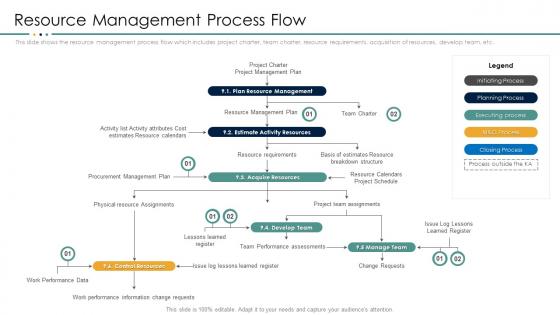
This slide shows the resource management process flow which includes project charter,team charter,resource requirements,acquisition of resources,develop team, etc.
People who downloaded this PowerPoint presentation also viewed the following :
Project resource management plan resource management process flow with all 6 slides:
Use our Project Resource Management Plan Resource Management Process Flow to effectively help you save your valuable time. They are readymade to fit into any presentation structure.





FAQs for Project resource management plan resource
Honestly, start with the basics - figure out what people, equipment, and materials you actually need first. Then map out who gets what and when, plus your timeline and budget limits. Risk planning is huge too. Oh, and definitely do a skills check on your team because I've watched projects die when managers just assumed everyone knew certain tools. Documentation matters but keep it flexible since stuff always changes. Don't forget to set up how you'll track performance and handle procurement. Pro tip: separate your must-haves from wishlist items right away.
Honestly, just dump everything out first - all your deliverables and every little task to get there. Figure out what you need for each one: which people, what skills, equipment, software, all that stuff. I'm weirdly obsessed with spreadsheets for this but whatever works for you. How long will you need each resource? Build in some buffer time because things always go sideways. Check if people are actually available when you need them. The whole point is catching conflicts before you're scrambling at the last minute trying to find someone who knows Python or whatever.
Honestly, start with a RACI chart - it's simple but makes a huge difference in clarifying who does what. Resource histograms help you see workload spikes coming, which is clutch. Critical path method shows you where to put your A-team players. I swear by resource leveling too since it prevents those nightmare weeks where everyone's drowning. MS Project or Smartsheet can handle the heavy calculations (though sometimes I just sketch things out first). Resource allocation sounds fancy but it's really just smart people-juggling. Try the RACI thing on your next project and watch how much smoother everything runs.
Honestly, having a solid resource plan is a lifesaver for catching problems early. You'll spot things like skill gaps or scheduling conflicts before they turn into disasters. Like when your best dev decides to take time off right before launch - ugh, the worst timing ever. Build in some buffer time for risky stuff and keep backup resources ready. I always track how we're using people so I can see bottlenecks coming. Trust me on this one - map out what you need now instead of playing catch-up later when everything's on fire.
Dude, you absolutely have to get your stakeholders involved from the start. They're the ones who actually know what resources you need and when. Without them, you're just guessing - and I've watched so many plans crash because someone thought they could figure it out alone. These people control the purse strings too, so if they're not bought in early, good luck getting approval later. Map out who owns what resources first. Then get everyone together to work through the messy details. Trust me, that upfront conversation saves you tons of headaches down the road.
Track your resource utilization rates first - like, are your devs actually busy or just browsing Reddit while deadlines approach? Budget variance is huge too. Compare what you planned to spend versus reality. I'd also check if projects finish on time, honestly that's where most plans fall apart. Employee surveys matter because burned-out teams = bad planning. ROI on resources tells the real story though. Pick maybe 2-3 metrics that actually fit your situation and review monthly. Don't overthink it.
Start by mapping what you've got - people, budget, tools - then match everything to your priorities. Cross-train your team because bottlenecks suck when someone's out sick. Trust me on this one, I got burned last quarter! Build buffer time into everything. Use tracking tools to spot problems early, and honestly? Stay flexible. Plans never survive reality anyway. Review your allocations weekly based on what's actually happening, not what looked good on paper. Those check-ins will save you from disasters down the road. Oh, and monitor utilization rates so you're not working people into the ground.
So resource leveling is when you push out deadlines because you don't have enough people - you're basically saying "okay, we'll finish later." Smoothing is different though. You keep the same end date but just shuffle resources around during slack time. I always think of it like this: leveling = flexible timeline, smoothing = flexible resources. Most projects honestly need both at some point (learned that the hard way lol). Quick tip - look at your critical path first. If there's wiggle room, try smoothing. No flexibility? You'll probably have to level and extend things.
Honestly, just get some decent project management software - it'll change your life. Monday or Asana work great for most teams. You can literally drag resources between projects and instantly see where you're double-booked or overcommitted. Real-time tracking beats the hell out of spreadsheets (though I still use Excel for random stuff, don't judge me). The automation handles all the boring capacity monitoring so you can focus on actual problems. Just make sure whatever you pick plays nice with your current systems. Nobody wants to deal with data living in five different places. Start simple with one tool first.
Honestly, you're gonna be juggling three main headaches: resource conflicts, scope creep, and those deadlines that make zero sense. Map out your dependencies first and always have a Plan B ready. Scope creep is the worst - set up proper change control so people can't just waltz in with "one tiny addition." Push back on unrealistic timelines with actual data showing what's possible. Oh, and build in buffer time from the start because something will definitely go wrong. Regular check-ins are clutch for catching problems early before they blow up in your face.
Look, a Resource Management Plan is basically your safety net so you don't blow through your budget or burn out your team halfway through. Map out what resources you'll need upfront - people, money, materials, whatever. That way you can spot potential problems before they hit and actually plan for when stuff goes wrong (because it will). Honestly, most people skip the audit step, but check what you already have first. You'd be shocked how much useful stuff is just sitting around. The whole point is avoiding waste while keeping everyone sane and your project actually doable long-term.
Think of resource forecasting as your project's roadmap for figuring out what people, money, and equipment you'll actually need. Trust me, skipping this step is a recipe for disaster - I've been there and it's not fun. You'll end up scrambling for resources at the last minute or watching your budget explode. The trick is mapping out your big milestones first, then working backwards to see what each phase really requires. This way you can grab resources early (before everyone else needs them) and give stakeholders a realistic picture. Honestly, it's one of those boring tasks that saves your butt later.
Cross-functional collaboration gets rid of those annoying silos that mess up resource allocation. Getting different departments to actually talk regularly gives you way better visibility into what everyone needs. Finance has the budget reality, ops knows the real timelines, project leads know the skills needed. It's honestly like having all your puzzle pieces together for once. Conflicts get caught early, you share stuff more efficiently, decisions happen with the full picture instead of just your corner. Oh and definitely start with regular cross-team planning sessions - they're a game changer.
Honestly, hands-on workshops work way better than boring lectures. Get your team practicing with actual scenarios from your company - like real projects they've dealt with. Role-playing different resource constraints is surprisingly effective. Cover the basics: capacity planning, priority frameworks, spotting conflicts before they blow up. Most teams I've worked with see huge improvements after just a few sessions like this. Don't forget to train them on time tracking tools and scheduling software too. Oh, and definitely do monthly check-ins afterward - people need that reinforcement or they'll just fall back into old habits.
Honestly, just build in buffer time and cross-train people so they can jump between roles. Half my team got sick during this huge sprint once - total nightmare. Regular check-ins help too, like every week or two to shuffle things around. Oh and put everything in a shared doc so people can actually see who's doing what. Don't get crazy planning months ahead though, that never works out anyway. Start with your next sprint and just... see what happens? Sounds chaotic but you'll adjust way faster than trying to predict everything upfront.
-
Easy to edit slides with easy to understand instructions.
-
Excellent design and quick turnaround.