


Resource Allocation Process Flowchart In Organization




Try Before you Buy Download Free Sample Product
 Impress Your
 Audience
 100%
100% Editable
 Save Hours
 of Time


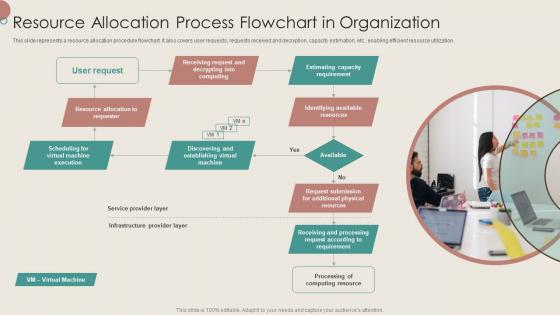
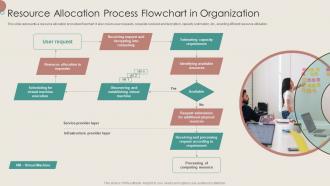
This slide represents a resource allocation procedure flowchart. It also covers user requests, requests received and decryption, capacity estimation, etc., enabling efficient resource utilization.
People who downloaded this PowerPoint presentation also viewed the following :
Resource Allocation Process Flowchart In Organization with all 6 slides:
Use our Resource Allocation Process Flowchart In Organization to effectively help you save your valuable time. They are readymade to fit into any presentation structure.





FAQs for Resource Allocation Process
Key factors include strategic alignment with business objectives, departmental performance metrics, growth potential, resource dependencies, and ROI projections. Organizations increasingly find that dynamic allocation approaches, where resources shift based on quarterly performance and market demands, deliver enhanced operational efficiency and competitive advantage across departments like sales, marketing, and product development.
Organizations balance short-term needs with long-term planning through strategic resource allocation frameworks, scenario-based budgeting, and flexible capacity management. These approaches enable businesses to maintain operational efficiency while investing in growth initiatives, with many financial services and manufacturing companies finding that integrated planning systems ultimately deliver both immediate responsiveness and sustainable competitive advantage.
Technology revolutionizes resource allocation through AI-powered analytics, automated scheduling systems, real-time monitoring tools, and predictive modeling platforms. These solutions streamline decision-making by analyzing usage patterns, forecasting demand, and optimizing distribution across departments, with many organizations finding significantly reduced waste and enhanced operational efficiency in increasingly competitive markets.
Resource allocation decisions significantly impact organizational performance by determining operational efficiency, strategic positioning, and competitive advantage across departments and initiatives. When organizations strategically distribute resources toward high-impact areas, they streamline workflows, enhance productivity, and accelerate growth, with many companies finding that optimized allocation ultimately delivers improved profitability and sustainable market positioning.
Methods for assessing resource allocation effectiveness include performance metrics analysis, cost-benefit evaluations, ROI calculations, variance analysis, and resource utilization rates. Through these assessment tools, organizations can identify inefficiencies, optimize budget distribution, and enhance operational performance, with many companies finding that regular evaluation cycles ultimately deliver improved profitability and strategic competitive advantage.
Data analytics improves resource allocation by identifying skill gaps, predicting project bottlenecks, and analyzing historical performance patterns to optimize team assignments. Through predictive modeling and real-time dashboards, project managers can redistribute workloads proactively, minimize idle time, and enhance delivery timelines, with many organizations finding that data-driven allocation reduces project costs by 15-20%.
Common resource allocation pitfalls include poor demand forecasting, lack of visibility into resource utilization, inadequate skills matching, and failure to account for project dependencies. Organizations avoid these challenges by implementing robust planning frameworks, utilizing resource management software for real-time tracking, and establishing clear governance processes, ultimately delivering improved project outcomes and operational efficiency.
Cultural differences significantly influence resource allocation in multinational organizations through varying communication styles, decision-making hierarchies, risk tolerance levels, and time orientations across regions. These cultural factors shape how teams prioritize projects, distribute budgets, and manage timelines, with many global companies finding that culturally-aware allocation strategies enhance cross-border collaboration and ultimately deliver more effective resource utilization.
Resource allocation significantly impacts team dynamics through workload distribution, role clarity, project prioritization, and access to necessary tools and support systems. When resources are allocated strategically, teams experience improved collaboration, reduced conflict, and enhanced productivity, while poor allocation can create tension and decreased morale, with many organizations finding that transparent, equitable resource distribution ultimately delivers stronger team cohesion and competitive advantage.
Agile methodologies enhance resource allocation through iterative planning, cross-functional team structures, and continuous prioritization based on business value and customer feedback. These approaches enable organizations to reallocate resources quickly between projects, minimize waste through regular sprint reviews, and optimize team productivity, with many companies finding that agile frameworks deliver improved project outcomes and enhanced operational efficiency.
Best practices for startup resource allocation include prioritizing high-impact activities, maintaining lean operational structures, focusing on customer acquisition metrics, implementing agile budget management, and preserving adequate cash reserves. These approaches enable startups to maximize limited resources while scaling efficiently, with many successful ventures finding that strategic resource distribution across product development, marketing, and talent acquisition ultimately delivers sustainable growth and competitive positioning.
The economic environment significantly influences resource allocation through market conditions, interest rates, inflation levels, and consumer demand patterns, requiring organizations to adapt their strategic priorities accordingly. During economic uncertainty, companies typically shift resources toward cost reduction and operational efficiency, while growth periods enable increased investment in innovation and expansion, with many businesses finding that flexible allocation strategies deliver competitive advantage across varying economic cycles.
Leaders effectively communicate resource allocation decisions through transparent rationale sharing, stakeholder-specific messaging, regular progress updates, and collaborative feedback mechanisms. By clearly explaining strategic priorities, budget constraints, and expected outcomes while addressing concerns proactively, organizations enhance stakeholder buy-in and trust, ultimately delivering stronger project execution and sustained organizational alignment across all levels.
Key resource allocation success metrics include resource utilization rates, project ROI, budget variance, time-to-completion ratios, and operational efficiency scores. These measurements enable organizations to track performance across departments, identify optimization opportunities, and streamline future planning decisions, with many companies finding that comprehensive metric tracking ultimately delivers improved profitability and competitive advantage.
Employee feedback significantly impacts future resource allocation by revealing operational gaps, identifying high-priority areas, and highlighting underutilized resources across departments. Organizations increasingly use structured feedback mechanisms to redirect budgets toward employee-identified needs like technology upgrades, training programs, and workflow improvements, ultimately enhancing productivity and employee satisfaction while optimizing strategic investments.
-
Informative and engaging! I really like the design and quality of the slides.
-
Thank you SlideTeam for such an excellent service.