


Project resource management plan resource allocation and management with time




Try Before you Buy Download Free Sample Product
 Impress Your
 Audience
 100%
100% Editable
 Save Hours
 of Time


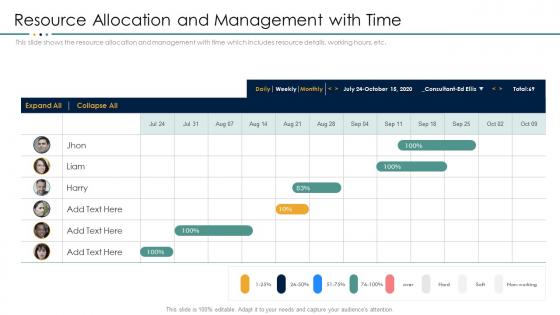
This slide shows the resource allocation and management with time which includes resource details,working hours, etc.
People who downloaded this PowerPoint presentation also viewed the following :
Project resource management plan resource allocation and management with time with all 6 slides:
Use our Project Resource Management Plan Resource Allocation And Management With Time to effectively help you save your valuable time. They are readymade to fit into any presentation structure.





FAQs for Project resource management plan resource allocation and
Effective project resource management includes resource planning, allocation optimization, capacity forecasting, performance tracking, and strategic reallocation protocols. These components streamline project delivery by minimizing resource conflicts, enhancing team productivity, and enabling dynamic resource redistribution, with many organizations finding that integrated resource management ultimately delivers faster project completion and improved operational efficiency.
Project managers can effectively estimate resource needs through work breakdown structures, historical data analysis, expert judgment, resource requirement matrices, and stakeholder input sessions. These methodologies enable accurate forecasting by examining task dependencies, skill requirements, and timeline constraints, with many organizations finding that combining multiple estimation techniques delivers more reliable resource allocation and ultimately reduces project risks while enhancing delivery predictability.
Resource allocation serves as the foundation for project success by ensuring the right people, budget, and materials are strategically deployed at optimal times throughout the project lifecycle. Effective allocation enables teams to meet deadlines, control costs, and maintain quality standards, while poor resource distribution often leads to bottlenecks, budget overruns, and compromised deliverables that undermine overall project objectives.
Technology streamlines resource tracking through real-time monitoring dashboards, automated time tracking systems, resource allocation software, and integrated project management platforms. These tools enable project managers to identify bottlenecks, optimize workforce deployment, and adjust resource distribution dynamically, with many organizations finding that automated tracking reduces administrative overhead while delivering enhanced visibility and improved project outcomes.
Effective strategies include resource prioritization matrices, cross-project collaboration frameworks, flexible resource pools, timeline adjustments, and stakeholder communication protocols. These approaches streamline allocation by establishing clear priority criteria, enabling resource sharing between teams, and maintaining transparent communication channels, with many organizations finding that proactive conflict resolution ultimately delivers improved project outcomes and enhanced operational efficiency.
Stakeholder engagement significantly influences resource management by ensuring accurate requirement gathering, securing necessary funding approvals, and facilitating smoother resource allocation decisions. Through active collaboration, project managers can identify potential resource constraints early, negotiate priority adjustments with sponsors, and maintain team alignment, ultimately delivering improved project outcomes and stakeholder satisfaction.
Managing human resources in remote work environments presents challenges including communication barriers, performance monitoring difficulties, maintaining team cohesion, ensuring work-life balance, and technology integration issues. These obstacles can be addressed through strategic digital collaboration tools, structured check-in processes, and comprehensive virtual engagement programs, with many organizations finding that proactive communication frameworks and flexible management approaches ultimately enhance productivity and employee satisfaction.
Assessing project team skills involves competency mapping, skills gap analysis, performance reviews, technical assessments, and peer evaluations to understand individual capabilities. Through structured interviews and practical tests, project managers can match team members' strengths with specific tasks, while identifying development opportunities, ultimately optimizing resource allocation and enhancing project delivery efficiency.
Key metrics include resource utilization rates, project completion times, budget variance, productivity ratios, and capacity planning accuracy. These measurements enable organizations to streamline allocation decisions, minimize waste, and enhance project outcomes, with many companies finding that tracking these indicators delivers significant cost reductions and competitive advantage.
Risk management integrates into project resource planning through contingency allocation, scenario modeling, skill diversification, and regular assessment protocols. This strategic combination enables project managers to anticipate resource shortages, develop backup staffing plans, and maintain buffer capacity, with many organizations finding that proactive risk-resource integration reduces project delays while optimizing operational efficiency.
Best practices for managing physical resources include implementing inventory tracking systems, establishing clear procurement protocols, creating maintenance schedules, developing storage and security procedures, and maintaining accurate resource documentation. These approaches streamline operations by minimizing equipment downtime, reducing material waste, and ensuring optimal resource allocation, with many organizations finding that systematic physical resource management ultimately delivers significant cost savings and improved project efficiency.
Project managers balance budget constraints with resource needs by prioritizing critical deliverables, implementing phased resource allocation, leveraging cross-functional team members, and utilizing cost-effective alternatives like freelancers or automation tools. Through strategic resource planning and continuous monitoring, organizations streamline project execution while maintaining quality standards, with many finding that flexible resource models ultimately deliver competitive advantage and improved project outcomes.
Resource availability forecasting techniques include capacity planning models, historical data analysis, resource utilization tracking, skills inventory assessments, and predictive analytics tools. These approaches enable project managers to anticipate bottlenecks, optimize team assignments, and maintain project momentum by proactively identifying potential shortfalls, ultimately delivering improved resource efficiency and reduced project delays across organizations.
Effective communication contributes to successful resource management by ensuring clear project requirements, transparent resource availability, and coordinated task assignments across teams. Through regular stakeholder updates and collaborative planning sessions, organizations streamline resource allocation, minimize conflicts, and accelerate project delivery, with many finding that enhanced communication ultimately delivers improved efficiency and stronger project outcomes.
Organizational culture significantly influences resource management through communication patterns, decision-making hierarchies, risk tolerance levels, and collaboration approaches. In hierarchical cultures, resources flow through formal approval chains, while collaborative cultures enable cross-functional teams to share resources more flexibly, ultimately delivering faster project outcomes and enhanced team productivity across diverse organizational environments.
-
I discovered this website through a google search, the services matched my needs perfectly and the pricing was very reasonable. I was thrilled with the product and the customer service. I will definitely use their slides again for my presentations and recommend them to other colleagues.
-
Appreciate the research and its presentable format.