

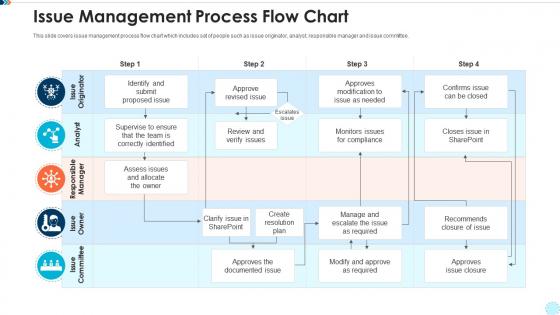
Issue management process flow chart





Try Before you Buy Download Free Sample Product
 Impress Your
 Audience
 100%
100% Editable
 Save Hours
 of Time


Our Issue Management Process Flow Chart are topically designed to provide an attractive backdrop to any subject. Use them to look like a presentation pro.
People who downloaded this PowerPoint presentation also viewed the following :
Issue management process flow chart with all 9 slides:
Use our Issue Management Process Flow Chart to effectively help you save your valuable time. They are readymade to fit into any presentation structure.








FAQs for Issue management
Risk management is about stuff that *could* go wrong - you're basically trying to spot problems before they happen. Issue management? That's when shit's already hit the fan and you're scrambling to fix it. So one's proactive, the other's reactive. During project planning, you'd do risk assessments and make backup plans. But once something actually breaks or goes sideways, you switch into firefighting mode. They work hand in hand though - the better you get at predicting problems upfront, the fewer disasters you'll have to deal with later.
Make a simple matrix - impact vs urgency. Plot your issues on both. High impact + high urgency = obvious priority, but here's the thing: don't cave to whoever yells loudest about their pet issue if it's actually low priority. That's how you end up fixing typos while critical bugs sit there. Create SLAs for each level and stick to them. Weekly backlog reviews help since business needs shift constantly. Also, always explain WHY you prioritized something. Saves you so much drama later when people question your decisions.
Honestly, communication makes or breaks the whole thing. People start assuming stuff or think someone else is handling it when updates go quiet. Set up your channels first - maybe a Slack thread or whatever works for your team. Daily standups help too, even if it's just "no updates today." I've seen issues drag on forever just because nobody knew who was doing what. Short bursts of info work better than long emails that nobody reads anyway. The trick is staying consistent with updates, not necessarily having groundbreaking news every time.
Get yourself a proper issue tracker first - Jira, Linear, or GitHub Issues. Trust me, spreadsheets are a nightmare for this stuff. Slack's great for quick updates about bugs and keeping everyone in the loop. Oh, and monitoring tools like Sentry will catch problems before your users start complaining (which is honestly a lifesaver). The key thing though? Don't go overboard with tools. Pick one main system that everyone will actually stick with instead of bouncing between five different apps that nobody uses properly.
Honestly, you've gotta stay on top of your data instead of waiting for disasters. Set up alerts for your 3-5 biggest risk areas first - don't overthink it. Regular stakeholder check-ins are clutch, and make sure people feel safe flagging small issues before they blow up. I've watched so many projects crash because teams tracked useless vanity metrics instead of stuff that actually mattered. Build dashboards that tie to real outcomes. Oh, and automate monitoring for critical metrics so you're not manually checking everything like some kind of masochist. Start this week with simple alerts.
Honestly, the biggest thing is logging problems the second they happen - with actual details, not just "it's broken" nonsense. Screenshots are clutch because future you will have zero memory of what you meant. I learned this the hard way lol. Make sure you note who's fixing it and when it needs to be done. Keep everything in one spot where your team can see it, and actually update the status or stuff gets forgotten. Oh, and track how it messes with your timeline - that part's key for explaining delays later.
Ugh, cultural differences totally throw a wrench into problem-solving with global teams. People from hierarchical cultures won't speak up about issues they spot, while others jump right in calling out problems. Some want everything written out in detail, others prefer quick phone calls - honestly depends where they're from. Timing's the worst part though. What seems urgent to someone in New York feels way too rushed in Tokyo. You should definitely set up clear escalation rules early and give people different ways to report stuff - maybe anonymous channels or regional contacts so everyone's comfortable.
Honestly, I'd focus on five key things. Resolution time and escalation rates are huge - they show if your team's actually solving problems or just passing them around. Customer satisfaction scores matter more than anything though, because who cares if you close tickets fast if people are still pissed off? First-contact resolution is another good one to watch. Oh, and definitely track your backlog trends - that'll help you catch bottlenecks before everything goes to hell. These metrics will give you a solid picture of what's working and what isn't.
So instead of just putting out fires constantly, you'd flip to actually getting ahead of problems. Look for patterns in what keeps breaking and why your fixes aren't sticking. The cool part? You start catching issues before they blow up by spotting trends early. After big incidents, do quick retrospectives to figure out what went wrong - then actually use those lessons to update your processes and documentation. Your escalation procedures get sharper over time too. Honestly, most teams skip the follow-up part, but that's where the real improvement happens.
Look, stakeholders are the people who actually know what's broken and have the power to fix it. Without them, you're just managing issues in a vacuum while nobody cares. They control the money and decide what gets priority - honestly, I've seen too many critical problems get buried because leadership wasn't looped in. Your stakeholders will catch stuff you miss since they're closest to the real impact. Don't just send them boring status updates though. Actually ask what they think and keep the conversation going. Otherwise your issue backlog becomes this sad graveyard of forgotten problems.
Look, first figure out what could actually screw up your big goals - that's your starting point. Then map out who needs to jump in when different problems hit, plus who gets to make the final call. Honestly, half the frameworks I've seen are total garbage because they sound great in meetings but nobody actually uses them. Build something that matches how your team really operates. Test it on smaller stuff first - you don't want to discover your process sucks during a real crisis. Oh, and definitely keep tweaking it based on what happens in practice.
Ugh, the worst thing is just not tracking stuff consistently. Like someone reports a bug in Slack, then it vanishes into the void and three weeks later you're still getting complaints. Super annoying. Also don't let people get away with vague descriptions - "login doesn't work" tells you literally nothing without steps to reproduce it. You'll want clear ownership too, otherwise everyone assumes someone else is handling it. Oh, and actually close resolved issues! I've seen backlogs turn into these terrifying monsters because nobody bothers. Just pick a simple triage process and stick with it.
So when the same crap keeps happening, you gotta get everyone in a room - not just whoever complained about it, but the people who've tried fixing it too. Ask "why" like five times in a row until you hit the real problem. Write it all down somewhere everyone can see it. Trust me, I've watched teams chase their tails because they weren't actually tracking patterns. Half the time what looks like different issues is really the same root cause wearing different masks. Don't just slap another quick fix on it - actually solve the thing.
Honestly, start with basic project management - that's your foundation. Root cause analysis training is clutch since you'll be digging into problems constantly. Get Six Sigma or Lean certified too; hiring managers eat that stuff up even if you barely touch it later. Communication skills matter way more than people think - you're basically translating technical disasters for executives who just want the bottom line. Oh, and definitely learn risk assessment and data analysis. Sounds boring but it'll save your butt when you can spot issues before they blow up. Build on problem-solving frameworks once you've got the basics down.
So basically, you'll want to look at your old data to spot patterns before stuff blows up. Track how long fixes take - that's where you'll find your bottlenecks. Honestly, dashboards are pretty clutch for this (I know, sounds boring but trust me). Set them up to show trending problems and team metrics. The whole thing becomes way easier once you're collecting solid data on issue types and severity levels. Oh, and use that info to figure out where to put your people and resources. It's like having a crystal ball but actually useful.
-
Informative design.
-
Topic best represented with attractive design.
-
Thanks for all your great templates they have saved me lots of time and accelerate my presentations. Great product, keep them up!