

 0 Comment
 Customer Reviews

The slide deck's been sitting in the shared drive for two weeks. Everyone knows it needs updating. Nobody's touched it.
Portfolio reviews are like that. The data exists—allocations, timelines, risk flags, performance numbers. But somewhere between having the information and presenting it coherently, something stalls. It's not that the portfolio is poorly managed. It's that the framework for showing it hasn't caught up with the complexity of what's actually happening.
There's a specific kind of discomfort in a portfolio review meeting where the slides don't match the conversation. The CFO asks about risk exposure. The slide shows a pie chart from last quarter. Someone starts scrolling. Somebody else opens a spreadsheet. The meeting drifts.
And it gets worse when the portfolio spans multiple asset classes, project types, or business units. One team tracks by ROI. Another by timeline. A third by strategic alignment. Nobody's wrong—but the slides don't reconcile any of it. What you end up with isn't a portfolio review. It's three separate conversations wearing a shared agenda.
Portfolio management framework templates exist because this gap is common. Not because organizations don't understand their portfolios—most do, at least partially. But because structuring what you know into something a room full of stakeholders can actually follow is a different skill entirely. The framework does the heavy lifting: it tells you where the sections go, what each view needs to show, how risk and performance sit alongside each other without competing for attention.
SlideTeam's portfolio management framework templates handle exactly this—pre-designed structures built around how these conversations actually run. Not generic business slides dressed up with the word "portfolio." Real frameworks for allocation decisions, governance reviews, risk assessment, agile planning, and project prioritization.
Here are the templates that make the meeting productive instead of painful.
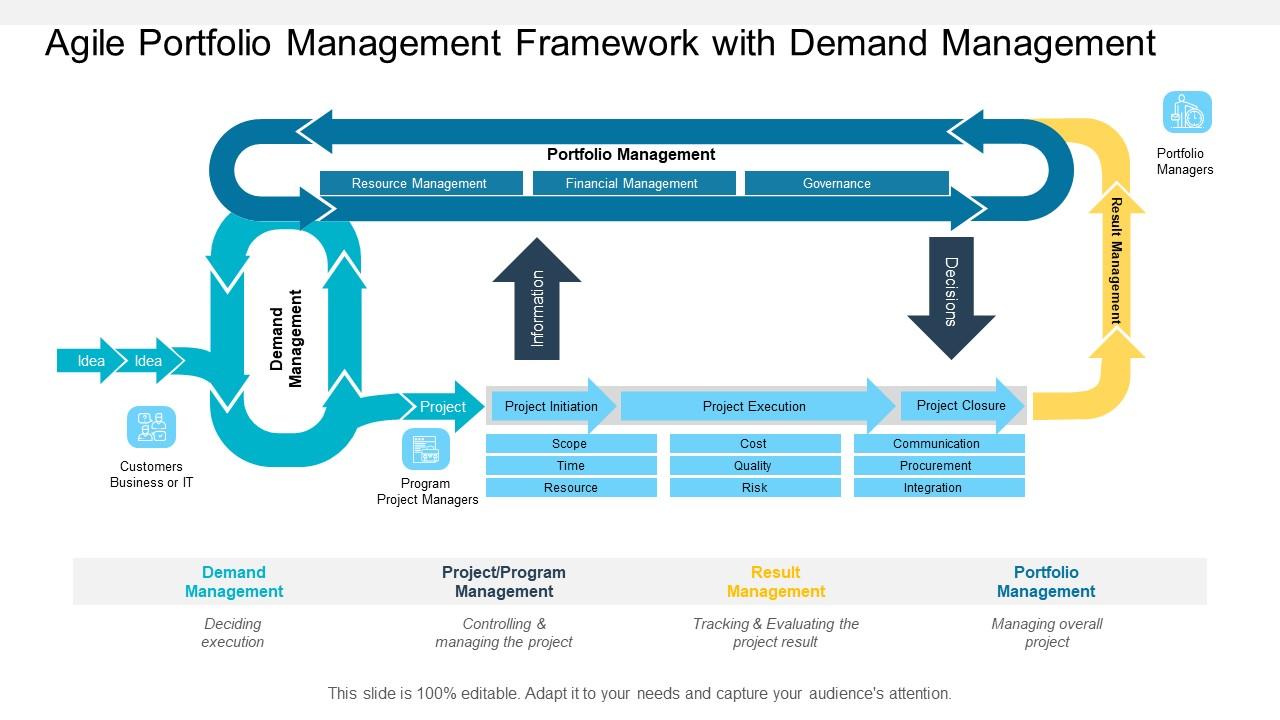
Template 1: Agile Portfolio Management Framework with Demand Management
Agile portfolio planning gets complicated fast when demand outpaces capacity. This deck merges structured demand management with an agile portfolio framework, giving you clear visibility across intake, prioritization, and delivery phases. The intuitive visual layouts translate complex backlog decisions into audience-ready slides. You can present agile governance reviews and marketing alignment with equal confidence. Each slide anchors a distinct phase of the agile portfolio management cycle. Transform your agile portfolio presentations today. Download this dynamic template now and unlock demand-driven planning clarity.
Download this PowerPoint Template
Template 2: Quantitative Investment Strategies and Portfolio Management PowerPoint Presentation Slides
Quantitative investment decisions demand more than gut instinct — they need structured, data-backed communication. This PPT preset covers the full spectrum of quantitative investment strategies and portfolio management in 79 well-researched slides. A practitioner presenting to an investment committee or an analyst briefing a risk board will find real use here. This deck supports financial portfolio management conversations where precision and credibility both matter. The template is 100% editable and customizable.
[product_image id=80356]
Template 3: PMO Framework in Portfolio PPT Presentation
PMO leads rarely struggle with knowing the framework — they struggle with presenting it cleanly to mixed audiences. This PPT template gives practitioners a structured way to communicate PMO governance, project oversight, and portfolio reporting in one coherent deck. It's the kind of slide that works in a steering committee briefing or a quarterly portfolio review. For context, this PPT preset fits naturally into enterprise portfolio management conversations where clarity of process matters. The template is 100% editable and customizable.
[product_image id=1539591]
Template 4: Agile Portfolio Management Framework with Demand Management PPT Information
Demand management inside an agile portfolio isn't just about prioritization — it's about showing stakeholders how decisions get made. This deck captures that logic visually, combining agile portfolio structure with intake and demand flow in a design that commands boardroom attention. The pre-designed layouts let you skip the blank-slide problem and focus on the actual conversation. Use it for sprint portfolio reviews, capacity planning sessions, or executive alignment meetings. Transform your agile portfolio management presentations today. Download this dynamic template now and elevate every demand review.
[product_image id=1473202]
Template 5: Creating a Project Portfolio Management Framework PPT Example
Building a project portfolio management framework from scratch is a significant undertaking. This PPT template gives practitioners the structural scaffolding to present each phase — from initiation through governance — with clarity. A PMO director or program lead can use this deck to walk leadership through the full PPM framework without losing the room mid-slide. It's grounded enough for technical audiences, clear enough for executives. The template is 100% editable and customizable.
[product_image id=1496425]
Template 6: Portfolio and Investment Management Team Structure PPT
Investment committee structures are easier to defend when the hierarchy is visible and unambiguous. This PowerPoint slide maps the full portfolio and investment management team structure — shareholders, investment committee, auditors, and supporting roles — in a single, readable view. A CFO or fund manager presenting governance to a board will find this layout does the explaining for them. It fits naturally into financial portfolio management decks and investor reporting packages. The template is 100% editable and customizable.

Download this PowerPoint Template
Template 7: Application Portfolio Management Framework Step by Step Implementation PPT Structure
Application portfolio rationalization needs a step-by-step structure that IT leaders can follow in a presentation. This deck delivers exactly that—a phased implementation framework for application portfolio management, built for clarity across technical and executive audiences. Each stage maps cleanly to real IT governance decisions, from inventory assessment to retirement planning. Use it to present IT portfolio management roadmaps or digital transformation reviews with full confidence. Transform your application portfolio presentations today. Download and drive structured IT decision-making.
[product_image id=1611757]
Template 8: Introduction to Project Portfolio Management Frameworks PPT Presentation
Getting a room to agree on what project portfolio management even means is half the battle. This deck introduces the core frameworks clearly—scope, prioritization logic, governance principles, and strategic alignment—without overwhelming newcomers or boring experienced practitioners. The design balances creativity with functional structure, so slides work equally well in a training session or a client pitch. Use it to anchor portfolio management best practices from the first slide forward. Transform your project portfolio presentations today. Download this dynamic template now and set the right foundation fast.
[product_image id=1561254]
Template 9: Framework for Project Portfolio Management PPT Example
A well-structured project portfolio framework slide doesn't just show what exists — it shows how decisions connect. This deck delivers that connective tissue, linking project selection, resource allocation, and performance tracking inside a single coherent visual flow. The audience-ready design captures attention from the first slide and holds it through every governance checkpoint. It's built for portfolio directors who need their framework to hold up under executive scrutiny. Transform your project portfolio presentations today. Download this dynamic template now and unlock structured decision-making at scale.
[product_image id=1840244]
Template 10: Application Portfolio Inventory Management Framework
Application inventory management gets unwieldy without a consistent framework to organize it. This seven-stage deck covers the full application portfolio lifecycle — business value, technology platform, interoperability, annual cost data, contract information, and operational data — in a structured, slide-by-slide flow. IT architects and portfolio managers can use it to present rationalization decisions with the evidence built in. Every stage answers a question a governance committee will actually ask. Transform your application inventory presentations today. Download this dynamic template now and unlock clarity across your entire application estate.

Download this PowerPoint Template
Template 11: Risk Management Approaches for Portfolio PPT Structure
Portfolio risk assessment isn't a single slide — it's a structured argument. This deck presents multiple risk management approaches side by side, giving portfolio managers the visual tools to show boards and committees how risk is identified, categorized, and addressed. The clean layout makes complex risk logic readable without sacrificing depth. Use it for investment risk reviews, regulatory presentations, or enterprise-wide portfolio management framework briefings. Transform your risk management presentations today.
[product_image id=1794448]
Template 12: How to Build a Customized Maturity Framework PPT Summary
Maturity frameworks are only useful when stakeholders can see where they currently stand and where they're going. This deck builds that picture — stage by stage, function by function — in a customizable layout that fits any organizational context. Portfolio leaders can adapt the maturity model to reflect their specific governance, capability, or process dimensions without starting from scratch. It's particularly effective for strategic portfolio planning conversations where current-state and future-state need to sit side by side. Transform your maturity framework presentations today. Download this dynamic template now and benchmark your portfolio's growth with confidence.
[product_image id=1594966]
Template 13: Application Portfolio Governance Framework
Portfolio governance only works when the rules are visible and the accountability is clear. This deck delivers a structured application portfolio governance framework — covering decision rights, review cadence, and escalation paths — in a design that holds up in front of both IT and business leadership. The balanced layout gives you flexibility to adapt governance layers without losing the structural integrity of the presentation. Use it for portfolio governance framework reviews, compliance briefings, or application rationalization sign-offs. Transform your governance presentations today. Download this dynamic template now and establish accountability that sticks.
[product_image id=1826007]
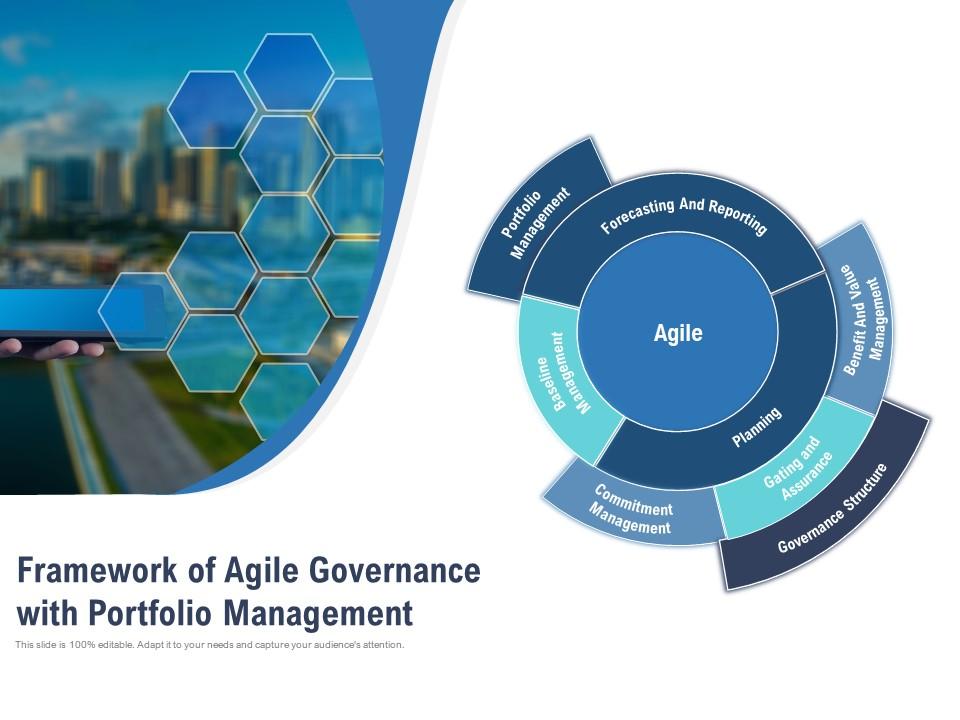
Template 14: Framework of Agile Governance with Portfolio Management
Agile governance and portfolio management sit at an uncomfortable intersection — one demands flexibility, the other demands control. This PPT preset resolves that tension visually, mapping governance structures onto an agile portfolio model in a way that both delivery teams and executive sponsors can follow. It's a useful slide for organizations moving toward agile portfolio management while still maintaining board-level oversight. The layout is clean, the logic is clear, and the structure holds across multiple delivery contexts. The template is 100% editable and customizable.
Download this PowerPoint Template
Template 15: Comprehensive Planning Cost Management Framework PPT Slides
Cost management across a portfolio isn't just a finance function — it's a planning discipline. This PowerPoint slide gives practitioners a structured way to present comprehensive cost planning frameworks, from budget allocation to variance tracking, in a format that works for both finance leads and project sponsors. A portfolio manager building the case for resource allocation decisions will find this deck grounded and presentation-ready. It supports portfolio management strategies conversations where cost control is a central concern. The template is 100% editable and customizable.
[product_image id=1538643]
Template 16: Tools and Techniques for Portfolio Management PPT Outline
Portfolio tracking tools only create value when the people reviewing the data understand what they're looking at. This deck presents the full toolkit — techniques, visual frameworks, and tracking methods — in a structured layout designed for portfolio directors and PMO leads. Each slide builds on the last, so the audience moves from tool awareness to application without losing context. Use it for portfolio performance metrics reviews, capability assessments, or team training on portfolio optimization techniques. Transform your portfolio management presentations today. Download this dynamic template now and give your team the tools to track what matters.
[product_image id=1502174]
Template 17: Investment Analysis and Portfolio Management Basics PPT Outline
Investment analysis is taught in classrooms but learned in boardrooms. This PPT preset covers the foundational concepts of investment analysis and portfolio management — asset allocation, risk-return trade-offs, diversification — in a clear, structured deck suited to both introductory and practitioner audiences. An analyst onboarding a new client or a manager briefing a junior team will find the flow logical and the design professional. It pairs naturally with asset allocation framework discussions. The template is 100% editable and customizable.
[product_image id=1500296]
Template 18: Portfolio Management Fundamentals for Financial and Project Success PPT Example
Portfolio management fundamentals often get presented as either too theoretical or too operational — rarely both at once. This deck bridges that gap, covering financial portfolio management and project success drivers in one cohesive flow. A portfolio lead presenting to a mixed audience of finance and delivery stakeholders will find this structure holds the room. It supports conversations around strategic portfolio planning without losing the practical edge practitioners need. The template is 100% editable and customizable.
[product_image id=1666816]
Template 19: Portfolio Management Framework for Monitoring and Controlling Risk
Monitoring and controlling risk across a portfolio requires a framework that shows the whole picture at once. This deck covers the complete risk governance cycle — corporate goals, strategic plan, performance assessment, portfolio reporting, and active portfolio control — in a single, structured visual flow. Risk officers and portfolio managers can use it to show exactly how oversight connects strategy to execution. Each slide reinforces accountability at a different governance level. Transform your portfolio risk presentations today. Download this dynamic template now and make your risk control framework impossible to overlook.

Download this PowerPoint Template
Template 20: Portfolio Management Framework to Enhance Financial Stability
Financial stability in a portfolio doesn't happen by accident — it comes from a well-sequenced governance process. This PPT template maps the full journey: strategic plan development, portfolio construction, and performance assessment, all tied to measurable business goals. A finance lead or asset manager can use this deck to present the organization's approach to financial asset management with structure and credibility. It covers both the 'achieve goals' and 'deliver benefits' dimensions of portfolio governance clearly. The template is 100% editable and customizable.
[product_image id=1138993]
Optimize Every Portfolio Decision with SlideTeam
SlideTeam's PowerPoint templates are the best in the industry for building a credible, structured portfolio management framework. These content-ready slides save hours of design work while ensuring your risk assessments, governance reviews, and strategic plans land with authority. Use these ready-made frameworks to align stakeholders, clarify decisions, and drive portfolio performance. Deploy SlideTeam's pre-designed templates and turn every portfolio presentation into a clear, confident case for action.
FAQs on Portfolio Management Framework
How do you balance short-term performance metrics with long-term strategic goals when managing a portfolio?
Track short-term metrics — budget variance, milestone completion, resource utilization — alongside long-term indicators like strategic alignment scores and capability growth. Review both sets in the same governance cycle, not separately. When they conflict, the long-term goal takes precedence unless there's a clear risk trigger. Most portfolio frameworks handle this through a two-tier reporting structure: operational dashboards for the short term, strategic scorecards for the long term.
What criteria should organizations use to prioritize projects within a portfolio when resources are constrained?
Score each project on three criteria: strategic alignment, expected value (financial or otherwise), and resource feasibility. Rank by combined score, then apply a hard resource constraint to set the cutoff. Projects below the line get deferred, not cancelled — that distinction matters for stakeholder trust. Avoid prioritizing by loudest sponsor or nearest deadline. A simple weighted scoring model, applied consistently, removes most of the politics.
How does a portfolio management framework differ from project and program management in terms of scope and objectives?
Project management focuses on delivering a specific output on time and budget. Program management coordinates related projects toward a shared outcome. Portfolio management sits above both — its job is to decide which projects and programs should exist at all, given limited resources and strategic priorities. Portfolio managers don't manage delivery; they manage selection, balance, and alignment across the entire investment set.
What role does risk tolerance play in shaping the composition of a strategic portfolio?
Risk tolerance sets the boundary conditions before any project selection begins. A low-tolerance organization will favor incremental, well-understood initiatives over experimental ones — even if the latter show higher expected returns. Practically, risk tolerance should be defined explicitly by leadership, not inferred from past decisions. It shapes how much uncertainty the portfolio can absorb at any one time without destabilizing strategic delivery.
How can organizations measure the return on investment across a diverse portfolio of initiatives?
Define ROI consistently across all initiatives before measurement begins — mix of financial return, strategic value, and risk reduction. Use a common baseline period and a shared discount rate for financial calculations. For non-financial initiatives, agree on proxy metrics upfront (e.g., customer satisfaction scores, cycle time reduction). Review ROI at fixed intervals, not just at project close. A portfolio dashboard that shows all initiatives on the same scale makes cross-portfolio comparison practical.
What are the most common pitfalls organizations face when implementing a portfolio management framework for the first time?
The three most common failures are: starting with too many projects and no clear selection criteria, treating the framework as a one-time exercise rather than an ongoing governance process, and skipping stakeholder buy-in before launch. Organizations also tend to underestimate the data quality problem — if project data is inconsistent, the framework produces unreliable outputs. Start with a small pilot portfolio, establish data standards early, and define decision rights before the first review cycle.
How should a portfolio management framework adapt during periods of economic uncertainty or organizational restructuring?
During uncertainty, shorten the review cycle — move from quarterly to monthly portfolio check-ins. Revalidate strategic priorities explicitly; what was aligned six months ago may no longer be. Shift selection criteria temporarily to favor lower-cost, shorter-duration initiatives with faster payback. During restructuring, freeze new project approvals until resource capacity is confirmed. The framework itself doesn't change — the inputs and thresholds do.
What governance structures are most effective for ensuring accountability in portfolio decision-making?
The most effective structure combines a portfolio steering committee (decision authority) with a PMO function (process oversight) and clear escalation paths for exceptions. Decision rights must be documented — who approves, who recommends, who is consulted. Regular cadence matters: monthly operational reviews, quarterly strategic reviews. Without a defined escalation path, accountability diffuses and decisions stall. Keep governance layers minimal — more layers slow decisions without improving them.