


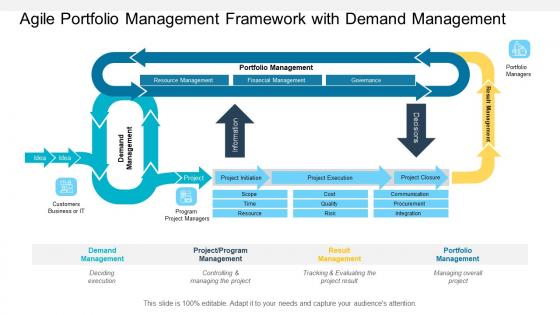
Agile portfolio management framework with demand management





Try Before you Buy Download Free Sample Product
 Impress Your
 Audience
 100%
100% Editable
 Save Hours
 of Time


Our Agile Portfolio Management Framework With Demand Management are invariably appreciated. Each design is equally inspiring
People who downloaded this PowerPoint presentation also viewed the following :
Agile portfolio management framework with demand management with all 5 slides:
Each design of our Agile Portfolio Management Framework With Demand Management is equally inspiring. It is invariably appreciated.


FAQs for Agile portfolio management framework
So basically, instead of planning your whole portfolio upfront and sticking to it, you're constantly shifting based on what's actually working. You fund teams and capabilities rather than individual projects - that part honestly confused me at first too. The big mindset change? Stop asking "did we hit our deadlines" and start asking "are we getting max value." Review your portfolio way more often than you probably do now. I'd start by mapping out your current value streams, then figure out how to check in on priorities more frequently. Maybe monthly instead of quarterly?
Set up quarterly reviews to check if your portfolio still makes sense against what's actually happening in the market. Define clear outcomes first - not just a bunch of features - so teams get why they're doing the work. Honestly, most companies I've seen mess this up by planning every tiny detail instead of just picking a direction. Map your current stuff to strategic themes and you'll spot the gaps pretty quick. OKRs work well for connecting everything to company goals, but don't box teams in too much. They need wiggle room to pivot when they learn new things.
Look, stakeholders are honestly your best friend in Agile Portfolio Management. They're the ones making funding calls and helping you figure out what actually matters for the business. You want them in your portfolio reviews giving real feedback - not just nodding along quietly in the corner. Here's the thing though: they can actually clear those annoying organizational roadblocks when your teams get stuck (and trust me, it happens constantly). Just don't drown them in technical details. Focus on translating their business priorities into stuff your teams can actually work with. Keep them engaged but make it worth their time.
So basically, score each project against your business goals using something simple like weighted scoring. Everyone's gonna claim their project is super critical (eye roll), which is why you need solid criteria. ROI and risk levels are obvious ones, but don't forget resource availability and how projects depend on each other. Keep your scoring to 3-5 clear criteria max - any more gets messy. Get stakeholders involved in the actual scoring so they buy in. Regular reviews let you pivot when things change. Honestly? Kill projects that aren't delivering. Sounds harsh but you'll thank me later.
Honestly, the hardest part is getting leadership to stop obsessing over deliverables and actually care about results. Cultural pushback is brutal. You'll also go insane trying to keep multiple teams aligned - meetings everywhere but somehow nobody knows what's happening. Finance teams hate it because they want their neat waterfall timelines back (can't blame them honestly). Resource planning becomes chaos when priorities flip every week, and most companies don't have decent tools to see the big picture across everything. Don't be a hero - just pick one business unit to test it out first.
Ditch the usual project stuff like velocity charts - nobody cares about that anymore. What matters is actual business impact: are customers happy? How fast are you shipping? ROI? Track things like feature adoption and cycle time as early signals, then measure retention and revenue later. I'd honestly pick maybe 3-5 metrics max that actually change how you make decisions. Any more and people just ignore the dashboards anyway. Set up automatic reporting so your team isn't wasting time on status updates. Oh, and make sure you're looking at both individual teams and the whole portfolio - sometimes the big picture tells a totally different story.
For Agile portfolio stuff, you'll want to look at Jira Align, Azure DevOps, or Rally (Broadcom bought them out). They're pretty much the heavy hitters for tracking dependencies and rolling up reports across teams. Fair warning though - Jira Align can feel like drinking from a fire hose at first, but it works great once you get the hang of it. If you don't need all that complexity, Portfolio for Jira or LeanKit might do the trick. Just make sure whatever you pick plays nice with your current tools - constantly jumping between platforms gets old fast. I'd start with what you already have and build up from there.
So basically, agile portfolio management lets you ditch those rigid yearly plans that are useless by spring anyway. Instead of being stuck, you do shorter planning cycles - like quarterly reviews - and constantly reassess what's actually working. When the market shifts or something new pops up, you can pivot fast. Honestly, most companies waste so much money on projects that look good on paper but don't deliver. The trick is keeping a flexible backlog of potential projects that you can shuffle around based on real feedback and data. Trust me, once you start doing quarterly reviews instead of annual ones, you'll wonder why you ever waited so long to make decisions.
Honestly, team structure can totally make or break your agile portfolio thing. You want teams that don't need to constantly pass work back and forth - like, they should handle stuff end-to-end without waiting around. The absolute worst is when everyone's siloed or fighting over the same resources. Total nightmare. Portfolio managers need direct access to team leads too, not some crazy chain of command situation. Really think about whether your teams can actually ship value or if they're always stuck waiting on someone else. If it's the waiting game, fix the structure first before doing anything fancy with portfolio management.
Honestly, you've gotta tear down those department walls first. Get people actually talking through regular cross-team demos where everyone shares their wins AND their disasters - the messy stuff is where you learn anyway. Set up shared dashboards showing real progress, not the sanitized version leadership usually sees. Coffee chats work better than formal meetings for this btw. Make sure your bosses actually participate instead of just showing up to check boxes. Oh, and create safe spaces where people can complain without it turning into a whole HR thing. Slack channels are perfect for this. The whole point is making transparency feel normal, not scary.
So here's what's worked for us - run retrospectives monthly or quarterly, whatever fits your rhythm. Track stuff that actually matters: cycle time, value delivery, stakeholder happiness. Velocity is kinda overrated tbh. Create that psychological safety vibe so people can admit when things are broken without getting roasted. Cross-team communities help spread the good ideas around. And honestly? Celebrate when you kill projects that suck - that's still a win. Oh, and don't go crazy trying to fix everything. One improvement experiment per cycle keeps things manageable.
Look, forget those massive upfront risk assessments - they're honestly kind of useless anyway. Short feedback loops work way better. Catch problems early through regular check-ins and retrospectives. Your portfolio shifts to monitoring risks as they emerge, then pivoting fast when stuff inevitably goes wrong. Keep lightweight risk registers that teams actually update frequently (not those dusty documents nobody touches). Teams should flag issues immediately instead of waiting for some formal review meeting three weeks later. Build flexibility into your whole portfolio so you can react quickly when new problems surface.
Honestly, the biggest mistake is trying to scale before you've got the basics down. Teams are still fumbling with basic Scrum but management wants portfolio-level stuff - recipe for disaster. Leadership often treats it like some fancy reporting system instead of actual collaboration. Half the "Agile transformations" I've seen are just waterfall with prettier meetings, if I'm being real. Culture gets ignored, governance becomes this overcomplicated mess, and training? What training. My advice - nail your team practices first, then slowly expand. Rome wasn't built in a day and neither should your Agile setup be.
Hey! So with Agile Portfolio Management, you get these regular ceremonies like PI Planning where teams actually talk to each other upfront about dependencies. Game changer compared to waterfall, honestly. The portfolio board becomes this visual map showing how work flows between teams - super helpful for catching bottlenecks early. Regular touchpoints are crucial so teams can flag issues before they snowball. Oh, and definitely start by mapping your current cross-project dependencies first. You'll be shocked how many you find! The transparency alone makes coordination way easier.
Look, feedback loops are what keep your portfolio from crashing and burning. Without them, you're just guessing and hoping for the best - which never works out well in my experience. Set up regular check-ins where you can actually see what's working and what's just draining money. Monthly health checks are perfect for this. You want to track the early warning signs, not wait until everything's already broken. The whole point is catching problems while you can still do something about it. Oh, and make sure you're actually talking to stakeholders regularly - their input matters way more than spreadsheets sometimes.
No Reviews