


Bluetooth Technology Used In Smart Homes To Pair Various Devices Iot Smart Homes Automation IOT SS




Try Before you Buy Download Free Sample Product
 Impress Your
 Audience
 100%
100% Editable
 Save Hours
 of Time


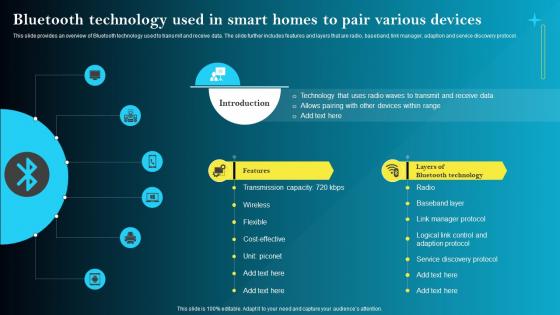
This slide provides an overview of Bluetooth technology used to transmit and receive data. The slide further includes features and layers that are radio, baseband, link manager, adaption and service discovery protocol.
People who downloaded this PowerPoint presentation also viewed the following :
Bluetooth Technology Used In Smart Homes To Pair Various Devices Iot Smart Homes Automation IOT SS with all 6 slides:
Use our Bluetooth Technology Used In Smart Homes To Pair Various Devices Iot Smart Homes Automation IOT SS to effectively help you save your valuable time. They are readymade to fit into any presentation structure.





FAQs for Bluetooth Technology Used In Smart Homes To Pair Various Devices Iot Smart Homes
Bluetooth technology operates on low-power radio frequency protocols, mesh networking capabilities, device-to-device communication without internet dependency, standardized pairing processes, and adaptive frequency hopping for interference reduction. These principles enable smart home systems to streamline device connectivity, enhance energy efficiency, and deliver seamless automation across lighting, security, and climate control applications, ultimately providing homeowners with reliable, scalable connectivity solutions.
Bluetooth Low Energy (BLE) consumes significantly less power than traditional Bluetooth by using intermittent connections, optimized data transmission protocols, and sleep modes between communications. This enhanced efficiency enables smart home devices like sensors, locks, and thermostats to operate for months or years on single batteries, while traditional Bluetooth requires frequent recharging, ultimately delivering cost-effective automation and seamless connectivity.
Bluetooth technology offers several advantages over Wi-Fi for smart home devices, including lower power consumption, faster device pairing, reduced network congestion, enhanced security protocols, and cost-effective implementation. These benefits enable smart thermostats, door locks, and lighting systems to operate efficiently with extended battery life, while many homeowners find that Bluetooth connections provide more reliable device-to-device communication without overwhelming their primary internet network.
Bluetooth mesh networks enhance smart home scalability by enabling hundreds of devices to communicate through interconnected nodes, eliminating single points of failure and extending coverage beyond traditional range limitations. This distributed architecture allows homeowners to seamlessly add lighting, security, and climate control devices across larger properties, while self-healing network capabilities automatically reroute communications if individual devices fail, ultimately delivering more robust and expandable smart home experiences.
Bluetooth security in smart homes includes AES-128 encryption, device authentication protocols, frequency hopping spread spectrum, regular firmware updates, and network segmentation capabilities. These measures work by encrypting data transmissions, verifying device identities, and creating isolated network zones, with many homeowners finding that combining multiple security layers significantly reduces vulnerability risks while maintaining seamless connectivity.
Bluetooth integrates into existing smart home ecosystems through mesh networking capabilities, device bridging protocols, and multi-standard hubs that enable seamless communication between Wi-Fi, Zigbee, and Bluetooth devices. Smart home platforms increasingly support hybrid connectivity approaches, with many homeowners finding that Bluetooth enhances localized device control, reduces network congestion, and delivers more responsive automation experiences.
Bluetooth-enabled sensors serve as data collectors, environmental monitors, security detectors, energy trackers, and health monitoring devices in smart home systems. These sensors streamline automation by detecting motion, temperature changes, and security breaches, while enabling real-time monitoring of air quality and energy consumption, ultimately delivering enhanced comfort, safety, and operational efficiency.
Bluetooth 5.0 enhances smart home performance by delivering four times the range, double the speed, and eight times the broadcasting capacity compared to previous versions. These improvements enable faster device responses, seamless connectivity across larger homes, and support for more simultaneous connections, ultimately streamlining home automation while reducing latency and power consumption.
Common Bluetooth implementation challenges include connectivity range limitations, device interference, battery drain concerns, compatibility issues across different versions, and security vulnerabilities. While these obstacles can complicate initial setup, many smart home manufacturers are addressing them through mesh networking, improved protocols, and enhanced encryption, ultimately delivering more reliable home automation experiences with seamless device integration.
Users ensure seamless Bluetooth interoperability by choosing devices with standardized protocols like Bluetooth SIG certifications, utilizing smart home hubs that support multiple device brands, and regularly updating firmware across all connected devices. Through platforms like SmartThings or Hubitat, homeowners streamline device communication, minimize connectivity issues, and create unified automation experiences, with many finding that strategic hub selection ultimately delivers enhanced system reliability and simplified smart home management.
Innovative Bluetooth use cases include mesh networking for seamless device communication, proximity-based automation triggering actions when residents enter rooms, asset tracking for keys and valuables, and low-energy sensors monitoring air quality or occupancy. These applications streamline home management by enabling responsive lighting, automated security systems, and efficient energy usage, with many homeowners finding that Bluetooth's reliability ultimately delivers enhanced convenience and reduced operational costs.
Bluetooth's limited range of 30-100 feet significantly influences smart home design by requiring strategic device placement, mesh network integration, and hybrid connectivity solutions that combine Bluetooth with Wi-Fi or Zigbee. This constraint drives manufacturers to develop innovative approaches like Bluetooth mesh networks and range extenders, enabling seamless whole-home automation while maintaining energy efficiency and reliable device communication throughout larger residential spaces.
Bluetooth technology assists smart home energy management through real-time monitoring of connected appliances, automated scheduling based on usage patterns, and seamless integration with smart thermostats and lighting systems. Through mesh networking capabilities, homeowners can optimize energy consumption across multiple devices simultaneously, ultimately reducing utility costs while maintaining comfort levels and enhancing overall operational efficiency.
AI integration with Bluetooth-connected smart home devices enhances user experiences by enabling predictive automation, personalized settings, and intelligent device coordination across connected ecosystems. Through machine learning algorithms, these systems anticipate user preferences, automatically adjust lighting and temperature based on behavioral patterns, and streamline daily routines, with many homeowners finding that AI-powered Bluetooth networks deliver seamless, responsive environments that adapt intuitively to lifestyle needs.
Future trends for Bluetooth technology in smart homes include mesh networking expansion, ultra-low power devices, enhanced security protocols, AI integration, and seamless cross-platform compatibility. These developments streamline home automation by enabling faster device communication, extending battery life, and improving user experiences, with many homeowners finding that advanced Bluetooth ecosystems ultimately deliver greater convenience and energy efficiency.
-
Good research work and creative work done on every template.
-
Love how there are no boring templates here! The design is fresh and creative, just the way I like it. Can't wait to edit and use them for my extended projects!