


Brainstorming Creative Idea Plan Business Success Challenges Learn





Try Before you Buy Download Free Sample Product
 Impress Your
 Audience
 100%
100% Editable
 Save Hours
 of Time


Our Brainstorming Creative Idea Plan Business Success Challenges Learn are topically designed to provide an attractive backdrop to any subject. Use them to look like a presentation pro.
People who downloaded this PowerPoint presentation also viewed the following :
Content of this Powerpoint Presentation
Slide 1: This slide introduces Brainstorming. State Your Company Name and begin.
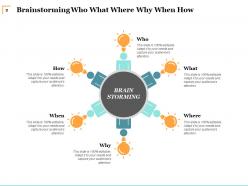
Slide 2: This slide shows Brainstorming describing Who, What, Where, Why, When, How.
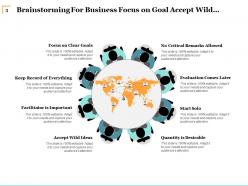
Slide 3: This slide presents Brainstorming For Business, Focus on Goal, Accept Wild Ideas.
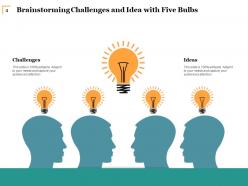
Slide 4: This slide displays Brainstorming Challenges and Idea with Five Bulbs.
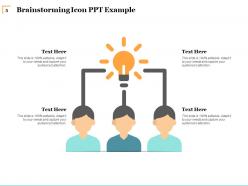
Slide 5: This slide represents Brainstorming Icon PPT Example.
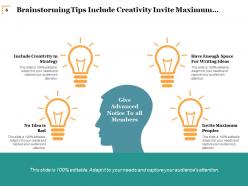
Slide 6: This slide showcases Brainstorming Tips as- Give Advanced Notice To all Members, Include Creativity in Strategy, Have Enough Space For Writing Ideas, Invite Maximum Peoples, No Idea is Bad.
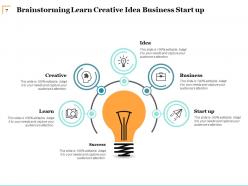
Slide 7: This slide shows Brainstorming describing- Start up, Business, Idea, Creative, Learn, Success.
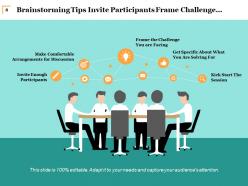
Slide 8: This slide presents Brainstorming Tips as- Invite Enough Participants, Make Comfortable Arrangements for Discussion, Frame the Challenge You Are Facing, Get Specific About What You Are Solving For, Kick Start The Session.
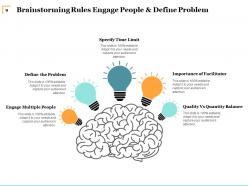
Slide 9: This slide displays Brainstorming Rules, Engage People & Define Problem.
Slide 10: This slide represents Brainstorming with Idea, Plan, Business, Teamwork, Success.
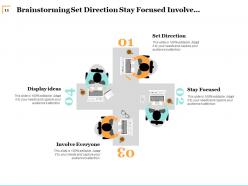
Slide 11: This slide showcases Brainstorming with- Set Direction, Stay Focused, Involve Everyone, Display ideas.
Slide 12: This is a Thank You slide with address, contact numbers and email address.
Brainstorming Creative Idea Plan Business Success Challenges Learn with all 12 slides:
Use our Brainstorming Creative Idea Plan Business Success Challenges Learn to effectively help you save your valuable time. They are readymade to fit into any presentation structure.


FAQs for Brainstorming Creative Idea Plan Business
Honestly, silent brainstorming is where it's at - have everyone write ideas alone for like 5-10 minutes before talking. Prevents the loudest person from taking over, you know? Mind mapping works great too since people can see how ideas connect visually. There's this improv thing called "Yes, and..." where you build on every suggestion instead of shooting it down. Oh, and try the "worst possible idea" exercise - sounds dumb but it actually breaks the ice and leads to surprising solutions. Don't mix techniques though, just pick one and stick with it.
Honestly, visual stuff just makes brainstorming way better. Some people need to *see* things to get them – I'm totally one of those people. Whiteboards and sticky notes help everyone spot connections they'd miss just talking. Mind maps are clutch for linking different ideas together. Digital tools let you shuffle concepts around on the fly, which is pretty satisfying actually. Next time, try sketching out a basic framework first instead of diving straight into discussion. It's like giving everyone the same map to work from.
Oh man, brainstorming has gotten so much better with all the new tech stuff. Tools like Miro let your whole team jump in at once, even when people are working from like three different countries. Digital whiteboards are clutch - no more losing those tiny sticky notes everywhere (seriously, where do they even go?). AI can throw out some starter ideas when you're stuck. Everything saves automatically too, which is nice since I used to lose half my notes anyway. Honestly, once you try a collaborative board you won't want to deal with regular meetings again.
Start with psychological safety - nobody's ideas are dumb, period. I always set ground rules like no interrupting and building on thoughts instead of shooting them down. The loudest people usually take over (ugh), so try silent brainstorming first or go around the room systematically. Some folks need time to think, others just blurt stuff out. Oh, and flip the usual order - ask your quiet team members to go first next time. You'll be surprised what they've been holding back.
Honestly, the worst thing is when people clam up because they don't want to look dumb in front of their boss. Judgment kills creativity fast. I'd start with ground rules - no shooting down ideas right away, and wild suggestions are totally welcome. Maybe have everyone jot stuff down individually first? That way quieter people actually contribute. Also don't let the senior person run every session - mix it up. Oh, and here's what drives me crazy: teams settling on the first okay idea instead of digging deeper. Set quotas like "we're not stopping until we hit 15 ideas." Trust me, the good stuff usually comes later.
Try turning your brainstorming into a story problem - like "what if our customer is the hero dealing with this mess?" People immediately start thinking in real scenarios instead of getting stuck on abstract stuff. Have your team build out character personas or roleplay different angles. Honestly, I've watched teams get so much more creative when they're crafting narratives rather than just spitballing features. That "what happens next?" energy leads to way better ideas. Oh, and start by asking "what story are we actually telling here?" - it changes everything.
Honestly, I'd start with the obvious stuff - count how many ideas you got. More is usually better for brainstorming. Then sort them into three piles: ready to go, needs work, and total duds. Check if everyone actually spoke up too (there's always that one person who hijacks the whole thing). The real question though is what happens after - did any ideas actually turn into something? That's where most brainstorming dies. End every session with specific next steps and make someone own each idea, otherwise it'll just disappear into the void.
Honestly, ditch the boring Zoom calls and try something like Miro or Figma where everyone can throw ideas up at once - it's weirdly addictive watching thoughts pop up everywhere. Keep sessions short though, because staring at screens for hours just murders creativity. I've started doing async brainstorming too where people dump ideas in a shared doc over a couple days. Works surprisingly well. Make sure your quiet teammates actually get to talk - they usually have the best insights anyway. Oh, and start with everyone writing ideas solo for 5 minutes before jumping into discussion. Trust me on this one.
Honestly, Miro's been a lifesaver for our team - everyone can throw up sticky notes and sketch stuff out at the same time. Mural's pretty similar if you want another option. FigJam works great too, especially if you're already using Figma for design stuff. Zoom's whiteboard is actually way better than people give it credit for (I was surprised). Stormboard's good for when you need things more organized. Pick whatever feels easiest for your group to jump into. Nothing kills creativity faster than everyone struggling with clunky software. The magic happens when people can just focus on ideas instead of figuring out how to use the tool.
Honestly, don't stress too much about prep, but do a little homework first. Jot down 3-4 rough ideas beforehand - even the terrible ones sometimes lead somewhere cool. Sleep well the night before because brainstorming on zero energy is rough (trust me on this one). I always bring sticky notes since I think better when I can visualize stuff. Here's the big thing though: leave your inner critic at home. Focus on building off what others say instead of poking holes in everything. Go in with a "yes, and..." mindset rather than immediately thinking "but that won't work."
Honestly, the biggest thing that kills brainstorming is people being scared they'll sound dumb. Once that fear creeps in, everyone just shuts down. Mental exhaustion doesn't help either - try brainstorming after a 10-hour workday and you'll see what I mean. Group stuff gets messy too. You've got the loud people drowning out everyone else, plus those who just sit back and let others do the work. And here's the thing - if people know their ideas are gonna get picked apart right away, they'll only share the boring "safe" ones. Best fix? Make it clear nothing's off-limits during idea time, then save the critiquing for later.
Oh totally - where you brainstorm makes a huge difference. Those sterile conference rooms? Absolute creativity killers. I swear they suck the life out of any good ideas. Try somewhere with natural light and comfy seating instead. People need to feel relaxed, not like they're in a board meeting. Temperature matters too (nobody thinks well when they're freezing). Snacks don't hurt either - there's something about munching that gets people's brains going. Even just switching up your usual spot can shake loose better ideas. Your team will thank you for ditching the corporate vibe.
I always start with silly warm-up games before the real brainstorming. My favorite? "Worst possible idea" - people share the most terrible solutions they can think of. Sounds weird but everyone loosens up fast. Word association works too, or give them 30 seconds to sketch the problem. Sometimes I'll throw in random perspectives like "how would a chef solve this?" The whole point is getting people comfortable being creative without worrying about finding THE perfect answer right away. Low-stakes stuff that gets brains moving, you know?
Try building in little pause moments during your brainstorm where everyone switches gears and evaluates stuff. After the initial creative dump, throw out questions like "What assumptions are we making here?" or "How could this totally backfire?" I love the idea of having someone play devil's advocate too - keeps things honest. The trick is making it feel collaborative instead of like you're tearing ideas apart. People shut down fast if they think you're being overly critical. It's basically toggling between creative brain and analytical brain, but doing it on purpose instead of randomly.
Oh man, definitely get someone writing stuff down or use one of those digital boards. I've watched so many good ideas just vanish because everyone thought they'd remember later (spoiler: they don't). Sort everything afterwards by what's actually doable vs pipe dreams. Give people specific tasks with deadlines - otherwise nothing happens. Send out notes within a day while it's all still in your head. Here's the thing though: you HAVE to do a follow-up meeting that same week or the whole thing was basically just an expensive coffee chat. Trust me on this one.
-
Thanks for all your great templates they have saved me lots of time and accelerate my presentations. Great product, keep them up!
-
Editable templates with innovative design and color combination.
-
Excellent work done on template design and graphics.