


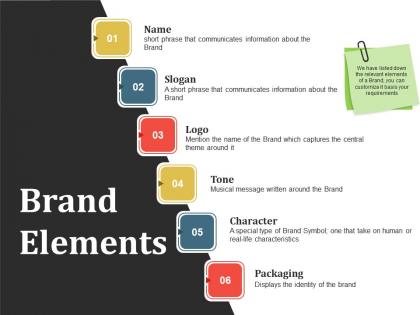
Brand elements powerpoint slide




Try Before you Buy Download Free Sample Product
 Impress Your
 Audience
 100%
100% Editable
 Save Hours
 of Time


Our Brand Elements Powerpoint Slide ensure a clarity of guidance. The directions to follow will appear clearly in front.
People who downloaded this PowerPoint presentation also viewed the following :
Brand elements powerpoint slide with all 5 slides:
Bring disagreement to a close with our Brand Elements Powerpoint Slide. They will concur and follow your example.

FAQs for Brand
Key brand elements include logo design, color palette, typography, visual imagery, brand voice, and messaging consistency. These components work together by creating recognizable visual identity, establishing emotional connections with customers, and differentiating businesses in competitive markets, with many organizations finding that cohesive brand elements ultimately enhance customer loyalty and drive measurable business growth.
Brand elements significantly influence consumer perception by creating immediate visual and emotional connections, establishing trust through consistent messaging, and differentiating products in competitive markets. Through strategic use of logos, colors, and typography, companies like Apple and Coca-Cola build strong brand recognition that drives customer loyalty, ultimately delivering higher retention rates and premium pricing power.
A strong logo enhances brand recognition by creating instant visual identification, establishing emotional connections with consumers, ensuring consistent brand presence across all touchpoints, and differentiating products from competitors. Through strategic design and placement, businesses in retail, hospitality, and technology sectors achieve higher recall rates, increased customer loyalty, and stronger market positioning, ultimately delivering measurable competitive advantage.
Colors significantly influence brand identity by conveying personality, values, and emotional associations that shape consumer perceptions and purchasing decisions. Through psychological triggers, brands like Coca-Cola's energetic red, IBM's trustworthy blue, and Starbucks' calming green create immediate recognition and emotional connections, ultimately driving loyalty and differentiation in increasingly competitive markets.
Typography strategically communicates brand values through font selection, weight variations, spacing choices, and hierarchical arrangements that reflect personality traits like trustworthiness, innovation, or sophistication. Financial institutions often choose clean, authoritative typefaces to convey stability, while creative agencies leverage custom fonts and dynamic spacing, ultimately enhancing brand recognition and emotional connection across touchpoints.
Creating effective taglines requires considering memorability through simplicity and rhythm, emotional resonance with target audiences, brand differentiation from competitors, and alignment with core brand values. Companies like Nike's "Just Do It" and McDonald's "I'm Lovin' It" demonstrate how strategic taglines combining brevity, emotional appeal, and brand consistency ultimately enhance recognition, customer connection, and market positioning across diverse touchpoints.
B2B brand elements typically emphasize trust, expertise, and professional credibility through conservative design, detailed value propositions, and industry-specific messaging. B2C elements focus on emotional connection, lifestyle appeal, and accessibility through vibrant visuals, memorable slogans, and broad market messaging, with many companies finding that B2B requires longer-term relationship building while B2C prioritizes immediate consumer engagement.
Consistency strategies include developing comprehensive brand guidelines, implementing centralized asset management systems, conducting regular brand audits, establishing approval workflows, and providing team training on brand standards. These approaches streamline brand management by standardizing visual identity, messaging protocols, and usage requirements across all touchpoints, with many organizations finding that systematic brand governance ultimately delivers enhanced recognition and stronger market positioning.
Storytelling integrates into brand elements through consistent visual narratives, compelling copy that reflects brand values, memorable logos that convey heritage, and cohesive messaging across touchpoints. These elements work together to create emotional connections, with many companies finding that narrative-driven branding significantly enhances customer engagement, builds loyalty, and ultimately drives stronger business outcomes.
Cultural differences significantly impact brand element interpretation through varying color symbolism, typography preferences, imagery associations, and linguistic meanings across different regions and demographics. For example, while white symbolizes purity in Western markets, it represents mourning in some Asian cultures, with global brands like McDonald's and Coca-Cola adapting their visual strategies to resonate locally while maintaining brand recognition, ultimately delivering culturally relevant messaging and stronger market penetration.
Startups can effectively develop brand elements by conducting thorough market research, defining clear value propositions, creating consistent visual identities, and establishing authentic brand voices that resonate with target audiences. Through strategic implementation across digital platforms, marketing materials, and customer touchpoints, emerging companies streamline brand recognition, enhance market positioning, and build competitive advantage, ultimately delivering stronger customer connections and accelerated growth trajectories.
Digital platforms transform traditional brand elements by enabling dynamic logos, interactive color schemes, personalized messaging, real-time customer feedback integration, and adaptive visual identities that respond to user behavior. Through social media analytics and AI-driven customization, brands can modify their voice, imagery, and positioning instantly across channels, ultimately delivering more targeted customer experiences and competitive differentiation.
Sensory elements create immersive brand experiences by triggering emotional connections, enhancing memory recall, and differentiating brands through multi-dimensional touchpoints beyond visual identity. Through strategic audio branding and signature scents, retailers like Starbucks and luxury hotels deliver consistent atmospheres that increase customer dwell time, strengthen brand recognition, and ultimately build deeper emotional loyalty across all customer interactions.
Brands can assess brand element effectiveness through customer surveys, A/B testing, brand recognition studies, market research analytics, and social media engagement metrics. These methods help organizations measure logo recall, color association strength, and messaging clarity across different demographics, with many companies finding that regular assessment enables strategic refinements that enhance brand recognition and drive customer loyalty.
Consumer feedback drives brand element evolution by revealing perception gaps, highlighting outdated associations, and identifying emerging customer preferences through surveys, social media monitoring, and market research. Through this continuous dialogue, companies strategically refine logos, messaging, and visual identity to maintain relevance, with many brands finding that responsive adaptation enhances customer loyalty and competitive positioning.
-
Very well designed and informative templates.
-
Unique design & color.