


Brief Overview Of Education Industry Training Ppt




Try Before you Buy Download Free Sample Product
 Impress Your
 Audience
 100%
100% Editable
 Save Hours
 of Time


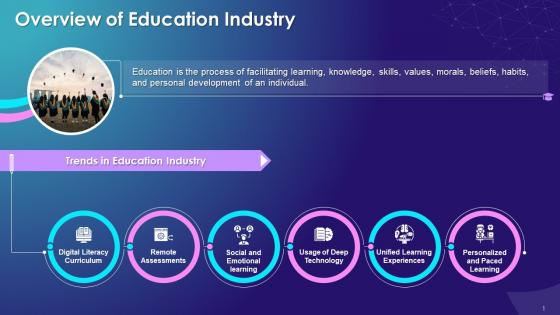
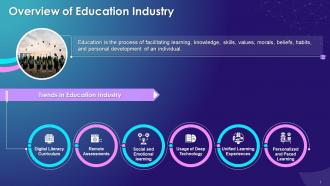
This slide highlights the concept of education industry. It also highlights key trends in education industry such as the digital literacy curriculum, remote assessments, social and emotional learning, usage of deep technology, unified learning experiences, and personalized paced learning.
People who downloaded this PowerPoint presentation also viewed the following :
Brief Overview Of Education Industry Training Ppt with all 16 slides:
Use our Brief Overview Of Education Industry Training Ppt to effectively help you save your valuable time. They are readymade to fit into any presentation structure.










FAQs for Brief Overview Of Education
Current trends impacting education industry training programs include personalized learning technologies, microlearning modules, virtual and augmented reality experiences, competency-based assessments, and hybrid delivery models. These approaches streamline skill development by accommodating diverse learning styles, reducing training time, and enabling scalable deployment across institutions, with many universities and corporate training centers finding enhanced engagement and measurable learning outcomes.
Technology integration enhances training effectiveness by enabling personalized learning paths, real-time performance analytics, and interactive simulations that adapt to individual learning styles. Through AI-powered platforms and virtual reality tools, educational institutions streamline instructor development, automate assessment processes, and deliver immersive experiences, ultimately improving knowledge retention and teaching quality.
Soft skills play a crucial role in educator and administrative training by enhancing communication, emotional intelligence, leadership capabilities, collaborative problem-solving, and adaptive thinking skills. These competencies enable educational professionals to create supportive learning environments, manage diverse student needs, and facilitate effective stakeholder relationships, with many institutions finding that strong soft skills training ultimately improves student outcomes and organizational effectiveness.
Training programs can be tailored through personalized learning paths, adaptive content delivery, multiple assessment formats, flexible scheduling options, and varied instructional methods. These approaches enable educational institutions to accommodate different learning styles, skill levels, and professional backgrounds, with many universities and corporate training centers finding that customized programs significantly enhance learner engagement and knowledge retention.
Best practices for assessing educational training effectiveness include pre-and post-training evaluations, learner feedback surveys, knowledge retention tests, practical skill demonstrations, and long-term performance tracking. These assessment methods work together by measuring immediate learning gains, behavioral changes, and sustained knowledge application, with many educational institutions finding that comprehensive evaluation frameworks ultimately deliver improved learning outcomes and enhanced training program ROI.
Collaboration between educational institutions and industry improves training outcomes by aligning curricula with real-world skills, providing hands-on experience through internships, and ensuring graduates meet market demands. Through strategic partnerships, universities and companies create targeted programs, share resources, and develop specialized training modules, with many tech firms and business schools finding that collaborative approaches ultimately deliver more job-ready graduates and enhanced workforce development.
Strategies include mentorship programs, peer collaboration networks, professional learning communities, regular skills assessments, and incentivized professional development opportunities. These approaches enhance educator engagement by promoting knowledge sharing, encouraging innovation, and supporting career advancement, with many educational institutions finding that continuous learning cultures ultimately deliver improved student outcomes and teacher retention.
Educators face challenges including resistance to change, insufficient technical infrastructure, limited training budgets, time constraints for professional development, and varying digital literacy levels among staff. While these obstacles can slow adoption, many educational institutions find that phased implementation approaches, peer mentoring programs, and strategic partnerships with technology providers ultimately streamline transitions and enhance teaching effectiveness.
Data analytics enhances educational training programs by identifying skill gaps, tracking learner progress, personalizing content delivery, and measuring program effectiveness through comprehensive performance metrics. Through predictive modeling and real-time dashboards, schools and universities can optimize curriculum design, reduce dropout rates, and improve knowledge retention, ultimately delivering more targeted professional development and better student outcomes.
Cultural competency is essential for educators in today's diverse classrooms, enabling them to understand, respect, and effectively teach students from varied backgrounds, ethnicities, and socioeconomic circumstances. This training enhances student engagement, reduces achievement gaps, and creates inclusive learning environments, with many schools finding that culturally competent educators deliver improved academic outcomes and stronger community relationships.
Online training platforms can be optimized through interactive content, gamification elements, personalized learning paths, microlearning modules, and real-time feedback systems. These approaches enhance engagement by creating immersive experiences, while adaptive assessments and progress tracking improve retention rates, with many educational institutions finding that personalized content delivery significantly increases course completion rates.
Educational policies significantly influence training frameworks, curriculum standards, resource allocation, professional development requirements, and assessment methodologies within schools. These policies shape how institutions design teacher training programs, implement technology integration, and establish student learning outcomes, with many schools finding that strategic alignment between policy mandates and internal development initiatives ultimately delivers enhanced educational quality and improved institutional performance.
Mentorship programs enhance educator training by pairing novice teachers with experienced professionals who provide guidance, classroom management strategies, curriculum insights, and emotional support during challenging transitions. These structured relationships accelerate professional development, reduce first-year burnout rates, and improve student outcomes, with many school districts finding that mentored teachers demonstrate higher retention rates and enhanced instructional effectiveness.
Student feedback serves as a cornerstone for designing effective education industry training programs, influencing curriculum development, instructional methods, assessment strategies, and technology integration. Through surveys, focus groups, and performance analytics, educational institutions can identify learning gaps, adapt content delivery approaches, and enhance engagement strategies, with many universities and corporate training centers finding that responsive program adjustments ultimately deliver improved learning outcomes and stronger student satisfaction rates.
Cross-disciplinary training enhances educators' ability to create integrated learning experiences, develop critical thinking skills, and connect abstract concepts to real-world applications across subjects like science, technology, arts, and humanities. This approach enables teachers to design more engaging curricula while helping students develop problem-solving abilities and analytical skills that mirror today's interconnected workplace demands, ultimately delivering improved academic performance and better preparation for diverse career paths.
-
Great templates that you can use in your next keynote or conference. They are perfect for quick and visually-engaging delivery.
-
I've been looking for a good template source for some time. I'm happy that I discovered SlideTeam. Excellent presentations must try!