


Build Measure Learn Feedback Loop Powerpoint Ppt Template Bundles




Try Before you Buy Download Free Sample Product
 Impress Your
 Audience
 100%
100% Editable
 Save Hours
 of Time


Our Build Measure Learn Feedback Loop Powerpoint Ppt Template Bundles are topically designed to provide an attractive backdrop to any subject. Use them to look like a presentation pro.
People who downloaded this PowerPoint presentation also viewed the following :
Build Measure Learn Feedback Loop Powerpoint Ppt Template Bundles with all 18 slides:
Use our Build Measure Learn Feedback Loop Powerpoint Ppt Template Bundles to effectively help you save your valuable time. They are readymade to fit into any presentation structure.





FAQs for Build Measure Learn Feedback Loop Powerpoint
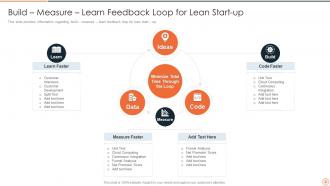
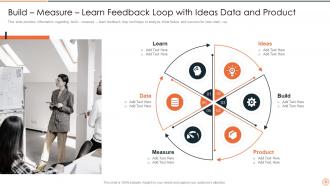
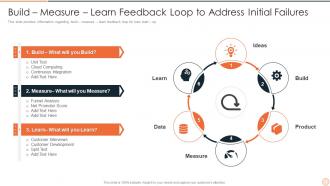
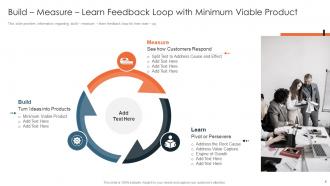
The Build-Measure-Learn feedback loop consists of three interconnected stages: building minimum viable products or features, measuring customer responses and key metrics, and learning from data to inform next iterations. These stages create a continuous cycle where learning insights drive new build decisions, measurement validates assumptions and identifies improvement opportunities, and building tests hypotheses, with many startups and established organizations finding that this iterative approach accelerates product development while minimizing resource waste.
Startups can effectively implement the Build-Measure-Learn feedback loop by developing minimum viable products, establishing clear success metrics, conducting rapid user testing, and iterating based on data-driven insights. This approach enables companies to minimize development costs, accelerate time-to-market, and validate product-market fit efficiently, with many tech startups finding that systematic feedback integration ultimately delivers stronger customer alignment and competitive positioning.
Common pitfalls include building too much before testing, measuring vanity metrics instead of actionable data, ignoring negative feedback, and extending learning phases without decisive action. Many startups find that rushing through iterations, avoiding difficult pivots, and focusing on features rather than customer problems ultimately undermines the loop's effectiveness in delivering validated learning and sustainable growth.
Teams ensure metric alignment with business goals by establishing clear key performance indicators (KPIs) that directly correlate with strategic objectives, implementing regular cross-functional reviews between product and business stakeholders, and creating measurement frameworks that track both leading and lagging indicators. This strategic approach enables organizations to maintain focus on outcomes that drive revenue growth, customer satisfaction, and competitive advantage, while ensuring that data collection efforts ultimately deliver actionable insights for sustainable business success.
Validation techniques during the Build phase include rapid prototyping, A/B testing, user interviews, minimum viable product development, and analytics tracking. These methods enable startups to test core assumptions through real user interactions, market feedback, and data collection, with many organizations finding that early validation reduces development costs while accelerating product-market fit discovery.
Customer feedback directly drives Build-Measure-Learn iterations by providing validated learning that shapes product pivots, feature prioritization, and development roadmaps based on real user behavior and preferences. Through systematic feedback collection, startups can quickly identify which assumptions are wrong, which features deliver value, and which market segments respond positively, ultimately accelerating product-market fit while minimizing resource waste.
The Build-Measure-Learn feedback loop enhances product team agility by accelerating iteration cycles, reducing development waste, enabling rapid pivot decisions, and fostering data-driven prioritization. Through continuous experimentation and real user feedback, teams streamline feature development, minimize time spent on unsuccessful initiatives, and ultimately deliver more relevant products, with many organizations finding that this approach significantly reduces time-to-market while improving customer satisfaction.
Organizations foster Build-Measure-Learn culture by encouraging experimentation, rewarding data-driven decisions, implementing rapid prototyping processes, and celebrating learning from failures alongside successes. This approach requires leadership commitment, cross-functional collaboration, and structured feedback mechanisms, with many companies finding that regular iteration cycles and transparent communication ultimately deliver faster innovation and competitive advantage.
Data analysis transforms raw feedback into actionable insights by identifying usage patterns, measuring key performance indicators, tracking user behavior analytics, and quantifying improvement opportunities throughout the build-measure-learn cycle. Through systematic data interpretation, organizations streamline product refinements, enhance user experiences, and accelerate iteration cycles, with many technology companies finding that data-driven decisions ultimately deliver faster market validation and competitive advantage.
Effective communication enhances Build-Measure-Learn cycles by ensuring rapid knowledge sharing, aligned decision-making, and seamless iteration across development phases. Through structured feedback sessions and collaborative analysis, teams streamline hypothesis validation, accelerate learning integration, and minimize miscommunication delays, with many organizations finding that enhanced communication reduces cycle time by 30-40% while improving product-market fit.
Tools for streamlining Build-Measure-Learn processes include analytics platforms like Google Analytics and Mixpanel, A/B testing software such as Optimizely, customer feedback systems like Hotjar, and project management tools including Jira and Trello. These technologies enhance decision-making by automating data collection, accelerating experiment cycles, and centralizing insights, with many startups and enterprises finding that integrated toolsets significantly reduce iteration time while improving product-market fit validation.
Businesses balance speed and quality in feedback loops by implementing rapid prototyping with structured testing phases, setting clear quality thresholds before launch, and using automated monitoring tools for real-time performance tracking. Through iterative development cycles, organizations can accelerate decision-making while maintaining standards, with many finding that shorter, frequent feedback intervals ultimately deliver both faster innovation and higher-quality outcomes.
**INPUT**: What strategies can be implemented to gather meaningful feedback from users during the Measure phase? **OUTPUT**: Effective feedback strategies include user surveys, A/B testing, analytics tracking, customer interviews, and behavioral observation tools. These methods enable organizations to capture quantitative metrics and qualitative insights simultaneously, with many companies finding that combining direct user feedback with usage analytics delivers comprehensive understanding of customer needs, ultimately driving more informed product iterations and enhanced user experiences.
The Build-Measure-Learn framework enables established companies to innovate within existing structures through controlled experimentation and resource allocation, while startups leverage it for rapid pivoting and market validation with minimal resources. Established companies benefit from integrated feedback systems across departments and customer bases, whereas startups gain speed and agility, with both ultimately delivering faster innovation cycles and reduced development risks in increasingly competitive markets.
The Build-Measure-Learn cycle enhances customer satisfaction by continuously refining products based on real user feedback, enabling rapid iteration, personalized experiences, and proactive problem resolution. This ongoing refinement process builds trust and loyalty, with many companies in retail and financial services finding that customers appreciate responsive development approaches that consistently deliver improved functionality and user experiences.
-
Every time I ask for something out-of-the-box from them and they never fail in delivering that. No words for their excellence!
-
Visually stunning presentation, love the content.