


Building Trust And Confidence With Prospects To Boost Sales Training Ppt




Try Before you Buy Download Free Sample Product
 Impress Your
 Audience
 100%
100% Editable
 Save Hours
 of Time


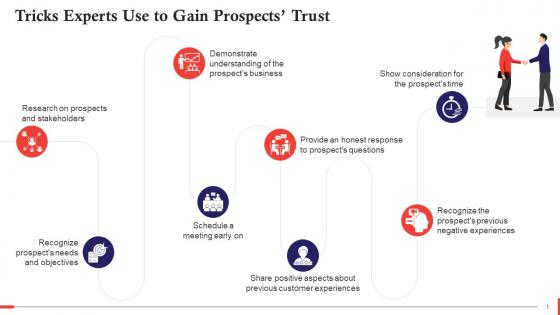
These slides highlight the tricks experts use to gain prospects trust. The tricks are Research on prospects and stakeholders, recognize prospects needs and objectives, demonstrate understanding of the prospects business, schedule a meeting early on, provide an honest response to prospects questions, share previous customer experiences, recognize the prospects previous negative experiences, and show consideration for the prospects time.
People who downloaded this PowerPoint presentation also viewed the following :
Content of this Powerpoint Presentation
Slide 1
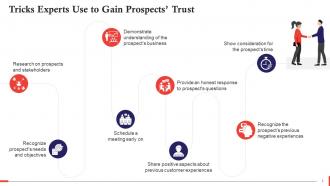
This slide depicts the tricks experts use to gain prospects’ trust. The tricks are: Research on prospects and stakeholders, recognize prospect's needs and objectives, demonstrate understanding of the prospect’s business, schedule a meeting early on, provide an honest response to prospect's questions, share previous customer experiences, recognize the prospect's previous negative experiences, and show consideration for the prospect's time.
Slide 2
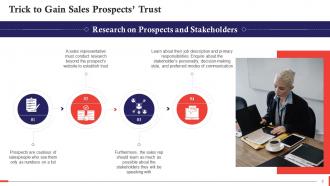
This slide explains a trick which is to research on prospects and stakeholders that a salesperson can use to gain the trust of prospects. It highlights that prospects are cautious of salespeople who treat them as numbers on a list. It also states that the sales rep should learn as much as possible about the stakeholders with whom they will be speaking, their job description, and their primary responsibilities. Enquire about the stakeholder's personality, decision-making style, and communication preferences.
Slide 3
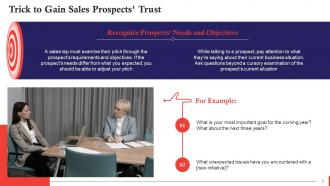
This slide explains how recognizing prospect’s needs and objectives can help gain the trust of prospects. It highlights that a sales rep must examine their pitch through the prospect's requirements and objectives. If the prospect's needs differ from what you expected, you should be able to adjust your pitch.
Slide 4
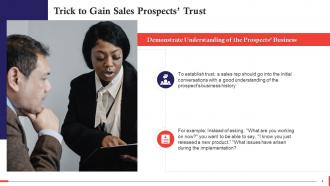
This slide explains demonstrating your understanding of the prospect’s business as a tip to gain their trust. It highlights that to establish trust, a sales rep should enter into initial conversations with a good understanding of the prospect's business history.
Slide 5
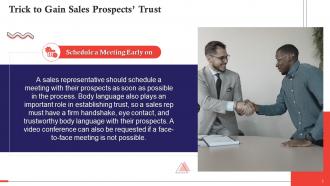
This slide explains how to gain clients’ trust by scheduling a meeting early on. It highlights that a sales representative should schedule a meeting with their prospects as soon as possible in the process. It also mentions that Body language also plays an important role in establishing trust, so a sales rep must have a firm handshake, eye contact, and trustworthy body language with their prospects.
Slide 6
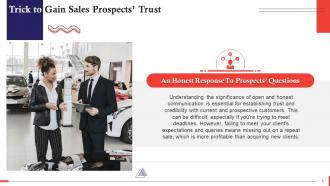
This slide explains how to respond honestly to a prospects’ question to gain their trust. It highlights the importance of open and honest communication in building trust and credibility with current and prospective customers. It also states that failing to meet your client's expectations and queries means losing a repeat sale, which is more profitable than acquiring new customers.
Slide 7
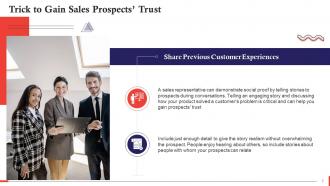
This slide explains how sharing stories about previous customer experiences can help you gain the trust of prospects. It emphasizes how a sales representative can demonstrate social proof in conversations with prospects by telling stories. It also mentions the importance of telling an engaging story and discussing how your product solved a customer's problem to gain prospects' trust.
Slide 8
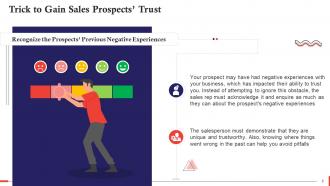
This slide explains how recognizing prospect’s previous negative experiences can help gain their trust. It highlights that your prospect may have had negative experiences with your business, which has impacted their ability to trust you. Instead of attempting to ignore this obstacle, the sales rep must acknowledge it and enquire as much as they can about the prospect's negative experiences.
Slide 9
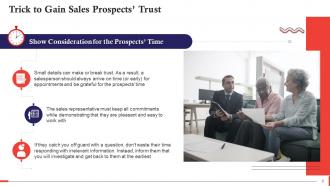
This slide explains how showing consideration for the prospects' time can help gain their trust, and it highlights that details can make or break trust. As a result, a salesperson should always arrive on time (or early) for appointments and be grateful for the prospects' time.
Building Trust And Confidence With Prospects To Boost Sales Training Ppt with all 25 slides:
Use our Building Trust And Confidence With Prospects To Boost Sales Training Ppt to effectively help you save your valuable time. They are readymade to fit into any presentation structure.









FAQs for Building Trust And Confidence With Prospects To Boost
Key elements that build trust in sales relationships include consistent communication, transparent pricing, reliable follow-through on commitments, genuine product knowledge, and authentic concern for client needs. These trust-building practices enhance customer retention, accelerate deal closure, and generate referral opportunities, with many sales organizations finding that trusted relationships ultimately deliver higher lifetime value and sustained competitive advantage.
Sales professionals communicate integrity through consistent transparency in pricing and processes, honest acknowledgment of product limitations, reliable follow-through on commitments, and sharing authentic client testimonials with specific outcomes. These trust-building approaches enable stronger prospect relationships, faster decision-making cycles, and higher conversion rates, with many organizations finding that authentic communication significantly reduces sales cycle length while enhancing long-term customer retention.
Emotional intelligence enables salespeople to read client emotions, adapt their communication style, and respond empathetically to concerns, creating deeper rapport and credibility. Through active listening, recognizing nonverbal cues, and managing their own emotional responses, sales professionals build authentic connections that foster trust, ultimately leading to stronger client relationships and higher conversion rates.
Sales teams can leverage customer testimonials by strategically incorporating them into presentations, proposals, and digital platforms, while showcasing specific results, industry relevance, and measurable outcomes from similar clients. These authentic endorsements enhance credibility by providing third-party validation, reducing prospect skepticism, and demonstrating proven value, with many organizations finding that testimonials accelerate decision-making and significantly improve conversion rates.
Common pitfalls that erode trust include overpromising deliverables, withholding critical product limitations, pressuring prospects with artificial urgency, and failing to follow through on commitments. These missteps undermine credibility by creating unrealistic expectations, reducing transparency, and damaging long-term relationships, with many organizations finding that authentic communication and consistent follow-through ultimately deliver stronger customer retention and referral rates.
Transparency in pricing significantly enhances customer confidence by eliminating uncertainty, reducing perceived risk, and demonstrating honest business practices. When companies openly share pricing structures, customers feel more informed and in control, with many organizations in retail, healthcare, and financial services finding that transparent pricing leads to higher conversion rates, reduced sales cycles, and stronger long-term relationships.
Active listening techniques include maintaining eye contact, asking clarifying questions, paraphrasing customer statements, avoiding interruptions, and taking notes during conversations. These approaches enable salespeople to demonstrate genuine interest, uncover deeper customer needs, and address specific pain points more effectively, with many sales professionals finding that consistent active listening ultimately delivers stronger client relationships and significantly higher conversion rates.
Understanding customer needs fosters trust by demonstrating genuine interest, active listening, and commitment to solving their specific challenges rather than pushing products. This approach enables sales professionals to offer tailored solutions, anticipate future requirements, and provide relevant insights, with many clients finding that personalized attention ultimately delivers stronger partnerships and increased confidence in vendor relationships.
Trust metrics in sales performance include customer retention rates, referral generation frequency, repeat purchase ratios, client satisfaction scores, and conversion rates from initial meetings. These indicators collectively demonstrate relationship quality by measuring long-term client loyalty, word-of-mouth advocacy, and sustained business growth, with many sales organizations finding that trust-focused representatives consistently outperform transaction-oriented peers.
Follow-up is crucial for maintaining trust as it demonstrates ongoing commitment, addresses post-purchase concerns, ensures satisfaction with delivered solutions, and reinforces the value proposition. Through consistent communication, sales professionals strengthen client relationships, identify expansion opportunities, and build long-term partnerships, with many organizations finding that systematic follow-up significantly increases customer retention and lifetime value.
Social proof bolsters buyer confidence through customer testimonials, case studies, industry awards, user reviews, and referral programs. These validation methods demonstrate real-world success and peer endorsement, with many sales organizations finding that showcasing specific client achievements and third-party recognition significantly accelerates decision-making while reducing buyer hesitation.
Ongoing training enhances salespeople's trust-building capabilities by developing deeper product knowledge, refined communication skills, and advanced relationship management techniques. Through consistent education, sales professionals master consultative selling approaches, learn to address client concerns more effectively, and stay current with industry trends, ultimately delivering more credible interactions and stronger client relationships that drive long-term business success.
Feedback mechanisms to encourage honest sales communications include regular customer satisfaction surveys, anonymous feedback portals, post-purchase follow-up calls, peer review systems, and transparent performance metrics that reward integrity over volume. These approaches enable organizations to identify communication gaps, enhance trust-building practices, and ultimately deliver better customer experiences, with many sales teams finding that honest communication consistently leads to higher retention rates and stronger long-term relationships.
Cultural perceptions of trust significantly influence international sales strategies through varying relationship-building timelines, communication preferences, and decision-making processes across different markets. While some cultures prioritize formal credentials and institutional backing, others emphasize personal relationships and face-to-face interactions, with many global organizations finding that adapting their approach to local trust-building customs ultimately delivers stronger client relationships and sustainable market penetration.
Sales professionals should prioritize honesty in product representation, transparent pricing without hidden fees, respect for customer privacy and data protection, and avoiding high-pressure tactics that compromise decision-making autonomy. These ethical practices enhance customer relationships, reduce returns and complaints, and build long-term loyalty, with many organizations finding that ethical sales approaches ultimately deliver higher retention rates and stronger market reputation.
-
Slideteam offers pocket-friendly products. As a college student this is a really necessary thing to look at while paying for something.
-
I can always count on your designs for my professional needs. I believe I found a one-stop-shop for PPTs.