


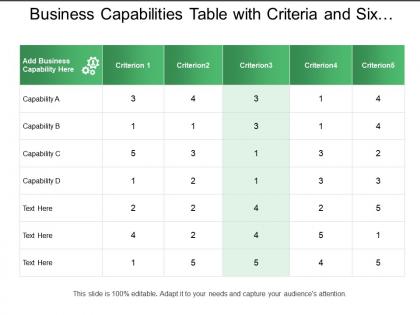
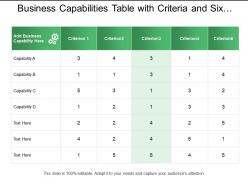
Business capabilities table with criteria and six columns




Try Before you Buy Download Free Sample Product
 Impress Your
 Audience
 100%
100% Editable
 Save Hours
 of Time


Our Business Capabilities Table With Criteria And Six Columns enable cross cultural flow. They generate excellent collaborations.
People who downloaded this PowerPoint presentation also viewed the following :
Business capabilities table with criteria and six columns with all 5 slides:
Lay out the charm with our Business Capabilities Table With Criteria And Six Columns. Sweep your listeners off their feet.

FAQs for Business capabilities table with criteria
Core components include strategic capabilities, operational processes, technological infrastructure, human resources, and governance structures, each defining what an organization can accomplish. These components interrelate through strategic alignment, with capabilities driving processes, technology enabling operations, people executing functions, and governance ensuring coordination, ultimately creating integrated value chains that enhance organizational performance and competitive advantage.
A business capabilities framework drives strategic alignment by mapping organizational strengths to business objectives, identifying capability gaps, and prioritizing resource allocation across departments. Through this structured approach, leadership teams can streamline decision-making processes, enhance cross-functional collaboration, and ensure all initiatives support core strategic goals, ultimately delivering improved operational efficiency and competitive advantage.
Stakeholder engagement ensures comprehensive capability identification, alignment with strategic objectives, and successful framework adoption across organizational levels. Through collaborative workshops, interviews, and feedback sessions, organizations capture diverse perspectives from executives, department heads, and frontline employees, ultimately delivering frameworks that reflect real operational needs and gain widespread buy-in for implementation success.
Organizations can measure business capabilities effectiveness through performance metrics, capability maturity assessments, outcome tracking, and strategic alignment evaluations that monitor both operational efficiency and competitive positioning. Through dashboards and regular reviews, companies in sectors like financial services and manufacturing streamline resource allocation, enhance decision-making processes, and ultimately deliver measurable improvements in customer satisfaction and market responsiveness.
Common pitfalls include lack of senior leadership buy-in, overly complex initial designs, insufficient stakeholder engagement, poor alignment with strategic objectives, and inadequate change management processes. Organizations often find that starting with broad, enterprise-wide implementations rather than focused pilot programs creates resistance and confusion, while successful frameworks begin with specific business units, demonstrate clear value through measurable outcomes, and gradually scale across departments.
A business capabilities framework supports digital transformation by mapping current capabilities against future-state requirements, identifying gaps, and prioritizing technology investments. Through this structured approach, organizations streamline resource allocation, ensure alignment between business strategy and digital initiatives, and accelerate implementation timelines, with many enterprises finding that capability-driven transformation delivers measurable ROI and competitive advantage.
A business capabilities framework enhances customer experience by mapping customer touchpoints, identifying service gaps, streamlining processes, and aligning resources with customer needs. Through this strategic approach, organizations can deliver personalized interactions, faster response times, and consistent service quality across all channels, with many retail and financial services companies finding that integrated capabilities ultimately drive customer loyalty and competitive advantage.
Organizations utilize existing business capabilities frameworks by systematically mapping current capabilities against strategic objectives, conducting maturity assessments, and performing gap analyses to reveal performance shortfalls and improvement opportunities. This structured evaluation enables businesses to prioritize investments, streamline resource allocation, and identify emerging market opportunities, ultimately delivering enhanced operational efficiency and competitive advantage in increasingly complex business environments.
Business capabilities frameworks benefit from enterprise architecture tools like TOGAF and ArchiMate, business process modeling software such as Visio or Lucidchart, and capability mapping methodologies including value stream mapping. These approaches streamline framework development by enabling visual documentation, cross-functional collaboration, and iterative refinement, with many organizations finding that combining multiple tools delivers comprehensive capability visibility and strategic alignment.
A business capabilities framework facilitates cross-functional collaboration by creating shared vocabulary, standardizing processes, and establishing common performance metrics across departments. Through capability mapping, teams from different functions can identify interdependencies, streamline handoffs, and align resources more effectively, with many organizations finding that this structured approach eliminates silos and accelerates decision-making.
A capabilities-driven approach significantly transforms resource allocation by prioritizing investments that strengthen core competencies, eliminate redundancies, and align spending with strategic objectives rather than traditional departmental budgets. Organizations using this framework streamline decision-making processes, enhance cross-functional collaboration, and optimize talent deployment, with many enterprises finding that capabilities-based prioritization delivers measurable operational efficiency and sustainable competitive advantage.
Technology integration into business capabilities frameworks enhances operational efficiency by automating routine processes, enabling real-time data analytics, and streamlining cross-functional workflows. Through digital tools and AI-powered systems, organizations reduce manual errors, accelerate decision-making, and optimize resource allocation, with many enterprises finding that strategic technology alignment delivers faster customer service and significantly lower operational costs.
Banking and financial services have leveraged business capabilities frameworks to streamline loan processing, enhance risk management, and accelerate digital transformation initiatives. Healthcare organizations, telecommunications companies, and retail enterprises have also found success, with many discovering that these frameworks enable better resource allocation, improved operational efficiency, and enhanced customer experiences while delivering measurable competitive advantages.
Business capabilities directly influence organizational structure by determining how teams, departments, and reporting relationships should be arranged to deliver specific business outcomes effectively. Organizations increasingly align their structural design with capability requirements, creating cross-functional teams around customer experience, product development, and operational excellence, ultimately enabling faster decision-making, clearer accountability, and enhanced strategic execution across all business units.
Continuous improvement embeds into business capabilities frameworks through regular capability maturity assessments, performance metrics alignment, and structured feedback loops that identify enhancement opportunities. Organizations integrate improvement cycles by establishing capability scorecards, conducting quarterly reviews, and creating cross-functional teams that monitor performance gaps, ultimately delivering enhanced operational efficiency and sustained competitive advantage.
-
Enough space for editing and adding your own content.
-
Much better than the original! Thanks for the quick turnaround.