

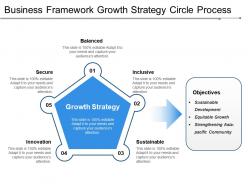
Business framework growth strategy circle process





Try Before you Buy Download Free Sample Product
 Impress Your
 Audience
 100%
100% Editable
 Save Hours
 of Time


Discover an attractive interplay of colors with our Business Framework Growth Strategy Circle Process. Create the exact composite image you imagined..
People who downloaded this PowerPoint presentation also viewed the following :
Business framework growth strategy circle process with all 5 slides:
Add to the effect of your thoughts with our Business Framework Growth Strategy Circle Process. You will come up with great anecdotes.




FAQs for Business framework growth
**INPUT**: What are the key components of an effective growth strategy framework? **OUTPUT**: Key components include market analysis, customer segmentation, competitive positioning, revenue diversification, and scalable operational systems. These strategic elements work together by identifying growth opportunities, optimizing resource allocation, and establishing sustainable competitive advantages, with many organizations finding that integrated frameworks ultimately deliver accelerated expansion and enhanced market penetration. *[Word count: 50]*
Companies identify ideal growth opportunities by analyzing market gaps, customer pain points, competitive weaknesses, emerging trends, and underserved segments through comprehensive market research and data analysis. These strategic assessments enable organizations to prioritize high-potential areas, allocate resources effectively, and develop targeted expansion plans, with many finding that combining customer feedback with competitive intelligence delivers the strongest growth outcomes.
Market research provides critical insights into customer needs, competitive landscapes, market opportunities, and emerging trends that directly inform strategic decision-making. Through comprehensive data analysis, businesses can identify underserved segments, validate expansion opportunities, and optimize resource allocation, with many organizations finding that research-driven strategies deliver significantly higher success rates and sustainable competitive advantages.
Competitive analysis and benchmarking inform growth strategies by identifying market gaps, revealing best practices, and highlighting differentiation opportunities across pricing, product features, and customer engagement approaches. Through systematic evaluation of competitor performance metrics, successful companies uncover strategic advantages in underserved segments, optimize resource allocation, and accelerate market positioning, ultimately delivering sustainable competitive advantage and enhanced market share.
Key growth strategy metrics include customer acquisition cost, lifetime value, revenue growth rate, market share expansion, and retention rates. These indicators enable organizations to assess strategic effectiveness by monitoring conversion improvements, resource allocation efficiency, and competitive positioning, with many companies finding that tracking both leading and lagging indicators delivers comprehensive performance insights and sustainable growth advantage.
Companies balance short-term gains with long-term objectives by implementing dual-horizon planning, strategic resource allocation, and performance metrics that track both immediate returns and future investments. Through portfolio diversification and phased implementation strategies, organizations in sectors like retail and manufacturing find that measured reinvestment of current profits into innovation and market expansion ultimately delivers sustainable competitive advantage.
Common pitfalls include inadequate market research, overextending resources, neglecting core business operations, misaligned team objectives, and insufficient performance metrics. While these challenges present significant risks, organizations increasingly find that strategic planning frameworks, phased implementation approaches, and continuous monitoring systems help mitigate such issues, ultimately delivering more sustainable growth and competitive advantage.
Customer feedback influences growth strategy frameworks by identifying market gaps, validating product-market fit, revealing customer pain points, and highlighting expansion opportunities. Through systematic feedback analysis, companies can prioritize high-impact initiatives, refine their value propositions, and align resource allocation with customer demands, ultimately delivering targeted solutions that accelerate sustainable growth and competitive advantage.
Strategies for sustainable growth in mature markets include market penetration through enhanced customer experiences, product diversification, strategic partnerships, digital transformation initiatives, and geographic expansion into underserved segments. These approaches enable organizations to revitalize existing offerings while discovering new revenue streams, with many retail and financial services companies finding that combining customer-centric innovation with operational efficiency delivers competitive advantage.
Digital transformation integrates into growth strategy by modernizing operations, enhancing customer experiences, and enabling data-driven decision making across all business functions. Through cloud technologies, automation, and analytics platforms, companies streamline processes, reduce operational costs, and accelerate market responsiveness, with many organizations finding that strategic digital initiatives ultimately deliver competitive advantages and sustainable scalability.
Scalability significantly influences growth strategy design by determining resource allocation, operational processes, technology infrastructure, and market expansion approaches. These considerations enable organizations to build sustainable frameworks that accommodate rapid growth without compromising quality, with many companies finding that scalable strategies deliver enhanced efficiency, reduced per-unit costs, and competitive advantage in dynamic markets.
Stakeholder engagement is critical for growth strategy success, as it ensures alignment, secures necessary resources, and builds organizational commitment across all levels. Effective engagement with employees, customers, investors, and partners creates unified execution momentum, minimizes resistance to change, and leverages diverse expertise, with many organizations finding that inclusive stakeholder involvement accelerates implementation and delivers sustainable competitive advantage.
Businesses can foster innovation through cross-functional collaboration, dedicated R&D investment, customer feedback integration, strategic partnerships, and employee idea programs. These approaches streamline product development by encouraging creative problem-solving, accelerating time-to-market, and enhancing customer experiences, with many organizations finding that structured innovation processes ultimately deliver competitive advantages and sustainable growth in increasingly dynamic markets.
Companies can leverage partnerships through strategic alliances, joint ventures, distribution agreements, technology collaborations, and market access partnerships that expand reach while sharing resources and risks. These relationships enable organizations to enter new markets faster, access complementary capabilities, and reduce operational costs, with many businesses finding that strategic partnerships accelerate growth trajectories significantly.
Corporate culture serves as the foundation for growth strategy success by shaping employee mindset, decision-making processes, and organizational adaptability to change. A culture that embraces innovation, calculated risk-taking, and continuous learning enables companies to execute growth initiatives more effectively, with many organizations finding that cultural alignment ultimately determines whether ambitious growth frameworks translate into sustainable competitive advantage and market expansion.
-
Innovative and Colorful designs.
-
Use of icon with content is very relateable, informative and appealing.