


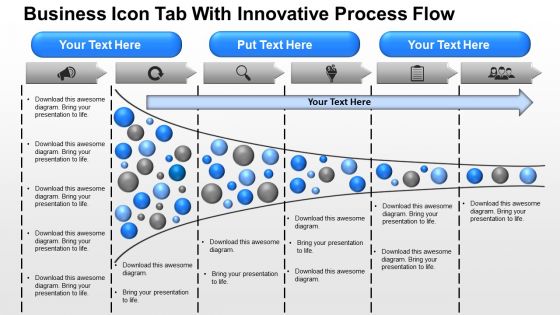
Business icon tab with innovative process flow powerpoint template slide




Try Before you Buy Download Free Sample Product
 Impress Your
 Audience
 100%
100% Editable
 Save Hours
 of Time


Use this business icon tab with innovative process flow PowerPoint template slides to enhance your business PPT in your firm. The process flow in a firm can be displayed innovatively with the help of this business innovative process flow by the various paths present to choose from this PPT. The process flow presentation is important in a business marketing strategy to implement it successfully and effectively as a clear path is conspicuous to the user. The icons in this slideshow are indicative of the process flow and can be used for pitching your ideas convincingly. The direction of the flow in this template is important as it determines the path a process has to undergo. The path shown to be followed for a process in this PowerPoint presentation is important to determine the direction of a business project in your firm. This PPT template is important to develop your business cycle. Our Business Icon Tab With Innovative Process Flow Powerpoint Template Slide are at your beck and call. They will come to your aid instantly.
People who downloaded this PowerPoint presentation also viewed the following :
Business icon tab with innovative process flow powerpoint template slide with all 4 slides:
Explode into activity with our Business Icon Tab With Innovative Process Flow Powerpoint Template Slide. You will feel a gush of energy.

FAQs for Business icon tab with innovative process flow
Key components of an effective business process flow template include clearly defined start and end points, sequential process steps, decision points with branching logic, responsible roles or departments, and measurable outcomes. These elements streamline workflow documentation by providing visual clarity, ensuring accountability, and enabling process optimization, with many organizations finding that standardized templates reduce training time and improve operational consistency.
A business process flow template improves operational efficiency by standardizing workflows, eliminating redundancies, and providing clear task sequences that reduce confusion and delays. Through visual mapping, organizations streamline communication, accelerate training processes, and identify bottlenecks more effectively, with many manufacturing and service companies finding that structured templates ultimately deliver faster project completion and reduced operational costs.
Manufacturing, healthcare, financial services, retail, and logistics benefit significantly from business process flow templates due to their complex, regulated operations requiring standardization and efficiency. These industries leverage templates to streamline workflows, ensure compliance, reduce operational costs, and enhance customer service delivery, with many organizations finding that structured processes ultimately deliver competitive advantages and scalable growth opportunities.
Visual representation in business process flow templates significantly enhances stakeholder understanding by transforming complex workflows into clear, intuitive diagrams that highlight dependencies, decision points, and bottlenecks. Through standardized symbols and logical sequencing, stakeholders across departments can quickly identify inefficiencies, understand their roles within broader processes, and collaborate more effectively on improvements, ultimately delivering faster decision-making and streamlined operations.
Popular software tools for creating business process flow templates include Microsoft Visio, Lucidchart, Draw.io, Bizagi, and process-specific platforms like Nintex and ProcessMaker. These platforms streamline documentation and analysis by offering drag-and-drop functionality, collaboration features, and integration capabilities, with many organizations finding that cloud-based solutions enhance team coordination and enable real-time process optimization across departments.
A business process flow template facilitates better communication by providing shared visual language, standardizing workflows across departments, and eliminating ambiguity in task handoffs. Through clear process mapping, teams streamline collaboration, reduce miscommunication errors, and enhance operational transparency, with many organizations finding that standardized templates ultimately deliver faster project completion and improved cross-functional coordination.
User-friendly business process flow templates require clear visual hierarchy, standardized symbols, logical sequencing, and minimal text clutter to ensure immediate comprehension. These design principles streamline workflow documentation by enhancing readability, reducing training time, and facilitating cross-departmental collaboration, with many organizations finding that intuitive templates accelerate process adoption and minimize implementation errors.
Business process flow templates support project management by providing standardized frameworks for task sequencing, resource allocation, milestone tracking, and stakeholder coordination across complex initiatives. These templates enable project managers to streamline planning phases, enhance team collaboration, and minimize execution risks, with many organizations finding that structured workflows ultimately deliver faster project completion and improved resource efficiency.
Yes, business process flow templates are highly customizable through modular components, configurable workflows, role-based permissions, and industry-specific adaptations that align with organizational structures and objectives. These templates enable companies to modify decision points, automate approval sequences, and integrate existing systems, with many organizations finding that customized workflows streamline operations, reduce processing times, and enhance compliance across departments.
Business process flow templates enable tracking of cycle time, throughput rates, error frequencies, resource utilization, and cost per transaction across operational workflows. These metrics help organizations identify bottlenecks, optimize resource allocation, and measure efficiency gains, with many companies finding that systematic tracking delivers measurable improvements in productivity and customer satisfaction.
Business process flow templates help identify bottlenecks by providing visual mapping of workflows, establishing standardized measurements, highlighting decision points, and enabling systematic analysis of task sequences and resource dependencies. Through these structured frameworks, organizations can pinpoint delays in manufacturing, approval processes, and customer service operations, while tracking performance metrics that reveal inefficiencies, ultimately streamlining operations and enhancing productivity.
Business process flow templates aid compliance by standardizing procedures, documenting audit trails, ensuring consistent regulatory steps, and embedding mandatory checkpoints throughout workflows. These templates enable organizations to maintain transparency, reduce compliance risks, and streamline regulatory reporting, with many financial services and healthcare institutions finding that structured processes significantly minimize audit findings while accelerating approval cycles.
Business process flow templates serve as foundational tools for continuous improvement by providing standardized frameworks for mapping current processes, identifying bottlenecks, and tracking enhancement opportunities. These templates enable organizations to systematically analyze workflows, measure performance metrics, and implement iterative improvements, with many manufacturing and service companies finding that structured process documentation accelerates their optimization efforts and delivers measurable operational efficiency gains.
Templates can be tailored for remote teams by incorporating digital collaboration tools, asynchronous communication checkpoints, virtual approval workflows, and cloud-based document sharing protocols. These adaptations enable distributed teams to maintain process consistency while accommodating flexible schedules and locations, with many organizations finding that structured remote workflows actually enhance transparency and accountability.
Organizations may face challenges including resistance to change from employees, inadequate training on new processes, poor template customization for specific workflows, and integration difficulties with existing systems. While these hurdles initially slow implementation, companies in manufacturing, healthcare, and financial services find that addressing these concerns through phased rollouts and comprehensive training ultimately delivers streamlined operations and enhanced efficiency.
-
Wonderful templates design to use in business meetings.
-
Excellent products for quick understanding.