


Business Process Automation KPI Dashboard Highlighting Automation Results In Supply Chain Management




Try Before you Buy Download Free Sample Product
 Impress Your
 Audience
 100%
100% Editable
 Save Hours
 of Time


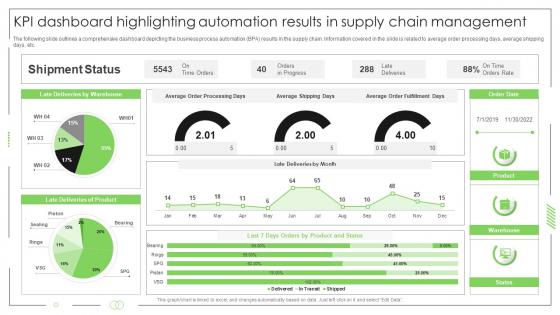
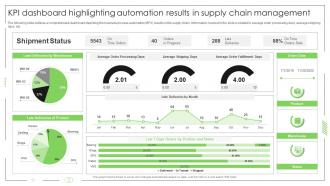
The following slide outlines a comprehensive dashboard depicting the business process automation BPA results in the supply chain.Information covered in the slide is related to average order processing days, average shipping days, etc.
People who downloaded this PowerPoint presentation also viewed the following :
Business Process Automation KPI Dashboard Highlighting Automation Results In Supply Chain Management with all 7 slides:
Use our Business Process Automation KPI Dashboard Highlighting Automation Results In Supply Chain Management to effectively help you save your valuable time. They are readymade to fit into any presentation structure.





FAQs for Business Process Automation KPI Dashboard Highlighting Automation Results In
Honestly, you're gonna love how much time it frees up - way less manual stuff to deal with. Your team stops making those silly human errors because everything runs the same way each time. Cost savings are real too. The best part though? People actually get to do interesting work instead of mindless data entry all day. I'd start with whatever takes your team the longest right now - those boring repetitive tasks are perfect for this. Your employees will probably thank you for it. Just pick one process and see how it goes.
Look for stuff that's super repetitive and rule-based first - data entry, processing invoices, generating reports. Basically anything that follows identical steps every time. Your team probably complains about certain tasks more than others, so start there honestly. I'd skip the creative work initially since automation usually bombs on that front. Map out your workflows and spot where people are doing boring manual stuff that takes forever. Oh, and definitely ask your team what makes them want to scream - those tedious tasks are goldmines for automation.
Look, tech is what makes automation actually happen - otherwise you're just daydreaming. AI and machine learning do the heavy thinking. APIs connect your systems so data moves around without breaking everything (which honestly happens more than it should). RPA handles those mind-numbing repetitive tasks nobody wants to do. Cloud stuff gives you room to grow and change things up later. My advice? Find whatever manual process is eating up most of your time and figure out what tech could fix it first. That's your starting point.
Look, automation just gets rid of all the soul-crushing busy work your team hates anyway. No more endless data entry or hunting down approvals through a million emails. Your people can actually work on interesting stuff - strategy, creative projects, real problem-solving. Trust me, nobody's complaining about less copy-pasting spreadsheets all day. When boring workflows run themselves, employees feel way more valuable since they're doing meaningful work. Honestly? Just pick your most annoying manual tasks first and automate those. You'll see the difference pretty quick.
Honestly, most companies mess this up because they go too big too fast. People will resist it - nobody likes their routine getting flipped upside down. Your existing systems probably won't play nice together either, which gets expensive quick. I'd say pick something super straightforward to automate first, not some crazy complex workflow. Oh, and if your data's a mess going in, you're screwed from the start. Half the time teams don't even know how to maintain these systems once they're running. Get your people on board early and budget way more than you think for training. Trust me on that last part.
Honestly, it's pretty simple math - just compare what you spent versus what you're saving. Track your baseline metrics first (super important step people skip). Implementation costs, training, tech expenses go on one side. Labor savings, fewer screwups, faster turnaround times on the other. The time thing is probably where you'll see the biggest wins since your team can actually do meaningful work instead of mind-numbing repetitive stuff. Some benefits are trickier to pin down though - like happier customers or staying compliant. But yeah, get those before/after numbers locked down.
Honestly, the biggest mistake is trying to automate stuff that's already broken - fix your process first or you're just making a faster mess. People hate when you spring this on them, so get your team involved early. I learned this the hard way lol. Don't go crazy with some massive rollout either. Start small with one simple thing. Also, you can't just set it up and walk away - automation breaks in weird ways you'd never expect. Change management is huge because nobody wants robots doing their job. Test everything like three times, build in good error handling, and honestly? Expect some pushback initially.
Honestly, automating your business processes is such a win for customer experience. Your customers get way faster responses when stuff like order processing and support tickets happen automatically. No more "oops, we dropped the ball on that one" moments. Plus everyone gets treated the same way - not depending on whether Sarah or Mike handles their case (and we both know Mike can be... inconsistent). Your team stops wasting time on boring data entry and can actually tackle the tricky stuff that matters. I'd start by looking at where customers usually interact with you and figure out what's creating bottlenecks.
Depends what you're trying to automate, but I'd start with Zapier - connects apps without any coding headaches. Microsoft Power Automate's solid if you're already using their stuff. UiPath handles the really complex automation tasks. Zapier's honestly been a game changer for me, saves like 10 hours weekly once you get hooked on it. For documents, DocuSign and Adobe Sign work well. Oh, and if you need something more custom, Bubble or Airtable are pretty flexible. My advice? Pick one annoying repetitive task first and automate just that. Don't go crazy trying to automate everything at once.
Security can't be an afterthought with automation - you gotta bake it in from the start. Set up role-based access so only the right people can mess with sensitive stuff. Encrypt everything, both when it's moving around and sitting still. Log all your automated processes too, trust me on this one. I've watched companies get burned by auditors because they skipped the boring compliance stuff early on. Oh, and don't forget to regularly check who has access to what - people change roles, leave, whatever. Basically treat your automation like any other system that touches important data.
So basically AI is gonna move way beyond those basic if-then rules we're used to. Machine learning will actually understand context and predict what should happen next - adapting stuff in real-time as conditions change. It's honestly getting crazy sophisticated. Your processes will optimize themselves and catch problems before they even happen. Some will suggest completely new workflows you never thought of. Way less "robot following commands" and more like having a business partner that actually learns. I'd mess around with AI tools now though. Better than playing catch-up later when everyone's already using this stuff.
So here's the thing - automation just clears out all that mindless busy work your team's drowning in. Data entry, repetitive workflows, all that stuff. Once that's gone, people actually have headspace for the creative problem-solving that matters. You'll also get way better visibility into your data, which honestly makes spotting new opportunities so much easier. I always tell people to start with whatever eats up the most time each week. It's crazy how fast teams pivot to thinking bigger once they're not buried in routine tasks. Like finally having a clean workspace where you can actually spread out and think.
Finance and healthcare are crushing it right now with automation. Invoice processing, compliance stuff - finance teams have cut out so much boring manual work it's actually crazy. Healthcare's doing patient scheduling and claims processing. Manufacturing companies are all over supply chain automation, and retail is huge on inventory management plus customer service workflows. Though honestly, customer service bots still kinda suck sometimes. Start with whatever repetitive tasks are driving you nuts - those rule-based things you do over and over. That's where you'll see results fastest.
Build flexibility in from the start - trust me on this. Make your processes modular so you can tweak one part without everything falling apart. Don't hard-code rules; use configurable parameters instead. That way when things change (and they will), you can adjust thresholds and triggers easily. Here's what I wish someone told me: don't automate everything at once. Leave manual checkpoints where people can jump in if something goes sideways. Schedule monthly reviews to see what's actually working. Your automation should grow with your business, not trap you in some rigid system that made sense two years ago.
Oh man, training is huge - probably the thing most companies totally botch. Start way earlier than you think and make it super hands-on. Your people need to get why you're doing this, not just the mechanics of clicking buttons. I've watched entire rollouts fail because someone thought a quick demo would cut it. Show them how their jobs will get better, not scarier. Honestly, budget like double the training time you originally planned. And for the love of all that's holy, don't let anyone think they're getting replaced. You'll just end up with people finding sneaky ways around your shiny new system.
-
You guys are life-saver when it comes to presentations. Honestly I cannot do much without your services. Thank you!!!
-
The information is visually stunning and easy to understand, making it perfect for any business person. So I would highly recommend you purchase this PPT design now!