

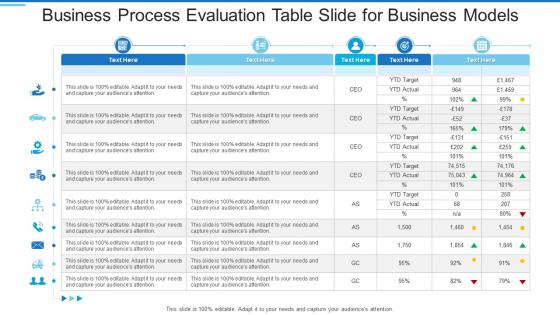
Business process evaluation table slide for business models infographic template




Try Before you Buy Download Free Sample Product
 Impress Your
 Audience
 100%
100% Editable
 Save Hours
 of Time


Derive factual results using this Business Process Evaluation Table Slide For Business Models Infographic Template. Deploy this PowerPoint template to make and display prospective strategies using impressive graphics that enhance the visual quotient of the presentation. This infographic template also helps in elevating the aesthetic appeal of the presentation, making it useful for every organization. Apart from this, things and projects can be visualized from the onset using this PPT design. As this PowerPoint visual provides an abundance of information in a single layout, it can impress any viewer or higher managerial staff. It also boosts business actions by presenting flawless presentations. The biggest advantage of this slide is that it can be reproduced in various formats, including Google Slides. Therefore, download it now to present a unique presentation every time.
People who downloaded this PowerPoint presentation also viewed the following :
Business process evaluation table slide for business models infographic template with all 9 slides:
Use our Business Process Evaluation Table Slide For Business Models Infographic Template to effectively help you save your valuable time. They are readymade to fit into any presentation structure.








FAQs for Business process evaluation table slide for business
Common KPIs in business process evaluation include cycle time, throughput rates, error rates, cost per transaction, customer satisfaction scores, and resource utilization percentages. These metrics enable organizations to streamline operations, identify bottlenecks, and enhance efficiency, with many financial services and manufacturing companies finding that strategic KPI monitoring delivers significant cost reductions and improved customer experiences.
Technology enhances business process evaluation through automated data collection, real-time analytics, process mining software, AI-powered insights, and digital dashboards that provide comprehensive visibility. These tools streamline assessment workflows by identifying bottlenecks, measuring performance metrics, and predicting optimization opportunities, with organizations across manufacturing, healthcare, and financial services finding significantly faster evaluation cycles and more accurate process improvement recommendations.
Common pitfalls include insufficient stakeholder involvement, focusing solely on symptoms rather than root causes, lack of clear evaluation criteria, resistance to change, and inadequate data collection methods. These challenges often result in incomplete assessments and failed implementations, with many organizations finding that comprehensive stakeholder engagement and systematic data analysis ultimately deliver more accurate insights and sustainable process improvements.
Balancing qualitative and quantitative data in business process evaluation involves combining metrics like cycle times, costs, and error rates with employee feedback, customer satisfaction insights, and stakeholder perspectives. This strategic combination enables organizations to identify both measurable inefficiencies and underlying cultural or operational issues, ultimately delivering comprehensive process improvements and enhanced organizational performance.
Stakeholder feedback provides critical insights into process effectiveness, identifying pain points, inefficiencies, and improvement opportunities that may not be visible through data alone. This input enables organizations to prioritize process enhancements based on real user experiences, ultimately delivering more streamlined workflows, increased adoption rates, and better alignment with business objectives across departments.
Businesses should conduct comprehensive process evaluations annually, with quarterly reviews for critical operations and monthly assessments for rapidly evolving areas like customer service or technology integration. Many organizations find that this strategic combination of regular touchpoints enables faster adaptation, improved operational efficiency, and sustained competitive advantage in increasingly dynamic markets.
Effective methodologies include process mapping, value stream analysis, root cause analysis, benchmarking studies, and stakeholder interviews. These approaches streamline evaluation by identifying bottlenecks, measuring performance gaps, and documenting current workflows, with many organizations finding that combining multiple methodologies delivers comprehensive insights and accelerates process optimization initiatives.
Businesses ensure continuous improvement by establishing regular review cycles, implementing feedback mechanisms, setting measurable performance indicators, and creating accountability structures for recommended changes. Through systematic monitoring and iterative adjustments, organizations can track progress against evaluation findings, adapt strategies based on real-world outcomes, and maintain momentum for operational excellence, ultimately delivering sustained competitive advantage.
Signs that indicate a business process needs evaluation include frequent errors, increasing customer complaints, rising operational costs, missed deadlines, and declining employee satisfaction. These indicators often surface when workflows become outdated or inefficient, with many organizations finding that regular process assessment helps identify bottlenecks early, ultimately streamlining operations and maintaining competitive advantage.
Organizational culture significantly influences business process evaluation by shaping employee participation levels, resistance to change, and openness to feedback during assessments. Companies with collaborative cultures often experience more thorough evaluations, streamlined implementation of improvements, and enhanced cross-departmental cooperation, while hierarchical environments may face communication barriers, ultimately affecting the accuracy and effectiveness of process optimization initiatives.
Effective business process evaluation identifies cost-saving opportunities through eliminating redundant activities, automating manual tasks, optimizing resource allocation, and streamlining workflows. Manufacturing companies reduce operational costs by 20-30%, while financial services minimize processing times and labor expenses, ultimately delivering enhanced efficiency and competitive advantage in increasingly cost-conscious markets.
Businesses measure evaluation ROI by comparing implementation costs against quantifiable benefits like reduced operational expenses, faster cycle times, improved quality metrics, and enhanced customer satisfaction scores. Through systematic tracking of pre- and post-evaluation performance indicators, organizations typically find cost savings of 15-30% and productivity gains that significantly outweigh initial assessment investments, ultimately delivering sustainable competitive advantages.
Cross-departmental collaboration enhances business process evaluation by combining diverse expertise, eliminating departmental blind spots, and revealing interdependency issues that single departments miss. When teams from operations, finance, IT, and customer service work together, organizations identify bottlenecks more comprehensively, streamline workflows more effectively, and ultimately deliver faster decision-making and improved operational efficiency.
Employee training significantly enhances business process evaluation outcomes by improving data accuracy, increasing staff engagement with evaluation processes, and ensuring consistent methodology application across departments. Well-trained employees provide more reliable feedback, identify process inefficiencies more effectively, and implement recommended changes more successfully, with many organizations finding that comprehensive training programs ultimately deliver faster evaluation cycles and more actionable insights.
Benchmarking business processes against industry standards is crucial for identifying performance gaps, establishing competitive positioning, and driving operational improvements across organizations. It enables companies to discover best practices, optimize resource allocation, and enhance efficiency, with many businesses finding that systematic benchmarking delivers measurable cost reductions and accelerated growth in increasingly competitive markets.
-
The content is very helpful from business point of view.