


Business Strategy Execution And Planning Map




Try Before you Buy Download Free Sample Product
 Impress Your
 Audience
 100%
100% Editable
 Save Hours
 of Time


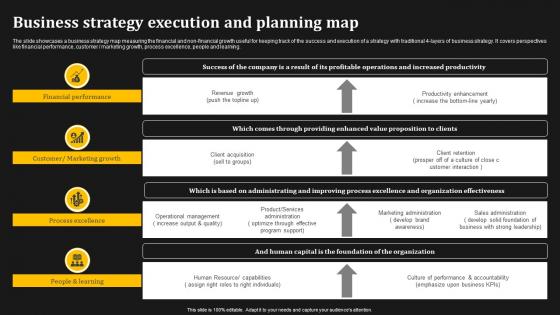
The slide showcases a business strategy map measuring the financial and non financial growth useful for keeping track of the success and execution of a strategy with traditional 4 layers of business strategy. It covers perspectives like financial performance, customer marketing growth, process excellence, people and learning.
People who downloaded this PowerPoint presentation also viewed the following :
Business Strategy Execution And Planning Map with all 6 slides:
Use our Business Strategy Execution And Planning Map to effectively help you save your valuable time. They are readymade to fit into any presentation structure.





FAQs for Business Strategy Execution
Effective business strategies include clear vision and mission statements, comprehensive market analysis, competitive positioning, resource allocation frameworks, and measurable performance metrics. These components work together by aligning organizational goals with market opportunities, optimizing operational efficiency, and establishing sustainable competitive advantages, with many companies finding that strategic integration ultimately delivers enhanced profitability and long-term growth.
Businesses can assess their competitive landscape through market research, competitor analysis, SWOT assessments, customer feedback analysis, and industry trend monitoring. These strategic evaluation methods enable organizations to identify market gaps, benchmark performance against rivals, and understand customer preferences, with many companies finding that comprehensive competitive intelligence ultimately delivers stronger positioning, informed decision-making, and sustainable competitive advantages.
Market research provides critical insights into customer needs, competitive landscapes, industry trends, and market opportunities that directly inform strategic decision-making. Through comprehensive data analysis, businesses can identify untapped segments, validate product concepts, and optimize resource allocation, with many organizations finding that research-driven strategies deliver higher success rates, reduced risks, and sustainable competitive advantages in increasingly dynamic markets.
Companies balance short-term wins with long-term strategic goals by establishing clear milestone frameworks, aligning quarterly targets with strategic objectives, and maintaining flexible resource allocation strategies. Through strategic prioritization, organizations achieve immediate revenue gains while investing in innovation, talent development, and market expansion, with many finding that integrated planning approaches ultimately deliver sustainable competitive advantage and consistent growth trajectories.
Businesses can foster innovation through diverse team composition, dedicated innovation time, cross-departmental collaboration, risk-tolerant cultures, and structured brainstorming processes. These strategies enhance creativity by encouraging experimentation, minimizing hierarchical barriers, and providing psychological safety for new ideas, with many organizations finding that combining structured frameworks with flexible environments ultimately delivers breakthrough solutions and competitive advantages.
Understanding customer personas influences strategic decision-making by enabling targeted product development, personalized marketing approaches, and optimized resource allocation across customer segments. Through detailed persona insights, organizations streamline their service offerings, enhance customer experiences, and prioritize strategic initiatives, with many companies finding that persona-driven strategies deliver higher conversion rates and ultimately stronger competitive positioning.
Common pitfalls include failing to conduct thorough market analysis, setting unrealistic goals, ignoring competitive positioning, lacking clear implementation roadmaps, and insufficient stakeholder alignment. These missteps often derail strategic initiatives by creating resource misallocation, missed opportunities, and execution gaps, with many organizations finding that comprehensive planning and regular strategy reviews ultimately deliver sustainable competitive advantage and measurable growth outcomes.
Businesses leverage data analytics to refine strategic direction by analyzing customer behavior patterns, market trends, operational performance metrics, and competitive positioning data. Through predictive modeling and real-time dashboards, organizations identify growth opportunities, optimize resource allocation, and anticipate market shifts, with many companies finding that data-driven strategies deliver 15-20% better performance outcomes.
Strong company culture enhances strategy execution by aligning employee behaviors with strategic goals, improving communication across departments, and fostering innovation through shared values and purpose. Organizations with cohesive cultures experience faster decision-making, better resource allocation, and higher employee engagement, with many companies finding that cultural alignment ultimately delivers competitive advantage and sustainable performance improvements.
Organizations should track financial metrics like revenue growth and ROI, operational indicators such as market share and customer acquisition costs, performance measures including employee engagement and process efficiency, and strategic objectives like innovation rates and competitive positioning. These comprehensive metrics enable businesses to assess strategy effectiveness across multiple dimensions, with many companies finding that balanced scorecards combining financial, customer, operational, and learning perspectives ultimately deliver clearer insights and more informed strategic decisions.
Businesses can adapt their strategies by conducting regular market analysis, diversifying revenue streams, embracing digital transformation, maintaining flexible operational structures, and investing in customer feedback systems. Through agile planning and strategic pivoting, organizations in sectors like retail, healthcare, and financial services enhance responsiveness to market shifts, ultimately delivering sustained competitive advantage and improved resilience.
Globalization requires local businesses to balance global market opportunities with regional customization, competitive pressures from international players, and supply chain complexities. While it presents challenges through increased competition, it also enables access to broader markets, diverse talent pools, and cost-effective resources, with many companies finding that strategic adaptation ultimately delivers competitive advantage and sustainable growth.
Sustainability integrates into business strategy through environmental goals alignment, sustainable supply chain management, circular economy practices, stakeholder engagement initiatives, and measurable impact reporting. Companies like Patagonia and Unilever demonstrate that embedding sustainability across operations, product development, and corporate governance delivers competitive differentiation, cost efficiencies, and enhanced brand loyalty while meeting increasingly conscious consumer expectations.
Stakeholder engagement ensures business strategies align with diverse perspectives, market realities, and operational constraints while building essential buy-in for implementation success. Through collaborative input from employees, customers, investors, and partners, organizations develop more comprehensive strategies, minimize resistance during execution, and enhance long-term sustainability, with many companies finding that engaged stakeholders become powerful advocates for strategic initiatives.
Businesses can align strategy with emerging trends by conducting regular technology assessments, investing in pilot programs, fostering innovation partnerships, and developing adaptive organizational capabilities. Companies in sectors like retail and healthcare increasingly integrate AI and automation into core operations, while maintaining flexibility to pivot quickly, ultimately delivering enhanced customer experiences and sustainable competitive advantages.
-
The PPT layout is great and it has an effective design that helps in presenting corporate presentations. It's easy to edit and the stunning visuals make it an absolute steal!
-
“You have the structure in place that are easy to explore new opportunities.I will be recommending your services to other people.”