


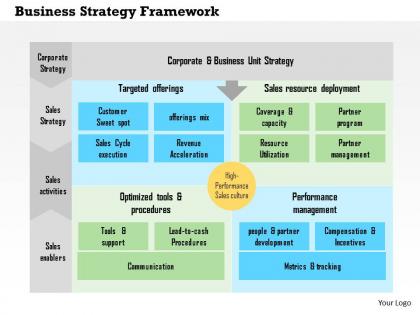
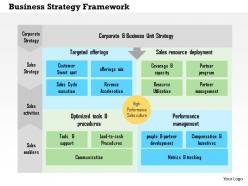
Business strategy framework flat powerpoint design




Try Before you Buy Download Free Sample Product
 Impress Your
 Audience
 100%
100% Editable
 Save Hours
 of Time


Tap the ingenuity of our Business Strategy Framework Flat Powerpoint Design. They are programmed to succeed.
People who downloaded this PowerPoint presentation also viewed the following :
Business strategy framework flat powerpoint design with all 5 slides:
Our Business Strategy Framework Flat Powerpoint Design make the audience forgiving. They will overlook minor errors.



FAQs for Business strategy framework
Effective business strategy frameworks include vision and mission alignment, competitive analysis, market positioning, resource allocation, and performance metrics. These components work together by defining clear objectives, identifying competitive advantages, and establishing measurable outcomes, with many organizations finding that integrated frameworks streamline decision-making while delivering sustainable growth and operational efficiency.
Startup frameworks prioritize agility, rapid iteration, and resource optimization with lean methodologies and pivoting capabilities, while established companies focus on market consolidation, operational efficiency, and leveraging existing assets. Startups typically emphasize customer discovery and product-market fit, whereas mature organizations concentrate on competitive positioning, diversification strategies, and sustained growth, ultimately requiring different approaches to risk management and strategic planning.
Market analysis provides essential foundation data for strategic planning by identifying customer needs, competitive landscapes, industry trends, regulatory environments, and growth opportunities. Through comprehensive market research, organizations can better allocate resources, minimize risks, and develop targeted approaches that deliver sustainable competitive advantage, with many companies finding that thorough analysis significantly improves strategic decision-making outcomes.
Companies ensure alignment between business strategy and operational plans by establishing clear communication channels, implementing regular review cycles, setting measurable KPIs that connect strategic goals to daily operations, and creating cross-functional teams. These approaches streamline decision-making by fostering transparency, enabling real-time adjustments, and ensuring resources support strategic priorities, with many organizations finding that structured alignment processes ultimately deliver faster execution and sustained competitive advantage.
Essential tools include SWOT analysis, Porter's Five Forces, balanced scorecards, scenario planning, and competitive benchmarking methodologies. These frameworks enhance strategic decision-making by identifying market opportunities, assessing competitive positioning, and measuring performance outcomes, with many organizations finding that combining multiple methodologies delivers comprehensive insights and sustainable competitive advantage.
A business strategy framework adapts to rapidly changing market conditions through continuous market monitoring, flexible resource allocation, scenario planning, and agile decision-making processes. These frameworks enable organizations to pivot quickly when disruptions occur, reallocate investments based on emerging opportunities, and maintain competitive advantage, with many companies finding that adaptable frameworks reduce response time and enhance long-term resilience.
Common pitfalls include lack of stakeholder buy-in, insufficient communication across teams, unrealistic timelines, inadequate resource allocation, and failure to adapt to market changes. These challenges often derail implementation in organizations ranging from startups to Fortune 500 companies, with many finding that successful frameworks require continuous monitoring, flexible execution, and strong leadership commitment to deliver sustainable competitive advantage.
Companies incorporate stakeholder feedback through structured engagement mechanisms like surveys, focus groups, advisory boards, and regular consultations with customers, employees, investors, and partners. This strategic integration enables organizations to identify market gaps, refine value propositions, and align operational priorities with stakeholder expectations, ultimately delivering enhanced customer satisfaction and sustainable competitive advantage.
Key metrics include revenue growth, market share expansion, operational efficiency ratios, customer acquisition costs, return on investment, and strategic goal achievement rates. These indicators enable organizations to assess framework performance across financial, operational, and competitive dimensions, with many companies finding that balanced scorecards combining quantitative and qualitative measures deliver comprehensive insights into strategic effectiveness and long-term sustainability.
Technology and data analytics enhance business strategy frameworks by providing real-time market insights, predictive modeling capabilities, automated performance tracking, and evidence-based decision-making tools. These technologies streamline strategic planning by identifying emerging opportunities, optimizing resource allocation, and measuring outcomes continuously, with many organizations finding that data-driven frameworks deliver faster pivots and sustainable competitive advantages.
A business strategy framework facilitates innovation by establishing clear innovation priorities, allocating resources systematically, creating structured experimentation processes, and defining measurable innovation metrics. Through strategic frameworks, organizations streamline idea evaluation, accelerate product development cycles, and minimize innovation risks, with many technology companies and manufacturers finding that structured approaches ultimately deliver faster time-to-market and sustainable competitive advantage.
Cultural factors influence business strategy frameworks by shaping communication styles, decision-making processes, risk tolerance, and stakeholder expectations across different markets and organizational contexts. These frameworks must account for local business practices, regulatory environments, and customer behaviors, with many multinational organizations finding that culturally-adaptive strategies deliver better market penetration and sustainable competitive advantage.
Competitive advantage serves as the cornerstone of effective business strategy frameworks, guiding resource allocation, market positioning, and operational priorities to create sustainable differentiation. It enables organizations to identify their unique value propositions, streamline decision-making processes, and develop strategic initiatives that deliver superior customer experiences, operational efficiency, and market share growth.
Scenario planning integrates into business strategy frameworks by developing multiple future scenarios, assessing potential impacts on strategic objectives, and creating flexible response strategies for each possibility. Organizations use this approach to stress-test their strategic plans, identify vulnerabilities and opportunities, and build adaptive capabilities, ultimately enabling more resilient decision-making in uncertain market conditions.
**INPUT**: What are the best practices for communicating a business strategy framework across an organization? **OUTPUT**: Best practices include cascading communication through leadership tiers, visual presentations with clear frameworks, regular town halls, departmental workshops, and consistent messaging across all channels. These approaches enhance organizational alignment by creating shared understanding, reinforcing strategic priorities, and enabling teams to connect daily operations with broader objectives, ultimately delivering improved execution and competitive advantage.
-
It saves your time and decrease your efforts in half.
-
Unique design & color.