


Business Work Plan Proposal Powerpoint Presentation Slides




Try Before you Buy Download Free Sample Product
 Impress Your
 Audience
 100%
100% Editable
 Save Hours
 of Time


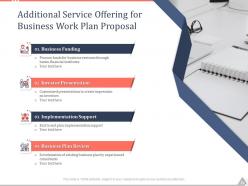
The competition has been increasing day by day and so as the new approaches. Entrepreneurs from all over the world keep on applying new methodologies to skyrocket their business. Some of them boost the performance of the workplace and some lessen their productivity. To be more progressive, organizations take the assistance of various service providers. Companies can easily choose their dealers through the best proposals. Providers can create astounding proposals and reach out to their potential clients by using our Business Work Plan Proposal PowerPoint Presentation Slides. Design an impressive cover-letter and hold the attention of the clients with the help of our corporate work strategy proposal PPT theme. Take the help of this intuitively designed proposal template to highlight the advanced services you want to deliver your investors. Keep the information in your proposal clear and concise which is easily understandable by the readers. Include a myriad of topics in this attractive business work plan PPT theme that explains the factors that nurture your clients’ organizations. The slide consists of a table of contents like project context, company overview, project process, statement of work and contract, etc. With the aid of this engaging work plan proposal PowerPoint templates, you can showcase your plan of action for the foreseeable future of clients’ organizations. Provide your client with a clear snapshot of the timeframe your company will take to execute the clients’ project. Included in this slide are various designs and font styles that create a modern effect on your proposal. Employ this interesting business work strategy proposal PowerPoint template to portray your advanced services such as business funding, investor presentation, implementation support, and business plan review. Talk about your numerous awards and certifications to engage more clients towards your impeccable services. Close deal with clients and create more customer base by downloading our eye-pleasing business work plan proposal PowerPoint presentation slides
People who downloaded this PowerPoint presentation also viewed the following :
Content of this Powerpoint Presentation
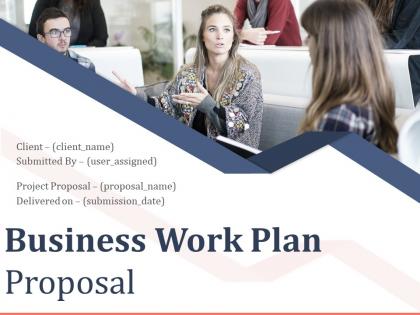
Slide 1: This slide introduces Business Work Plan Proposal. State Client name, User assigned, Submission date and begin.
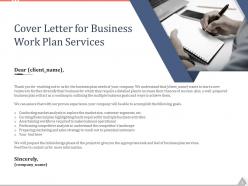
Slide 2: This slide displays Cover Letter for Business Work Plan Services.
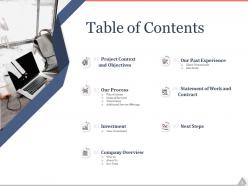
Slide 3: This slide displays Table of Contents
Slide 4: This slide depicts Table of Contents contaning- Project Context and Objectives
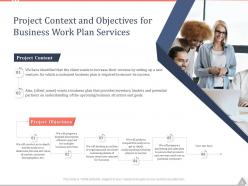
Slide 5: This slide describes Project Context and Objectives for Business Work Plan Services
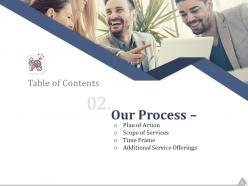
Slide 6: This slide shows Table of Contents with- Our Process, Plan of Action, Scope of Services, Time Frame, Additional Service Offerings.
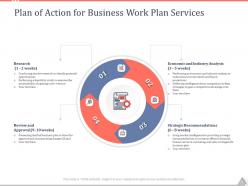
Slide 7: This slide represents Plan of Action for Business Work Plan Services
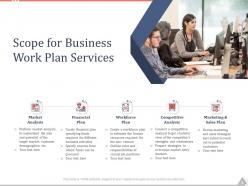
Slide 8: This slide showcases Scope for Business Work Plan Services contaning- Market Analysis, Financial Plan, Workforce Plan, Competitive Analysis, Marketing & Sales Plan.
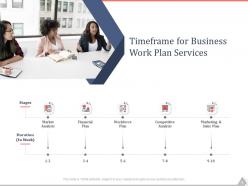
Slide 9: This slide represents Timeframe for Business Work Plan Services
Slide 10: This slide showcases Additional Service Offering for Business Work Plan Proposal.
Slide 11: This slide displays Table of Contents with- Your Investment
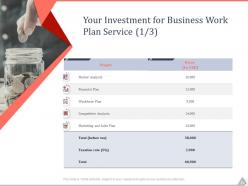
Slide 12: This slide depicts Investment details for Business Work Plan Service.
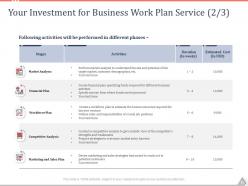
Slide 13: This slide showcases Investment details for Business Work Plan Service.
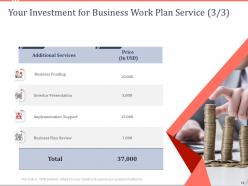
Slide 14: This slide also presents Investment details for Business Work Plan Service.
Slide 15: This slide displays Table of Contents with- Company Overview, Why Us, About Us, Our Team.
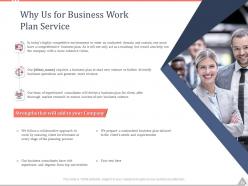
Slide 16: This slide shows the reasons for choosing Us for Business Work Plan Service
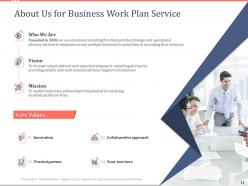
Slide 17: This is About Us slide with Vision, Mission and Core values of the company.
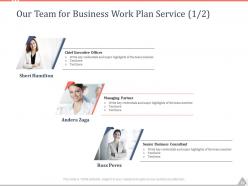
Slide 18: This is Our Team slide with Names and Designations.
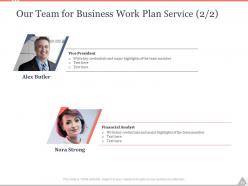
Slide 19: This is Our Team slide with Names and Designations.
Slide 20: This slide displays Table of Contents with- Client Testimonial Case Study Our Past Experience
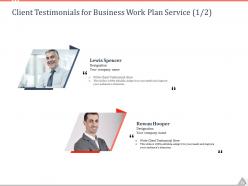
Slide 21: This slide displays Client Testimonials for Business Work Plan Service.
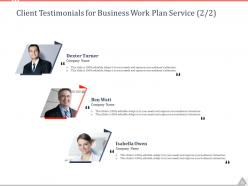
Slide 22: This slide shows Client Testimonials for Business Work Plan Service. Add Client Testimonials Here.
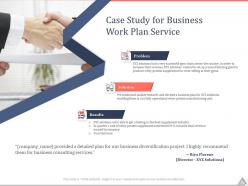
Slide 23: This slide displays Case Study for Business Work Plan Service
Slide 24: This slide displays Table of Contents with Statement of Work and Contact
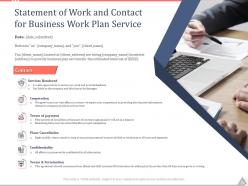
Slide 25: This slide showcases Statement of Work and Contact for Business Work Plan Service.
Slide 26: This slide showcases Table of Contents with- Next Step
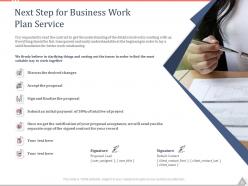
Slide 27: This slide showcases Next Step for Business Work Plan Service
Slide 28: This is Contact Us slide with Email Address, Contact number and Email address.
Slide 29: This is Icons Slide for Business Work Plan Proposal.
Slide 30: This slide is titled as Additional Slides for moving forward.
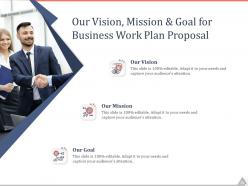
Slide 31: This slide displays Our Vision, Mission & Goal of the Company.
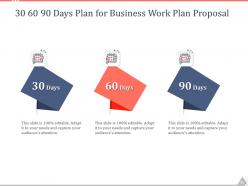
Slide 32: This is 30 60 90 Days Plan slide.
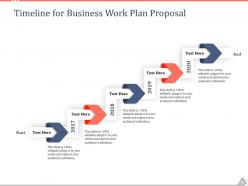
Slide 33: This slide displays Timeline process.
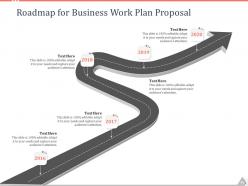
Slide 34: This slide showcases Timeline process.
Business Work Plan Proposal Powerpoint Presentation Slides with all 34 slides:
Use our Business Work Plan Proposal Powerpoint Presentation Slides to effectively help you save your valuable time. They are readymade to fit into any presentation structure.








FAQs for Business Work Plan Proposal
Key components of an effective business work plan include clear objectives, detailed task breakdowns, realistic timelines, resource allocation strategies, and measurable performance indicators. These elements work together by providing structured roadmaps, ensuring accountability across teams, and enabling systematic progress tracking, with many organizations finding that comprehensive planning ultimately delivers improved operational efficiency and strategic goal achievement.
A business work plan aligns with strategic objectives by translating high-level goals into specific tasks, timelines, and measurable outcomes, ensuring every activity directly contributes to broader organizational priorities. This strategic alignment enables teams to focus resources efficiently, track progress systematically, and adapt quickly to market changes, ultimately delivering improved operational performance and competitive advantage.
Market analysis forms the foundation of strategic planning by identifying target demographics, competitive landscapes, industry trends, and revenue opportunities within your business environment. This research enables organizations to allocate resources effectively, set realistic timelines, and develop competitive positioning strategies, with many businesses finding that comprehensive market insights significantly reduce operational risks while maximizing growth potential.
Small businesses can structure work plans more efficiently through streamlined decision-making processes, direct communication channels, flexible resource allocation, and simplified approval hierarchies. While larger organizations require complex coordination across departments, small businesses leverage their agility to pivot quickly, implement changes rapidly, and maintain closer customer relationships, ultimately delivering faster response times and more personalized solutions in an increasingly competitive marketplace.
Project management platforms like Asana, Monday.com, Trello, Microsoft Project, and Smartsheet excel at creating comprehensive business work plans through task scheduling, resource allocation, and progress tracking features. These tools streamline collaboration by enabling real-time updates, automated reporting, and milestone management, with many organizations finding that integrated dashboards ultimately deliver enhanced visibility and operational efficiency.
Business work plans should be reviewed quarterly for comprehensive assessment, with monthly check-ins for progress tracking and annual strategic overhauls for major pivots. This approach enables organizations to adapt to market changes, reallocate resources effectively, and maintain competitive positioning, with many companies finding that regular review cycles ultimately deliver improved operational efficiency and faster strategic responses.
Common pitfalls include setting unrealistic timelines, lacking specific measurable goals, insufficient resource allocation, poor stakeholder communication, and inadequate risk assessment. These oversights often lead to project delays, budget overruns, and team confusion, with many organizations finding that detailed planning phases and regular review checkpoints ultimately deliver better execution and sustainable results.
Stakeholder input enhances business work plan effectiveness by providing diverse perspectives, identifying potential risks, ensuring resource alignment, and improving buy-in across departments. Through collaborative planning sessions, organizations streamline implementation timelines, minimize resistance to change, and leverage specialized expertise from various teams, ultimately delivering more comprehensive strategies and higher success rates.
Business work plan metrics should include revenue growth, cost reduction percentages, project completion rates, customer satisfaction scores, employee productivity measures, and timeline adherence rates. These performance indicators enable organizations to track operational efficiency, financial health, and strategic progress, with many companies finding that combining quantitative metrics with qualitative assessments delivers comprehensive insights into plan effectiveness and competitive positioning.
A work plan focuses on tactical execution of specific projects or initiatives with detailed tasks, timelines, and resource allocation, while a business plan provides strategic vision, market analysis, financial projections, and long-term goals. Work plans enable teams to execute daily operations efficiently and track progress systematically, whereas business plans secure funding, guide strategic decisions, and communicate company direction to stakeholders, with both ultimately delivering organizational alignment and sustainable growth.
**INPUT**: What are best practices for communicating a business work plan to a team? **OUTPUT**: Best practices include clear objective articulation, regular progress updates, interactive feedback sessions, accessible documentation, and defined accountability measures. These approaches enhance team alignment by establishing transparent expectations, facilitating open communication channels, and creating structured review processes, with many organizations finding that consistent communication ultimately delivers improved project outcomes and stronger team engagement. [Word count: 54 words]
Businesses can incorporate flexibility by building buffer time into timelines, establishing contingency budgets, creating modular project phases, and implementing regular review checkpoints. Through agile planning methodologies, organizations enable rapid resource reallocation, pivot strategies when market conditions shift, and maintain operational continuity, with many companies finding that flexible frameworks ultimately deliver competitive advantage in increasingly dynamic business environments.
Successful business work plans include Starbucks' global expansion strategy, Amazon's diversification into cloud services, Tesla's vertical integration approach, and Netflix's streaming transformation initiative. These strategic frameworks enabled organizations to streamline operations, allocate resources effectively, and achieve measurable growth targets, with many companies finding that structured planning ultimately delivers competitive advantage and sustained market leadership.
Financial projections serve as the quantitative backbone of a comprehensive business work plan, translating strategic goals into measurable revenue forecasts, expense budgets, cash flow analysis, and profitability timelines. These projections enable organizations to validate business assumptions, secure funding from investors or lenders, and establish performance benchmarks, with many companies finding that detailed financial modeling ultimately delivers greater operational clarity and strategic decision-making capabilities.
Visual aids like templates and charts enhance business work plan clarity by standardizing information presentation, highlighting key milestones, simplifying complex workflows, and creating intuitive progress tracking systems. These tools streamline communication across teams by transforming dense text into digestible formats, with many organizations finding that visual elements reduce misinterpretation while accelerating decision-making and stakeholder alignment.
-
Informative design.
-
Topic best represented with attractive design.
-
Use of different colors is good. It's simple and attractive.
-
Informative design.