


17918328 style hierarchy flowchart 1 piece powerpoint presentation diagram infographic slide




Try Before you Buy Download Free Sample Product
 Impress Your
 Audience
 100%
100% Editable
 Save Hours
 of Time


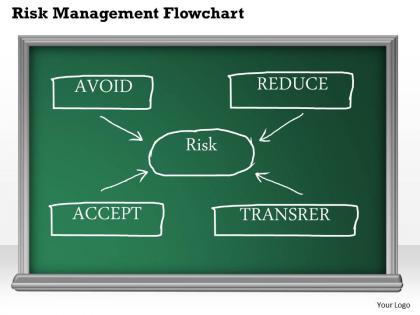
Organizations need to have directions in place to make sure they meet compliance requirements and minimize risk let’s review it with 0314 business PPT diagram risk management flowchart PowerPoint template. This presentation template put focus on the recognition and assessment of risk followed by best use of resources to observe and mitigate the same. This presentation layout designed to quantify the risk and forecast the effect of the risk on the project and the outcome of risk are generally based on the project manager’s acceptance level. Risks can be classified with this PPT theme at each stage of the business cycle, which includes eliminating a definite threat normally by removing the cause, reducing the reoccurrence and accepting the cost of the risk which is often accompanied by creating a contingency plan. By assessing, Identifying and developing a responsive plan to risk will not only reduce the reoccurrence of event but also the magnitude of its blow. Add to their growth with our 0314 Business Ppt Diagram Risk Management Flowchart Powerpoint Template. They will absorb your ideas better.
17918328 style hierarchy flowchart 1 piece powerpoint presentation diagram infographic slide with all 5 slides:
Our 0314 Business Ppt Diagram Risk Management Flowchart Powerpoint Template help you pinpoint your timelines. Highlight the reasons for your deadlines with their use.




FAQs for 17918328 style hierarchy flowchart 1 piece powerpoint presentation
Key components include risk identification, assessment and prioritization, mitigation strategies, monitoring systems, and contingency planning. These elements work together by establishing clear protocols, enabling proactive responses, and maintaining continuous oversight, with many organizations finding that this comprehensive approach significantly reduces operational disruptions while enhancing strategic decision-making and competitive resilience.
Organizations identify and assess potential risks through systematic risk registers, stakeholder workshops, historical data analysis, scenario planning, and expert consultations. These methodologies enable project teams to evaluate probability and impact matrices, conduct SWOT analyses, and implement continuous monitoring frameworks, with many financial services and manufacturing companies finding that proactive risk identification reduces project delays by 30% and enhances strategic decision-making capabilities.
Stakeholder communication serves as the foundation of effective risk management, ensuring transparency, alignment, and coordinated response across all organizational levels through regular updates, clear reporting structures, and collaborative decision-making frameworks. This strategic communication enables faster risk identification, more informed mitigation strategies, and enhanced organizational resilience, with many companies finding that proactive stakeholder engagement significantly reduces response times and improves overall risk outcomes.
Technology enhances risk management strategies by automating threat detection, providing real-time monitoring capabilities, and enabling predictive analytics for proactive decision-making. Through AI-powered systems and advanced data analytics, organizations streamline compliance processes, minimize operational vulnerabilities, and accelerate incident response times, with many financial institutions and healthcare providers finding that these technologies ultimately deliver enhanced security while reducing costs and improving regulatory adherence.
Qualitative risk assessment uses descriptive scales, expert judgment, and subjective analysis to evaluate risks, while quantitative techniques employ numerical data, statistical models, and mathematical calculations. Through qualitative methods, organizations streamline initial risk identification and stakeholder communication, whereas quantitative approaches deliver precise probability calculations and financial impact modeling, ultimately enabling strategic risk prioritization.
Businesses can prioritize risks by evaluating probability and impact severity, categorizing them into high, medium, and low priority levels based on potential financial losses and operational disruption. Organizations typically address critical risks first, such as cybersecurity threats in financial services or supply chain disruptions in manufacturing, while developing mitigation strategies that deliver maximum protection and competitive advantage.
High-priority risk mitigation strategies include risk avoidance, transfer through insurance, acceptance with contingency planning, reduction through controls, and diversification across operations. These approaches work by eliminating exposure, sharing financial burden, and implementing preventive measures, with many organizations finding that combining multiple strategies, such as insurance coverage with operational controls, delivers comprehensive protection and enhanced business resilience.
Regulatory requirements fundamentally shape risk management practices by mandating specific compliance frameworks, reporting standards, and governance structures across industries. Financial services must implement Basel III capital requirements, healthcare organizations follow HIPAA data protection protocols, and manufacturing companies adhere to environmental safety standards, with these regulations ultimately driving enhanced transparency, operational efficiency, and competitive advantage through systematic risk mitigation approaches.
Risk monitoring best practices include establishing regular risk review cycles, maintaining updated risk registers, implementing early warning indicators, conducting stakeholder feedback sessions, and performing continuous impact assessments. These approaches enable project teams to identify emerging threats, adjust mitigation strategies, and maintain project momentum, with many organizations finding that systematic monitoring reduces project delays and budget overruns significantly.
A risk management framework supports decision-making in uncertain environments by providing structured risk assessment processes, establishing clear risk tolerance levels, and creating systematic evaluation criteria for potential outcomes. Through scenario planning and probability analysis, organizations can make informed strategic choices despite uncertainty, with many financial institutions and healthcare systems finding that comprehensive frameworks enable faster, more confident decisions while minimizing potential losses.
Common pitfalls include inadequate stakeholder buy-in, insufficient risk assessment frameworks, poor communication across departments, lack of regular monitoring systems, and inadequate resource allocation. These challenges often stem from treating risk management as a compliance exercise rather than strategic initiative, with many organizations finding that siloed approaches and reactive mindsets ultimately undermine comprehensive risk mitigation efforts.
Organizations cultivate risk-aware cultures through comprehensive training programs, clear communication of risk policies, regular risk assessment workshops, and integrating risk considerations into daily decision-making processes. By establishing open reporting channels, recognizing proactive risk identification, and ensuring leadership demonstrates risk-conscious behaviors, companies create environments where employees actively identify and mitigate potential threats, ultimately strengthening organizational resilience.
A risk management dashboard serves as a centralized platform for monitoring risk metrics, tracking mitigation progress, generating automated reports, and providing real-time visibility across organizational levels. These systems streamline risk oversight by consolidating data from multiple sources, enabling predictive analytics, and facilitating stakeholder communication, with many financial institutions and healthcare organizations finding that comprehensive dashboards ultimately enhance decision-making speed and regulatory compliance.
Organizations effectively communicate risk findings through tailored messaging formats, executive dashboards, detailed technical reports, visual risk matrices, and regular stakeholder briefings. These approaches streamline complex risk data by matching communication depth to audience needs, using clear visualizations for executives while providing comprehensive analysis for operational teams, ultimately enabling faster decision-making and stronger organizational risk alignment.
Real-world risk management failures reveal critical lessons including inadequate early warning systems, insufficient scenario planning, poor communication channels, overreliance on historical data, and lack of cross-functional coordination. These case studies, from financial institutions like Lehman Brothers to manufacturing companies facing supply chain disruptions, demonstrate that organizations achieve better resilience through comprehensive risk assessment frameworks, regular stress testing, and integrated response protocols, ultimately delivering stronger operational continuity and competitive advantage.
-
I discovered this website through a google search, the services matched my needs perfectly and the pricing was very reasonable. I was thrilled with the product and the customer service. I will definitely use their slides again for my presentations and recommend them to other colleagues.
-
Use of different colors is good. It's simple and attractive.