


83820898 style cluster stacked 5 piece powerpoint presentation diagram infographic slide




Try Before you Buy Download Free Sample Product
 Impress Your
 Audience
 100%
100% Editable
 Save Hours
 of Time


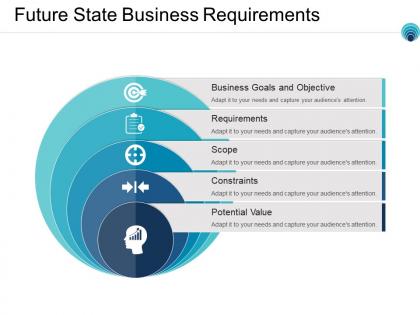
If you wish that analysis is conducted of your business organization on a long term basis it is advised that you use our future state business requirements PowerPoint slide background. This past present future aspects PPT presentation lets you lay emphasis on business-related long term processes like potential value, constraints, scope, requirements, basic goals & objectives, etc. Our business experts have skillfully for business professionals like you who do not have time to design the slides themselves made this future state business requirements PowerPoint slideshow. We assure you that using our before and after business aspects diagram model presentation will allow you to make a better judgment as to about the various needs and requirements of your business organization on a long term basis. The use of high resolution and premium quality slides in designing this current state & future state PPT will help you raise the standard of your work. Using this deck of slides you will be able to make a differentiation on the basis of the future requirements and goals of your organization. So simply hit the download button and use this ready-made set of slides. Highlight areas of disparity with our Future State Business Requirements Powerpoint Slide Backgrounds. Guide folks on how to eliminate them.
83820898 style cluster stacked 5 piece powerpoint presentation diagram infographic slide with all 5 slides:
Rise above the banal with our Future State Business Requirements Powerpoint Slide Backgrounds. Project the inherent classiness of your thoughts.
FAQs for 83820898 style cluster stacked 5 piece powerpoint presentation
Digital transformation, regulatory compliance changes, evolving customer expectations, competitive market pressures, and sustainability mandates are key drivers shaping future state business requirements across industries. These drivers enable organizations to streamline operations, enhance customer experiences, and maintain competitive advantage, with many companies finding that proactive adaptation to these influences ultimately delivers improved efficiency and market positioning.
Effectively gathering customer feedback involves deploying surveys, focus groups, social media monitoring, analytics platforms, and direct interviews across multiple touchpoints. These methods enable organizations to identify emerging trends, anticipate market shifts, and align product development with customer expectations, ultimately delivering enhanced experiences and competitive advantage in increasingly dynamic markets.
Technology serves as both the enabler and foundation for defining future state business requirements by providing data analytics for requirement identification, automation capabilities for process optimization, and scalable platforms for implementation. Through AI-driven insights, cloud infrastructure, and digital transformation tools, organizations streamline operations, enhance customer experiences, and accelerate decision-making, with many finding that strategic technology integration ultimately delivers competitive advantage and operational efficiency.
Regulatory changes significantly influence future business requirements by mandating new compliance frameworks, data protection standards, operational procedures, and reporting mechanisms that organizations must integrate into their strategic planning. These evolving regulations require businesses to build adaptive systems, enhance transparency measures, and develop scalable compliance infrastructure, with many financial services and healthcare organizations finding that proactive regulatory alignment delivers competitive advantage and reduces implementation costs.
Methodologies include agile requirements management, continuous market research, stakeholder feedback loops, scenario planning, and trend analysis frameworks. These approaches streamline adaptation by monitoring industry shifts, gathering real-time customer insights, and maintaining flexible requirement structures, with many organizations finding that regular requirement reviews and cross-functional collaboration ultimately deliver sustained competitive advantage.
Aligning future state business requirements with corporate strategy involves mapping operational capabilities to strategic objectives, conducting comprehensive stakeholder analysis, and establishing measurable performance indicators. Through strategic planning frameworks, organizations streamline resource allocation, enhance cross-functional collaboration, and accelerate decision-making processes, with many enterprises finding that this alignment delivers sustainable competitive advantage and improved operational efficiency.
Effective stakeholder engagement strategies include collaborative workshops, structured interviews, cross-functional focus groups, design thinking sessions, and continuous feedback loops throughout the planning process. These approaches enable organizations to capture diverse perspectives from executives, end-users, and operational teams, while building consensus around strategic priorities, ultimately delivering more comprehensive requirements and stronger stakeholder buy-in across departments.
Scenario planning helps anticipate future state requirements by modeling multiple potential business environments, identifying key uncertainties, and stress-testing current capabilities against various outcomes. Through systematic evaluation of different market conditions, regulatory changes, and technological shifts, organizations can define flexible requirements that adapt to changing circumstances, ultimately enabling more resilient strategic planning and competitive positioning.
Success metrics for future state business requirements should include operational efficiency improvements, cost reduction percentages, customer satisfaction scores, process cycle time reductions, and employee productivity gains. These measurements enable organizations to track transformation progress across departments, with many finding that combining quantitative performance indicators with qualitative stakeholder feedback ultimately delivers comprehensive insights into strategic implementation effectiveness.
Ensuring process agility requires implementing flexible frameworks, continuous feedback loops, cross-functional collaboration, modular system architectures, and regular requirement reassessments. These approaches enable organizations to pivot quickly when market conditions shift, with many companies finding that agile methodologies streamline decision-making, reduce implementation timelines, and ultimately deliver competitive advantages in increasingly dynamic business environments.
Tools for documenting and tracking future state requirements include business process modeling software, requirements management platforms, collaboration tools, version control systems, and visual mapping applications. These technologies streamline requirement capture, enhance stakeholder alignment, and automate tracking workflows, with many organizations finding that integrated platforms significantly reduce documentation errors while accelerating project delivery timelines.
Cultural shifts significantly influence future business requirements by driving changes in employee expectations, customer service standards, and operational methodologies. Organizations experiencing cultural transformations often find themselves needing new collaboration technologies, updated training programs, and revised performance metrics, with many companies discovering that aligning business processes with evolving cultural values ultimately delivers enhanced employee engagement and competitive market positioning.
Common pitfalls include over-relying on historical data, ignoring market disruptions, underestimating technology evolution, failing to incorporate stakeholder feedback, and creating overly rigid timelines. Organizations avoid these by implementing scenario planning methodologies, conducting regular market analysis, and establishing cross-functional review processes, with many finding that flexible forecasting frameworks ultimately deliver more accurate predictions and competitive advantage.
Cross-departmental collaboration enhances future requirements identification by combining diverse perspectives, breaking down silos, and leveraging departmental expertise to create comprehensive solutions. This strategic approach enables organizations to anticipate market changes, streamline resource allocation, and develop integrated strategies, with many companies finding that collaborative planning ultimately delivers more accurate forecasting and sustainable competitive advantage.
Competition significantly influences future state business requirements by driving innovation demands, accelerating digital transformation timelines, and necessitating enhanced customer experience capabilities. Through competitive pressure, organizations must streamline operations, adopt emerging technologies, and develop agile response mechanisms, with many companies finding that staying ahead requires continuous requirement evolution and strategic differentiation to maintain market position.
-
Content of slide is easy to understand and edit.
-
Easily Understandable slides.