

Call Center Staff Job Roles And Responsibilities Inbound Call Center Business Plan BP SS




Try Before you Buy Download Free Sample Product
 Impress Your
 Audience
 100%
100% Editable
 Save Hours
 of Time


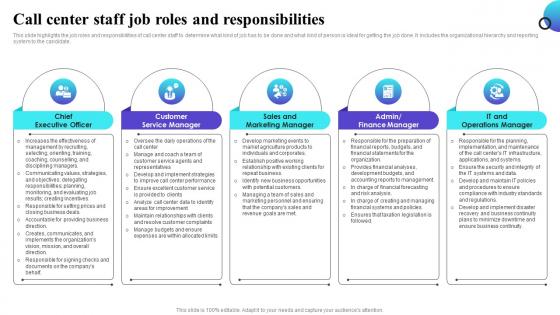
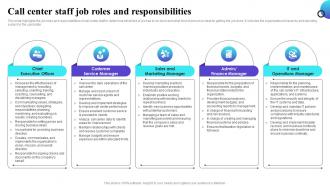
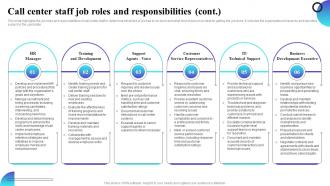
This slide highlights the job roles and responsibilities of call center staff to determine what kind of job has to be done and what kind of person is ideal for getting the job done. It includes the organizational hierarchy and reporting system to the candidate.
People who downloaded this PowerPoint presentation also viewed the following :
Call Center Staff Job Roles And Responsibilities Inbound Call Center Business Plan BP SS with all 10 slides:
Use our Call Center Staff Job Roles And Responsibilities Inbound Call Center Business Plan BP SS to effectively help you save your valuable time. They are readymade to fit into any presentation structure.








FAQs for Call Center Staff Job Roles And Responsibilities Inbound Call Center Business
Call center agents handle inbound and outbound customer communications, resolve service inquiries, process orders and payments, maintain detailed interaction records, and escalate complex issues to supervisors. These responsibilities enable organizations to deliver consistent customer experiences, reduce response times, and improve satisfaction rates, with many companies finding that well-trained agents significantly enhance customer retention and operational efficiency.
Inbound call center roles focus on receiving customer inquiries, providing support, resolving complaints, and processing orders, while outbound roles concentrate on making calls for sales, lead generation, market research, and customer follow-up. Inbound agents typically handle reactive customer service situations requiring problem-solving skills, whereas outbound teams proactively engage prospects and existing customers, ultimately delivering different skill sets and performance metrics for comprehensive customer relationship management.
Essential communication skills in call centers include active listening, clear verbal articulation, emotional intelligence, patience, and adaptability to diverse customer personalities and situations. These competencies enable agents to handle complex inquiries, de-escalate tensions, and build rapport effectively, with many organizations finding that strong communicators significantly reduce call resolution times while enhancing customer satisfaction and retention rates.
Technology enhances call center productivity through automated call routing, CRM integration, predictive dialers, chatbots, and real-time analytics dashboards. These solutions streamline operations by reducing wait times, providing agents instant customer histories, and enabling supervisors to monitor performance metrics, with many financial services and retail organizations finding significantly improved customer satisfaction and operational efficiency.
Customer service training significantly enhances call center performance by developing communication skills, product knowledge, conflict resolution techniques, and emotional intelligence capabilities. Through comprehensive training programs, agents deliver faster issue resolution, improved customer satisfaction scores, and reduced call escalation rates, while organizations benefit from lower turnover costs and stronger customer retention in competitive service markets.
Common call center performance metrics include average handle time, first call resolution rate, customer satisfaction scores, call abandonment rates, and quality assurance ratings. These metrics enable managers to assess agent efficiency, service quality, and customer experience outcomes, with many organizations finding that balanced scorecards combining productivity and satisfaction measures deliver optimal performance insights.
Call center supervisors focus on daily team management, monitoring agent performance, handling escalations, and ensuring service quality through direct coaching and real-time support. Managers operate strategically, overseeing multiple departments, setting operational policies, analyzing performance metrics, and driving long-term improvements, with many organizations finding that this dual-layer approach streamlines operations while delivering enhanced customer experiences and operational efficiency.
Call centers can reduce employee turnover through competitive compensation packages, comprehensive training programs, flexible scheduling options, clear career advancement pathways, and recognition initiatives. These strategies enhance workplace satisfaction by addressing work-life balance, professional development, and employee engagement, with many organizations finding that investing in retention ultimately delivers lower recruitment costs, improved service quality, and stronger customer relationships.
Call centers ensure compliance through comprehensive data encryption, regular staff training on privacy protocols, secure access controls, audit trails, and clear data retention policies. These measures help organizations protect customer information while maintaining operational efficiency, with many financial services and healthcare call centers finding that robust compliance frameworks ultimately enhance customer trust and reduce regulatory risks.
Entry-level call center agents can advance to team leader, supervisor, quality assurance specialist, trainer, or workforce management roles, with many progressing to customer success manager or operations coordinator positions. These career paths enhance professional development through leadership experience, specialized skills training, and cross-functional exposure, ultimately delivering higher earning potential and strategic business expertise.
The shift to remote work transforms call center roles by expanding talent pools, requiring enhanced digital communication skills, and emphasizing self-management capabilities. While remote agents gain flexibility and reduced commute stress, they must master virtual collaboration tools and maintain customer service excellence without direct supervision, with many companies finding that hybrid models deliver optimal productivity and employee satisfaction.
Call center agents face challenges including emotional stress from difficult customers, time pressure to resolve issues quickly, limited authority to offer solutions, complex product knowledge requirements, and maintaining professionalism during heated interactions. These obstacles can lead to agent burnout, high turnover rates, and inconsistent customer experiences, with many organizations finding that comprehensive training, empowerment tools, and emotional support systems significantly enhance agent performance and retention.
Different industries significantly shape call center operations through varying complexity levels, regulatory requirements, and customer interaction types. Healthcare call centers handle HIPAA-compliant patient inquiries and appointment scheduling, while financial services focus on fraud detection and loan processing, and retail emphasizes order management and product support, with each sector requiring specialized training and delivering distinct customer experiences that ultimately drive industry-specific competitive advantages.
Cultural competence enables global call centers to deliver personalized customer experiences across diverse markets by understanding local customs, communication styles, language nuances, and business practices. This strategic capability enhances customer satisfaction, reduces miscommunication, and builds stronger relationships, with many multinational companies finding that culturally trained agents significantly improve retention rates and operational efficiency across international markets.
Call centers create positive work environments through comprehensive training programs, flexible scheduling options, competitive compensation packages, clear career advancement pathways, and regular recognition initiatives. By investing in employee development, providing modern technology tools, and fostering supportive team cultures, organizations enhance job satisfaction and reduce turnover rates, ultimately delivering better customer experiences and improved operational efficiency.
-
SlideTeam makes creating presentations easy. Unlimited products, premium quality designs and affordable.
-
Use of different colors is good. It's simple and attractive.