

Call QA Scorecard For Customer Service Ppt File Infographic Template




Try Before you Buy Download Free Sample Product
 Impress Your
 Audience
 100%
100% Editable
 Save Hours
 of Time


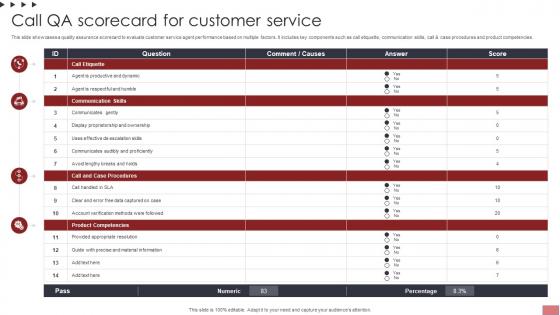
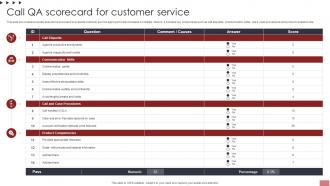
This slide showcases a quality assurance scorecard to evaluate customer service agent performance based on multiple factors. It includes key components such as call etiquette, communication skills, call and case procedures and product competencies.
People who downloaded this PowerPoint presentation also viewed the following :
Call QA Scorecard For Customer Service Ppt File Infographic Template with all 6 slides:
Use our Call QA Scorecard For Customer Service Ppt File Infographic Template to effectively help you save your valuable time. They are readymade to fit into any presentation structure.





FAQs for Call QA Scorecard For Customer Service Ppt
Track both hard and soft skills on your scorecard. Technical stuff matters - did they follow procedures, give accurate info? But don't skip communication quality like clarity and empathy. Compliance is obvious. I'd add call resolution metrics too since that's what actually matters to customers. First call resolution, did they solve the problem, greeting protocols, hold times. Honestly, some managers go overboard with this stuff. Balance the easy-to-measure quantitative things with qualitative elements that show real customer experience. Start with maybe 5-7 core metrics so agents aren't drowning in checkboxes.
A Call QA Scorecard helps you evaluate agents with consistent criteria instead of just winging it based on gut feelings. You'll catch patterns - like agents skipping scripts, missing when customers need empathy, or rushing calls. Honestly, it's so much better than the random feedback most places give. Without structure, you end up telling people "do better" which doesn't help anyone improve specific skills. The scorecard gives you actual data to work with. Pick maybe 5-7 metrics that really matter to your customers and stick with scoring those consistently. Way more actionable than vague comments.
Honestly, consistency is everything here. I'd create a scorecard with super specific criteria - not fuzzy stuff like "sounds professional" but actual measurable things like "said customer's name twice" or whatever. Listen to the whole call first, jot down notes. The hardest part? Scoring your favorite agents the same as everyone else (we all have them lol). Calibrate with other QA people regularly so you're not going rogue with scoring. But here's the thing - don't just throw numbers at people. Turn those scores into actual coaching conversations. That's where agents actually improve instead of just feeling judged.
So basically you get everyone to score the same calls, then hash out where you disagree. We do it monthly but honestly it's kind of a pain - though it actually works. The whole point is catching when one person's being way stricter than others, which happens more than you'd think. You'll spot patterns like "oh wait, Sarah always dings people for dead air but Mike doesn't care." Then you align on what actually counts as good or terrible performance. Write down whatever you figure out so people can check it later when they're confused.
Your agents' feedback is honestly the make-or-break factor for your scorecard. They're the ones actually using it, so they'll tell you if your criteria make sense or if you're measuring stuff that doesn't matter. I've watched companies create these "perfect" scorecards that completely bombed because nobody asked the agents what actually works. Short sentences hit different sometimes. When agents point out which metrics actually improve customer calls versus the ones that just look good in reports, that's gold. You'll want to collect their input regularly and actually use it - otherwise your scorecard stays stuck in theory land instead of driving real results.
Honestly, automating your scoring is huge - way better than doing everything manually. Speech analytics can catch keywords, sentiment, and compliance stuff that people miss all the time. Real-time flagging means you spot issues immediately instead of finding out weeks later. The data insights are so much cleaner too, plus it cuts down on that annoying inconsistency between different evaluators. I'd start with call transcription first (it's pretty straightforward), then add the analytics on top. You'll actually get instant dashboards showing trends instead of waiting around for someone to update a spreadsheet. Trust me, it's worth the setup time.
Here's what I'd do - stick to like 6-8 criteria max. More than that and your agents will just zone out. Been there! Also, skip the vague stuff like "sounds professional" without examples. What does that even mean, right? I've watched scorecards totally bomb because nobody could agree on how to score the same call. Oh, and your scale matters too. If you're really just checking yes/no, don't overcomplicate it with 1-10 ratings. Start basic, then build from there once everyone gets the hang of it.
Honestly? Monthly is what I'd do if you're actively coaching people. Quarterly at the bare minimum though. Business goals change fast these days, and your scorecard needs to keep up or it becomes pretty useless. I've watched teams get totally stuck with old scorecards that don't actually help anyone improve - it's painful to see. Watch for consistent scoring patterns too. That's usually when you know something's off with what you're measuring. Oh, and definitely pull in your frontline supervisors when you review it. They're the ones hearing what's really happening on calls every day. Set a calendar reminder or you'll forget.
Honestly, empathy is everything when you're listening to calls. Watch how agents handle frustrated customers - are they actually picking up on the emotions or just robotically following scripts? Active listening makes such a difference. Also pay attention to whether they can stay calm when things get heated, because stressed agents usually crash and burn. Oh, and see if they're matching the customer's vibe - some people need high energy, others want you to slow down. I swear emotional intelligence beats technical skills every time. Customers won't remember what you said, but they'll remember how you made them feel. Track this stuff alongside your regular metrics and patterns will pop up fast.
So basically, call scorecards show you exactly what's going wrong instead of just guessing. Like if your agents suck at handling objections or keep skipping compliance stuff - you'll see it right there in the data. Then you can actually fix those specific problems with targeted training. Honestly, it beats the old "you need to improve" feedback that helps nobody. Your agents get real numbers too, so they know what to work on. Plus you can track if your coaching is actually doing anything or just wasting time. Way better than flying blind with training programs.
Honestly, a good scorecard actually makes people feel way better about their jobs. No more guessing what "good work" even means, you know? Everyone can see exactly what they're measured on upfront. I've seen teams get so much less stressed once they have clear criteria instead of wondering if their boss just doesn't like them or something. The best ones don't just point out what you're screwing up - they also call out what you're crushing. Just make sure it's focused on specific stuff people can actually control. Nobody wants to be judged on weird vague things that change depending on someone's mood that day.
Honestly, scorecard data is like a roadmap for figuring out where your team's actually falling short. Check if everyone's bombing the same areas - maybe product knowledge or how they wrap up calls. I dig into patterns by agent, different time periods, whatever. Way better than just throwing random training at people and hoping it sticks! Oh, and you can actually see if your coaching worked by comparing scores before and after. The real trick is turning those numbers into specific fixes - new scripts, focused training sessions, or maybe your quality standards need tweaking based on what's happening.
So call evaluations are basically looking at individual conversations - like did your agent follow the script, were they nice, did they actually solve the problem? Performance appraisals are way broader. You're reviewing someone's whole work over months or a year. I always think of it like this - call evals are the close-up shots, performance reviews are the wide angle. But here's the thing, the call data becomes gold when you're doing those bigger reviews. Don't wait for review season though. Use those call scores to coach people right away when stuff's fresh.
Look up industry benchmarks first - they'll show you what realistic targets actually look like instead of just winging it. Compare your current numbers to standards for first call resolution, customer satisfaction, call times, etc. Honestly, this saves you from setting goals that are either way too easy or completely unrealistic (trust me, demoralized agents help nobody). Focus on your biggest gaps when building the scorecard criteria. Oh, and make sure you're looking at benchmarks for your specific industry and call center size - comparing a small tech support team to a massive retail operation won't help much.
Honestly, start with weekly calibration meetings - that's where the magic happens. Get your agents and QA folks in a room to hash out scoring disagreements. Those conversations will show you exactly what needs fixing on your scorecard. Have agents score themselves first, then compare with QA scores. The gaps tell you everything. I'd also do monthly focus groups because agents will straight up tell you which criteria are confusing or just plain unfair. Track your metrics over time too - if certain categories always cause drama, you know what to tweak. The self-assessment thing sounds like extra work but it really helps with buy-in.
-
I’ve been your client for a few years now. Couldn’t be more than happy after using your templates. Thank you!
-
I have just started downloading templates for my presentations and I must say this is a great design. It helped accelerate my presentation design process and made it more visually appealing.