


Call to action with buy and order options
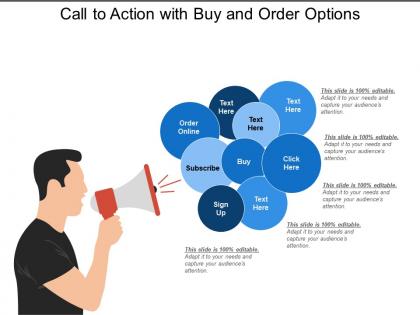




Try Before you Buy Download Free Sample Product
 Impress Your
 Audience
 100%
100% Editable
 Save Hours
 of Time


Involve the journalists with our Call To Action With Buy And Order Options. Get them interested in digging up facts.
People who downloaded this PowerPoint presentation also viewed the following :
Call to action with buy and order options with all 5 slides:
Our Call To Action With Buy And Order Options are applicable in any forum. They can be employed anywhere.
FAQs for Call to action with buy
Effective call to action elements include clear, specific language, compelling value propositions, urgency indicators, visual prominence, and simplified next steps. These components work together by eliminating ambiguity, highlighting immediate benefits, and reducing friction in the decision-making process, with many presenters finding that strategic placement and emotional resonance ultimately drive higher audience engagement and conversion rates.
Strategic template design enhances calls to action through bold color contrasts, prominent placement, clear typography, whitespace utilization, and visual hierarchy that guides audience attention. These design elements streamline message delivery by reducing cognitive load, highlighting key actions, and creating intuitive navigation paths, ultimately delivering stronger audience engagement and higher conversion rates across business presentations.
Psychological triggers in calls to action include scarcity ("limited time"), social proof ("join thousands"), urgency ("act now"), fear of missing out, and personalization techniques. These strategies enhance engagement by creating emotional responses, building trust through testimonials, and emphasizing immediate benefits, with many marketers finding that combining multiple triggers significantly increases conversion rates and audience response.
Tailoring calls to action involves analyzing demographic preferences, communication styles, generational values, and decision-making patterns to craft targeted messaging that resonates with specific audience segments. For example, younger professionals often respond to digital-first approaches and social impact messaging, while senior executives prefer data-driven appeals with clear ROI implications, ultimately enhancing engagement and conversion rates across diverse presentation audiences.
Color psychology significantly influences call-to-action effectiveness by leveraging emotional associations and visual hierarchy, with warm colors like red and orange creating urgency while blues build trust and greens suggest positive action. These strategic color choices enhance audience response rates by directing attention, reinforcing messaging intent, and triggering subconscious behavioral cues, ultimately delivering higher engagement and conversion outcomes across presentations.
Storytelling techniques can be integrated into presentation CTAs through narrative arcs, emotional hooks, character-driven scenarios, and outcome-focused messaging that connects audience pain points to solutions. These approaches transform standard CTAs by weaving compelling scenarios, relatable challenges, and aspirational outcomes into templates, with many organizations finding that story-driven CTAs significantly enhance audience engagement and response rates.
Common mistakes include using vague language, presenting multiple competing actions, placing CTAs poorly within the presentation, lacking urgency or compelling benefits, and failing to match the action to audience capability. These missteps significantly reduce response rates by creating confusion, decision paralysis, and missed opportunities, with many presenters finding that clear, singular, strategically-placed calls to action ultimately deliver higher engagement and measurable business outcomes.
Data and statistics enhance call-to-action persuasion by providing credible evidence, creating urgency through quantified benefits, and addressing audience skepticism with concrete proof points. Through strategic presentation of relevant metrics, organizations can demonstrate measurable outcomes like "30% faster processing" or "reduce costs by 25%," ultimately delivering compelling, fact-based arguments that drive immediate action and competitive advantage.
Sales pitches benefit from direct, specific CTAs like "Schedule a demo today" or "Sign the contract now," while educational presentations work best with softer approaches such as "Download our research guide" or "Join our upcoming webinar." The context determines urgency and tone, with sales presentations requiring immediate action-oriented language and educational contexts focusing on continued engagement and knowledge-building, ultimately delivering higher conversion rates when properly matched to audience expectations and presentation objectives.
Strategic call to action placement significantly impacts presentation effectiveness, with mid-presentation CTAs driving engagement and final slide CTAs maximizing conversion rates. Research shows that presentations with CTAs placed after key benefit sections, during natural transition points, and reinforced at conclusion generate higher response rates, with many sales teams finding that multiple strategic placements throughout their presentation ultimately deliver better audience commitment and follow-through actions.
Effective presentation CTAs should be 2-7 words using action-oriented verbs like "Start," "Discover," or "Transform," paired with specific outcomes like "Start Your Digital Journey" or "Schedule Strategy Session." The wording must create urgency while clearly communicating value, with many presenters finding that concise, benefit-focused language drives significantly higher audience engagement and follow-through rates.
Presenters can ensure alignment by directly connecting their call to action to the presentation's core problem, solution, and desired outcomes through consistent messaging, reinforced key themes, and explicit language that mirrors their main points. This strategic alignment enables audiences to see clear pathways from insights to implementation, with many business presenters finding that tightly integrated calls to action significantly increase audience engagement and follow-through rates.
Feedback from past presentations reveals which calls to action resonated with audiences, what language drove engagement, and which formats generated the highest response rates. By analyzing audience reactions, conversion metrics, and post-presentation surveys, presenters can refine their messaging strategies, optimize timing and placement, and craft more compelling action statements that ultimately deliver stronger audience engagement and higher conversion rates across future presentations.
Digital design tools include Canva, Adobe Creative Suite, Figma, PowerPoint Designer, and specialized presentation platforms like Prezi and Visme. These platforms streamline CTA creation by offering customizable templates, color psychology guides, and A/B testing capabilities, with many marketing teams finding that integrated analytics and brand consistency features ultimately deliver higher engagement rates and improved conversion tracking across campaigns.
Presenters can measure call to action effectiveness through response rates, conversion metrics, engagement analytics, feedback surveys, and follow-up communication tracking. By monitoring email responses, website traffic spikes, social media engagement, and direct inquiries within specific timeframes, organizations can quantify audience action while gathering qualitative insights, ultimately optimizing future presentations for stronger business outcomes.
-
Great product with effective design. Helped a lot in our corporate presentations. Easy to edit and stunning visuals.
-
Use of icon with content is very relateable, informative and appealing.