

Capabilities framework process good ppt example




Try Before you Buy Download Free Sample Product
 Impress Your
 Audience
 100%
100% Editable
 Save Hours
 of Time


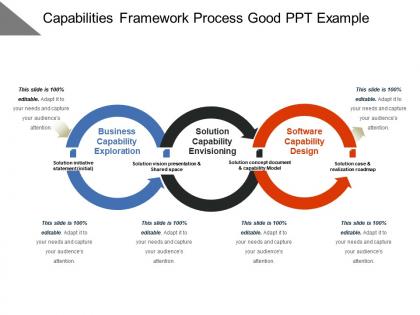
Our capabilities framework process good PPT example facilitate faster growth. Arrive at decisions at the earliest with this PPT deck for a generic audience. This is a three stage process which comprises of the following components: capabilities, potential and ability. Use this PowerPoint to explain the concept of business capability exploration, solution capability envisioning and software capability design to an audience. This PPT has been carefully designed and integrated to incorporate the attention of a professional and a varied audience during business meetings. Use this PPT to smartly highlight and convey the concept of capabilities framework process in a business meeting within an organisation. The components of a software platform network can be explained within just one slide making it less complex and less time consuming. You can now captivate your audience with our capabilities framework process PowerPoint layout at the simple click of a button! Simply download, add your data and present it to your audience! Our Capabilities Framework Process Good Ppt Example facilitate faster growth. Arrive at decisions at the earliest.
People who downloaded this PowerPoint presentation also viewed the following :
Capabilities framework process good ppt example with all 5 slides:
All the professionals know that powerful presentations are not about bullet points and unnecessary transitions and animations. If you cant produce good presentations yourself, just make use of our Capabilities Framework Process Good Ppt Example.


FAQs for Capabilities framework process
So there are four main pieces to a capabilities framework. You've got the capability map - that's just the visual of what your company actually does. Maturity levels come next, showing if you're terrible or amazing at each thing. Someone has to own this stuff too, so governance covers who's in charge of what. The assessment part is last - measuring how you're doing. That assessment bit honestly trips up most people because it's way trickier than it seems. My advice? Just start with mapping your core capabilities first. Everything else you can figure out later - no need to overthink it from the start.
So basically do a capabilities audit - figure out what you're actually good at vs what you need to be good at to win. Map out your core stuff that drives real value, then honestly assess the gaps. Don't sugarcoat it because that's where companies mess up. Once you see where you stand, prioritize which capabilities to build internally, buy through acquisitions, or just partner for. Focus on strategic importance and how hard they'd be to develop. Way better than trying to be amazing at everything - that never works. Create targeted plans for the gaps that matter most.
So a capabilities framework is basically your business reality check - shows what you can actually pull off vs what you think you need for your goals. Pretty useful for catching those "wait, we definitely can't do that" moments before you commit to something impossible. You map out current skills and resources, then compare against where you want to go. Makes it way easier to figure out investment priorities and whether you should build stuff in-house or just partner with someone who already does it well. I'd start with auditing what you've got now against your big picture plans.
Start with mapping out what you've actually got - current processes, skills, resources across each area. Industry reports and competitor analysis are super helpful for benchmarking (expensive though, fair warning). CMMI works well, or just build your own scorecards from best practices you find. Survey tools help put numbers on where you are vs where you need to be. Honestly, being harsh about gaps is crucial - nobody likes hearing their baby is ugly but it's necessary. Focus on maybe 3-5 critical capabilities first instead of trying to boil the ocean.
Honestly, getting people on board is the hardest part. Nobody wants to change how they work, and different departments guard their turf like crazy. You'll also drive yourself nuts figuring out the right level of detail - go too broad and it's meaningless, too specific and you're buried in charts nobody uses. Oh, and keeping it updated after the honeymoon phase? Good luck with that. Leadership backing makes or breaks this whole thing. I'd say pick one small area first, show some quick wins, then grow from there. Trying to fix everything at once is just setting yourself up to fail.
So basically, a capabilities framework maps out exactly what skills people need at different levels - no more guessing what "senior" actually means. Makes hiring and promotions way less biased since you're not just going off gut feelings. You can spot where someone's missing skills and build a real development plan around it. People finally know what they need to work on instead of wondering why they didn't get promoted (honestly, that ambiguity is the worst). Plus career conversations become so much easier when you can point to specific capabilities. Total game-changer for managing talent decisions.
Honestly, think of it like getting everyone to speak the same language about what your company actually does. No more weird department silos where marketing talks in buzzwords and IT speaks in code. The framework maps out who needs what from whom - so you're not guessing when to loop in other teams. Short version: clearer dependencies, shared vocab, and way better cross-team meetings. Oh, and it'll highlight gaps that need multiple departments working together. I've seen this work really well when companies actually stick with it instead of abandoning it after two months.
Figure out which capabilities matter most first. Then see if your tech actually helps or hurts each one. I've watched companies blow tons of money on fancy software that somehow made their basic workflows worse - it's wild. Check if data flows smoothly between systems and whether people actually use what you bought them. Are outcomes getting better? That's what counts. Don't get distracted by every new tool that pops up. Just focus on where tech is genuinely holding you back instead of trying to fix everything at once.
So you need to track a few different things to know if this framework is actually doing anything. Capability maturity is the obvious one - like, are teams actually getting better at the levels you set up? Then tie it to real business stuff - faster delivery, better quality, happier customers. That kind of concrete impact. Oh, and don't skip the adoption piece. I've seen so many frameworks that look great on paper but nobody uses them because they're a pain. Employee feedback tells you if it's actually helpful or just more corporate busywork. Start small though - maybe 2-3 metrics per area. You can always add more later.
Honestly, start with whatever standard framework you can find, then tear it apart for your specific industry. Healthcare? Patient safety stuff becomes way more critical than it would be for, say, retail. Map out your actual value chain first - don't just copy-paste some generic model. Weight the capabilities based on what actually matters for your strategy. Oh, and definitely talk to your frontline people before finalizing anything. They'll spot the gaps that C-suite folks miss because they're dealing with the real operational mess every day. Most frameworks are too vanilla without that customization.
First thing - map out what you've already got before building anything new. That baseline will save you tons of headaches later. Don't overcomplicate the framework either. I've watched teams get so caught up in subcategories that nothing ever gets done. Business outcomes should drive everything, not just cool tech features. Each capability needs a clear line to actual strategic value. Get stakeholders involved early since they're the ones who'll use it daily. Build in review cycles too - this stuff changes constantly. Oh, and start small with your most critical capabilities. You can always expand once you've got momentum going.
So basically you map out all the skills your team needs for each role, then see where people actually stack up. Think of it as a really thorough skills audit. Once you've got that comparison, the gaps become super obvious - whether it's technical stuff, leadership abilities, or just knowing the industry inside and out. Makes deciding on training or new hires so much clearer. I'd start by writing down your main business needs first, then figure out who can actually handle what. It's honestly one of those things that sounds boring but saves you tons of headaches later.
So basically, a capabilities framework is like having a map of all the skills your team actually needs to get stuff done. You'll spot gaps super fast and know exactly where to focus training or who to hire next. Honestly, it makes project planning so much easier - no more guessing who can handle what. The cool thing is you won't be screwed if someone leaves, since you're not putting all your eggs in one basket with critical skills. I'd start by looking at your best projects and figuring out what capabilities made them work.
So basically, you map out what your company can actually do vs what it needs to do - makes risks way more obvious. Like, you'll spot if your cybersecurity team is too small or you're relying on just one supplier (yikes). Honestly shocked me how much clearer everything got once we drew it out. Then you can figure out which problems to fix first based on how important those capabilities are. I'd say start with your top 3 most critical areas and see what's missing. Way better than just guessing at risks.
Your framework needs to be flexible from day one - build it like LEGO blocks, not concrete. Market shifts will expose gaps you never saw coming (remember when everyone suddenly needed remote work systems?). I'd schedule quarterly reviews with your team to figure out what's actually working. Some capabilities become way more critical while others get outdated fast. You can add new categories, dump old ones, or shuffle priorities around. The trick is treating it like a living doc that evolves with your business. Don't overthink it though - just start with regular check-ins and adjust as you go.
-
Enough space for editing and adding your own content.
-
Appreciate the research and its presentable format.