

Business challenges and solutions good ppt example




Try Before you Buy Download Free Sample Product
 Impress Your
 Audience
 100%
100% Editable
 Save Hours
 of Time


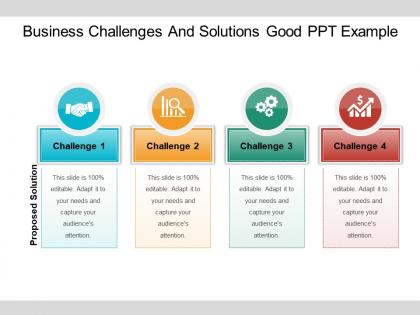
Check our business challenges and solutions good PPT example design. This PowerPoint graphic helps you present information on how to manage the top global economic challenges. Today, there are many challenges faced by corporate firms that call for international collaboration but as they all are competing with each other, the outcome makes an impact on the overall growth of the business sector. Some global level challenges that you can highlight with this presentation template are technology driven change in jobs, rising protectionism, growing income inequality, growing influence of social media. Our creative and innovative designing experts have designed this PowerPoint graphic with professionally designed icons that helps you to communicate the information to your audience effectively and engage them with your presentation. Besides this, you can also use this to deliver a statement about challenges faced by other departments such as sales, finance, marketing as it is completely editable. So, download business challenges and solutions good PPT sample. To access more innovative designs, you can access our complete website. Our Business Challenges And Solutions Good Ppt Example have a unique quality. They imprint themselves in the mind in an everlasting way.
People who downloaded this PowerPoint presentation also viewed the following :
Business challenges and solutions good ppt example with all 5 slides:
Apply your brains in a clinical manner. Our Business Challenges And Solutions Good Ppt Example allow every detail to be examined.


FAQs for Business challenges and solutions
Honestly, the big pain points are always the same few things. Your team will fight you on it - nobody wants to learn new systems when the old ones work "fine." Budget's another killer since most companies lowball what training actually costs. Integration is where things get messy too, especially if you're trying to connect shiny new tools with whatever ancient system you're already running. Oh, and good luck getting leadership to understand ROI on digital stuff. My take? Don't go all-in right away. Test things out with small pilot programs first, get some quick wins, then expand from there.
Honestly, just get your communication down first - daily standups are clutch. Use Slack for random stuff and maybe Asana for tracking projects. The weird part? You gotta manufacture those random office conversations somehow. Some teams do virtual coffee breaks which sounds cheesy but actually works. Oh, and async video updates where people ramble about their work. Don't obsess over hours though - I've seen that kill morale fast. Give clear deadlines and goals, then back off. Trust me, micromanaging remote workers is a recipe for everyone quitting.
You're nimble - that's your biggest advantage right there. Big companies can't pivot like you can or give that personal touch customers actually want these days. Pick your niche and completely own it instead of trying to compete everywhere. Customer service is where you'll kill it. Build real relationships while they're stuck with call centers and chatbots. Partner locally, show your personality on social media, make quick decisions when stuff comes up. Honestly? Sometimes I think people are just tired of dealing with massive corporations. Figure out that one thing you do way better than them and go all-in.
Downturns mess with everything - cash flow, demand, your whole supply chain goes wonky. Customers cut spending while your costs somehow go up (makes total sense, right?). The key is building cushions before you need them. Diversify where your money comes from, keep decent cash reserves, and make sure you can scale costs quickly. I'd focus on keeping current customers happy rather than chasing new ones when things get rough. Also, build those supplier relationships now. Stress-test your business model today - you don't want to discover weak spots mid-crisis.
Honestly, customer feedback is like having a GPS for product development - saves you from building stuff nobody wants. Get it early and often, not just when you're done. I've watched teams fall in love with their own ideas and completely ignore what users actually need (spoiler: usually not what they think). Try setting up regular check-ins during development. Could be surveys, quick interviews, whatever works. The whole point is catching those "oh crap" moments before you've already spent months going down the wrong path. Much better than realizing later you built something useless.
Honestly, automation is your best friend here - way cheaper than hiring more people. Get software that handles reporting and monitoring automatically. It'll save you tons in the long run. Industry associations are goldmines for this stuff too. They already know what matters and what's just bureaucratic nonsense (there's always a lot of that). Don't create whole new processes from scratch either. Map what you're already doing and just build compliance checks right into those workflows. Way less headache that way.
Honestly, you've gotta build flexibility before stuff hits the fan. Don't put all your suppliers in one region - learned that lesson during COVID when everything went sideways. Keep safety stock for anything critical, and get some decent visibility tools so you're not flying blind. Build relationships with backup suppliers too, because when your main guy can't deliver, you'll be scrambling otherwise. The smart companies I've seen always plan for when things go wrong, not just when everything's perfect. Oh, and map out contingency plans for your most vulnerable products - trust me on this one.
Make failing safe - that's honestly the key to everything. Google does that 20% time thing for a reason. Celebrate when experiments don't work but teach you stuff. Sounds weird, but people need to know their job isn't at risk for trying. Mix teams up for brainstorming since outside perspectives usually spark better ideas. Oh, and start with cheap pilot programs so you can test fast. I've seen too many companies kill creativity because everyone's scared to mess up. Give people actual permission to think outside the box and some budget to play with.
Honestly, start by asking your current people what they actually want instead of just guessing. Three big things though: pay them fairly (check what competitors offer), give clear paths to move up with real feedback, and flexible work is everything now. Good managers matter more than you'd think - most folks quit their boss, not the company. Oh and recognition goes a long way too. I'd survey everyone first, then tackle whatever will make the biggest difference. Remote options are kind of non-negotiable these days. Focus on culture but make sure it's not just pizza parties, you know?
Look, when everything's going sideways, you've gotta watch the metrics that actually move the needle - customer shifts, cash flow, where things are breaking down operationally. Real-time dashboards beat historical reports every time. Most companies I know get obsessed with feel-good numbers while their world's burning, which is honestly insane. Run some scenario planning with what you've got. Focus on leading indicators so you're not always reacting. Oh, and if a data point doesn't help you make an actual decision? Toss it. Speed matters way more than perfection right now.
Honestly, start with training your people first - most hacks happen because someone clicks a sketchy link. Multi-factor authentication is a pain but use it on everything. Software updates? Don't put them off, just do them. Oh, and actually test your backups work (we found out ours didn't during a real emergency... awkward). You'll want an incident response plan ready so you're not panicking later. The whole company needs to care about this stuff, not just dump it on IT. I'd get that training scheduled this week if I were you.
Honestly, going green isn't just feel-good stuff - it actually saves you money through lower energy bills and less waste. Plus younger workers are obsessed with this (which is smart since they'll inherit the planet). You can charge more for eco-friendly products too. The regulations are only getting stricter, so you're basically getting ahead of that mess. Green loans often have better rates, which is nice. Oh, and it forces you to get creative with solutions. I'd start by looking at where you waste the most - that's usually your quickest wins right there.
Saturated markets are brutal, but there's usually some niche getting ignored that you can own. First thing - audit how you sound compared to competitors. If you're saying the same stuff as everyone else, that's problem
-
Very well designed and informative templates.
-
Really like the color and design of the presentation.