

Challenges and solution template powerpoint guide





Try Before you Buy Download Free Sample Product
 Impress Your
 Audience
 100%
100% Editable
 Save Hours
 of Time


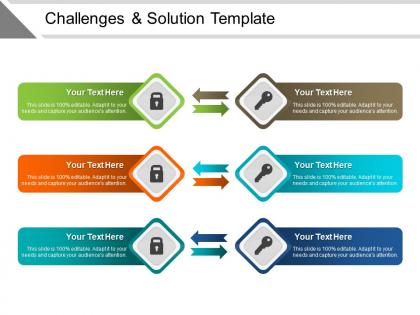
Introducing Challenges And Solutions Template PowerPoint Guide with the help of which you can solve your complex problems. The procedure of solving the challenges of project management can also be depicted using this readily available PPT slide. The major hurdles in the way of success can be displayed and the template can be incorporated to devise strategies to deal with the hurdles. This problem solving PowerPoint slide will assist you in recognizing the problems. Also, one can easily evaluate the solutions with the assistance of this readymade PPT slide. Indulge your teammates in the decision making process with the assistance of this professionally designed PowerPoint layout. Business professionals, managers, and marketing professionals can get this slide to solve a number of problems after carefully analyzing them. Showcase the different solutions for a particular problem and invite suggestions from the audience. Download this content ready PPT template and deliver high-quality PPT presentations without any hassle.
People who downloaded this PowerPoint presentation also viewed the following :
Challenges and solution template powerpoint guide with all 5 slides:
Rest assured with our Challenges And Solution Template Powerpoint Guide. They will be by your side night and day.



FAQs for Challenges and solution
Honestly, the main thing you'll deal with is people hating change - like, they're SO attached to their routines it's almost funny. Communication usually sucks too, so nobody knows what's actually happening. Then there's never enough money or training to pull it off right. Leadership always wants results yesterday, which is unrealistic. Different departments end up working against each other instead of together. My advice? Get people on board early by being super transparent about what's coming. Give them proper training and don't promise the moon timeline-wise. Maybe try a small test run first to figure out what'll break before going all-in.
Get input from everyone - your frontline people catch stuff executives totally miss, but leadership sees the bigger picture gaps. Make a simple scoring thing that weighs impact, urgency, and what resources you'll actually need. Teams can debate this forever (trust me, I've watched it happen), so just pick a deadline and stick to it. Data's great when you have it, but don't ignore your experienced people's gut feelings either. Whatever you pick, make sure it actually connects to your main business goals first. Once you've got your top 3-5, tell everyone what you're focusing on so there's no confusion.
Honestly, talking things through changes everything at work. Small problems don't blow up when you catch them early in conversation. Plus you get perspectives you'd never think of - like maybe someone from a totally different department has the perfect solution. Teams that actually brainstorm together? They're way more committed to following through. I'd start with regular check-ins where people can bring up issues before they get messy. It's wild how much smoother things run when everyone's actually communicating instead of just hoping problems fix themselves.
Ugh, yeah - tech supposedly makes project management easier but honestly just creates different problems. You end up switching between like 5 apps constantly (Slack, Asana, Zoom, whatever dashboard your company loves this month). Information gets scattered everywhere and nobody knows where anything is. Plus there's always that one teammate who refuses to learn the new system, which is... fun. The worst part? When one tool goes down, your whole workflow dies. Instead of piling on more software, try cutting down to just the essentials. Set up actual processes for how your team uses them.
Honestly, you've gotta walk the walk first - your team's watching how you react when stuff hits the fan. Make it safe for people to mess up without getting crucified. I always think it's weird how some managers preach about bouncing back but then lose their minds over small setbacks! Check in with your team regularly so you can spot stress before it explodes. Give them what they need to handle curveballs. Share war stories about challenges you've all survived together - that stuff really sticks. Oh, and just ask them straight up what kind of support would help them recover faster next time.
Honestly, analytics can be a game-changer for catching problems early. Start with dashboards tracking your most important stuff - sales numbers, customer complaints, inventory, whatever keeps you up at night. Modern tools are pretty wild - they'll actually predict issues months out if you feed them enough data. I'd focus on one area where you've gotten burned before rather than trying to do everything at once. Look for weird patterns in your historical data and set up alerts when things go sideways. The seasonal stuff is huge too. Once you nail that first area, you can expand from there.
Ugh, market volatility makes your strategic plans basically useless - like writing in sand during a windstorm. Instead of those rigid 3-5 year plans, you gotta build in flexibility with multiple scenarios and shorter cycles. I've watched so many teams crash and burn on this! Set up early warning systems so you'll know when to pivot. Here's what actually works: focus on building capabilities that'll survive different market conditions rather than gambling on one outcome. Oh, and definitely stress-test your current strategy against various volatility scenarios.
So workplace stress basically destroys people's well-being - I've watched it happen way too many times. Heavy workloads and crappy communication will burn out your team faster than you think. Start by just asking what's stressing them out most (their answers might shock you honestly). Then do regular check-ins, offer flexible schedules if you can, and create space where they won't get punished for speaking up. Oh, and realistic deadlines are huge - I can't stress that enough. Mental health resources help too, but sometimes it's the small stuff that makes the biggest difference.
Honestly, anonymous surveys work best - people won't sugarcoat things when their boss can't trace it back to them. Ask about specific stuff like processes and communication instead of vague "what sucks?" questions. Then do some smaller focus groups or quick one-on-ones to dig deeper. Oh, and this is crucial - you have to actually DO something with the feedback or people will just roll their eyes next time. Some folks like writing things out, others prefer talking it through. Always circle back and tell everyone what you're changing based on what they said.
Honestly, the biggest thing is giving them real decision-making power - none of this "let me check with my manager" nonsense. Get someone senior who can bulldoze through the inevitable politics (and there's always politics, lol). Make sure everyone can actually speak for their department. Quick wins are your best friend for keeping momentum. Oh, and those check-ins? They should move stuff forward, not just be another boring status meeting. Set up metrics the whole team gives a damn about. Figure out who really needs to be there vs. who just wants to stay in the loop - that alone saves so much time.
Honestly, there's some pretty smart stuff happening right now. Companies are building these AI "control towers" that can spot problems before they explode. Regional sourcing is huge again - turns out maybe don't ship literally everything from China, who knew? 3D printing is actually viable now for certain stuff, and blockchain finally found its purpose tracking shipments. The biggest move though? Everyone's ditching single suppliers and spreading risk around. My advice? Map out your backup plans yesterday. Also blockchain for supply chains makes way more sense than crypto, just saying.
Dude, you absolutely HAVE to get stakeholders involved early - I can't stress this enough. Map out who actually matters for your specific problem first. Then bring them into defining the issue, not just approving whatever you've already decided. Trust me, I've watched brilliant strategies crash and burn because people skipped this step. Without their buy-in, you're gonna hit resistance walls everywhere. Plus they'll give you way better insights into what's really broken and solutions that might actually work. Nobody wants to implement changes they had zero say in creating, you know?
Look, change management basically keeps your whole team from losing their minds when everything gets flipped upside down. People need to understand what's happening and why - otherwise they'll just resist everything. The emotional side is huge too, honestly way bigger than most people think. Even brilliant plans totally bomb if nobody knows how to actually work in the new setup. Communication has to start early, like way before you think it should. Oh and definitely don't pretend change isn't stressful - acknowledge that upfront because everyone's feeling it anyway.
Look, you gotta get people on board from day one - can't just drop changes on them and expect it to stick. Focus on fixing the actual problem, not just slapping band-aids on symptoms. Design stuff that'll grow with you and won't fall apart when Sarah from accounting quits (because she will). Schedule regular check-ins to see what's working. Maybe I'm old school, but mapping out 6-month vs 2-year goals really helps. Most crucial thing though? Get leadership to commit resources upfront. I've seen too many good ideas die because nobody wanted to fund them properly.
Dude, the second you hesitate in competitive markets, your rivals pounce. Market share just vanishes - I've watched entire companies lose whole customer bases because they waited too long to act. Trust me, it's painful to see. Problems get way messier when you ignore them, plus they cost a fortune to fix later. Your team starts getting demoralized too when nothing gets addressed. Honestly, the best move is setting up some kind of early alert system so issues don't blindside you. And maybe create a space where people can actually speak up without getting blamed for everything.
-
Qualitative and comprehensive slides.
-
Excellent Designs.