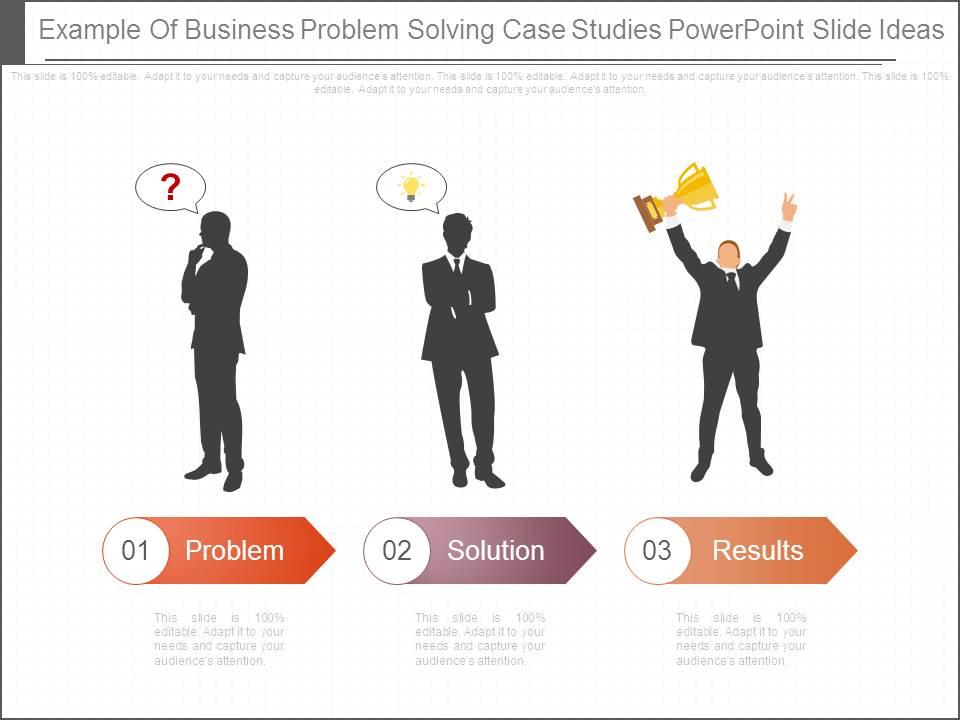
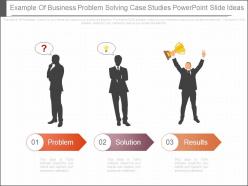
Example of business problem solving case studies powerpoint slide ideas
Try Before you Buy Download Free Sample Product
Audience
Editable
of Time
Our Example Of Business Problem Solving Case Studies Powerpoint Slide Ideas provide unconditional support. They will welcome your views warm heartedly.
People who downloaded this PowerPoint presentation also viewed the following :
Example of business problem solving case studies powerpoint slide ideas with all 7 slides:
From this day forward you won't look back. Our Example Of Business Problem Solving Case Studies Powerpoint Slide Ideas keep you focused ahead.
FAQs for Example of business problem solving case studies
Analyzing past case studies improves current problem-solving by revealing proven methodologies, identifying common failure patterns, and providing tested frameworks for similar challenges across industries. Through case study analysis, organizations streamline decision-making processes, minimize costly trial-and-error approaches, and accelerate solution implementation, with many businesses finding that historical insights deliver faster resolutions and enhanced strategic outcomes.
Effective methodologies include design thinking, lean six sigma, agile problem-solving, root cause analysis, and data-driven decision frameworks. These approaches streamline complex challenges by fostering cross-functional collaboration, eliminating process inefficiencies, and leveraging analytics for evidence-based solutions, with many organizations finding that combining multiple methodologies delivers faster implementation and sustainable competitive advantages.
Different industries approach problem-solving through sector-specific methodologies, with healthcare emphasizing evidence-based protocols, manufacturing leveraging lean Six Sigma principles, technology companies using agile iterative processes, and financial services applying risk assessment frameworks. These diverse approaches demonstrate that successful problem-solving combines data-driven analysis with industry context, ultimately delivering faster resolution times and competitive advantage across sectors.
Data analytics plays a crucial role in business problem-solving by identifying patterns, trends, and root causes through systematic data examination, predictive modeling, and performance measurement. In case studies across retail, healthcare, and financial services, organizations leverage analytics to streamline operations, enhance customer experiences, and optimize resource allocation, ultimately delivering measurable improvements and competitive advantages.
Netflix's pivot from DVD-by-mail to streaming, Amazon's expansion from books to cloud services, and Airbnb's transformation of unused spaces into hospitality assets demonstrate how innovative thinking revolutionizes business challenges. These companies identified emerging market opportunities, leveraged technology strategically, and reimagined traditional business models, ultimately delivering competitive advantages, new revenue streams, and enhanced customer experiences in increasingly dynamic markets.
Small businesses can leverage corporate case studies by adapting strategic frameworks, process improvements, and problem-solving methodologies to their scale and resources. While large corporations have bigger budgets, the underlying principles of customer-centricity, operational efficiency, and data-driven decision making translate effectively, with many small businesses finding that simplified versions of enterprise solutions deliver competitive advantages and streamlined operations.
Common pitfalls include rushing to solutions without proper analysis, overlooking stakeholder perspectives, ignoring implementation challenges, and failing to measure results effectively. Real-life case studies reveal how companies like Netflix navigated market disruption and Amazon addressed scaling challenges, demonstrating that successful problem-solving requires systematic analysis, cross-functional collaboration, and iterative approaches, ultimately enabling organizations to avoid costly mistakes while building competitive advantage.
Company culture significantly impacts problem-solving effectiveness by shaping communication patterns, risk tolerance, decision-making processes, and collaborative approaches within organizations. Case studies consistently show that companies with open, innovative cultures enable faster solution implementation and cross-functional teamwork, while hierarchical environments may slow progress, with many organizations finding that cultural alignment ultimately determines whether strategic problem-solving initiatives deliver sustainable competitive advantage.
Successful businesses measure solution impact through key performance indicators, customer satisfaction metrics, revenue growth analysis, operational efficiency improvements, and cost reduction assessments. These measurement frameworks enable organizations across sectors like retail, healthcare, and manufacturing to quantify outcomes, demonstrate ROI to stakeholders, and refine strategies, ultimately delivering sustainable competitive advantage and scalable business growth.
Case studies demonstrate stakeholder engagement's critical role by showcasing how inclusive approaches lead to comprehensive problem identification, diverse solution perspectives, and smoother implementation across organizations. Through documented examples in sectors like healthcare system reforms, retail digital transformations, and manufacturing process improvements, these studies reveal that engaging employees, customers, and partners early delivers higher success rates, reduced resistance, and sustainable solutions that address root causes rather than symptoms.
Ethical considerations include maintaining confidentiality of sensitive data, ensuring accurate representation of facts without bias, respecting stakeholder privacy, obtaining proper consent for information use, and avoiding conflicts of interest. These principles enhance credibility and trust in case study analysis, with many organizations finding that ethical frameworks ultimately deliver more reliable insights, stronger stakeholder relationships, and sustainable competitive advantage in their problem-solving approaches.
Visual aids and presentation templates enhance case study communication by structuring complex data into digestible formats, highlighting key insights through charts and infographics, and maintaining audience engagement through professional design consistency. These tools enable businesses to present findings more persuasively to stakeholders, with many organizations finding that visual presentations increase comprehension rates and decision-making speed significantly.
Effective KPIs for tracking case study solution success include revenue growth metrics, operational efficiency ratios, customer satisfaction scores, cost reduction percentages, and time-to-market improvements. These indicators enable organizations to measure tangible outcomes across sectors, with many companies finding that combining financial metrics with operational benchmarks delivers comprehensive insights into solution effectiveness and competitive advantage.
Businesses can create a framework by establishing standardized case study formats, developing systematic analysis methodologies, creating centralized knowledge repositories, and implementing regular review processes. Through structured documentation templates and cross-functional analysis sessions, organizations streamline decision-making, enhance institutional learning, and accelerate problem resolution, with many companies finding that consistent case study frameworks ultimately deliver faster strategic responses and improved operational efficiency.
Best practices for documenting successful problem-solving stories include creating standardized case study templates, capturing both quantitative results and qualitative insights, maintaining searchable knowledge repositories, and establishing regular sharing mechanisms through workshops and internal publications. These approaches enhance organizational learning by preserving institutional knowledge, accelerating future problem-solving efforts, and building collaborative cultures, with many companies finding that structured documentation ultimately delivers improved decision-making and competitive advantage.
-
Informative design.
-
Thanks for all your great templates they have saved me lots of time and accelerate my presentations. Great product, keep them up!