


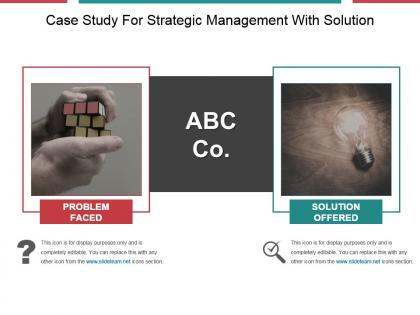
Case study for strategic management with solution powerpoint template




Try Before you Buy Download Free Sample Product
 Impress Your
 Audience
 100%
100% Editable
 Save Hours
 of Time


Our Case Study For Strategic Management With Solution Powerpoint Template will help you be quick off the draw. Just enter your specific text and see your points hit home.
People who downloaded this PowerPoint presentation also viewed the following :
Case study for strategic management with solution powerpoint template with all 6 slides:
Great designs evolve due to our Case Study For Strategic Management With Solution Powerpoint Template. It allows you to focus on areas of improvement.

FAQs for Case study for strategic management with
An effective strategic management case study template includes executive summary, company background, industry analysis, strategic challenges identification, and solution recommendations with implementation timelines. These components work together by providing comprehensive context, enabling systematic problem analysis, and delivering actionable insights, with many business schools and consulting firms finding that structured templates enhance strategic thinking while streamlining case evaluation processes.
A strategic management case study template enhances understanding by providing structured frameworks for analyzing strategic contexts, competitive landscapes, stakeholder impacts, and decision outcomes systematically. Through standardized evaluation criteria, organizations can examine complex scenarios like market entry strategies or merger decisions more comprehensively, ultimately delivering deeper strategic insights and improving future decision-making capabilities across leadership teams.
An executive summary should include the problem statement, key findings, strategic recommendations, financial implications, and expected outcomes. These elements provide stakeholders with a comprehensive overview by highlighting critical challenges, presenting data-driven insights, and outlining actionable solutions, ultimately enabling faster decision-making and strategic alignment across organizations.
Stakeholder analysis typically appears in the environmental assessment section of strategic management case study templates, identifying key internal and external parties, their interests, influence levels, and potential impact on strategic decisions. This analysis enables organizations to develop targeted engagement strategies, anticipate resistance or support, and align strategic initiatives with stakeholder expectations, ultimately enhancing implementation success and minimizing strategic risks.
Data gathering methodologies for strategic management case studies include primary research through surveys and interviews, secondary research using industry reports and financial statements, observational studies, focus groups, and competitive analysis. These approaches enable comprehensive stakeholder perspectives, market intelligence, and operational insights across sectors like retail, healthcare, and manufacturing, ultimately delivering robust strategic frameworks and evidence-based decision-making capabilities for organizational growth.
SWOT analysis integrates into strategic management case study templates by providing structured assessment of strengths, weaknesses, opportunities, and threats within specific business scenarios. This framework enables organizations to systematically evaluate competitive positioning, market dynamics, and internal capabilities, with many consulting firms and business schools finding that SWOT-driven case studies deliver clearer strategic insights and more actionable recommendations.
Competitive analysis forms the strategic foundation of case studies by examining market positioning, competitor strengths and weaknesses, differentiation strategies, and industry dynamics that influence decision-making. This analysis enables organizations to identify opportunities, assess threats, and develop strategic responses, with many consulting firms and business schools finding that comprehensive competitor evaluation ultimately delivers deeper insights and more robust strategic recommendations.
Future strategic recommendations can be effectively presented through clear priority rankings, specific implementation timelines, resource allocation requirements, and measurable success metrics within dedicated template sections. This structured approach enables organizations to evaluate feasibility, assign accountability, and track progress systematically, with many companies finding that well-formatted recommendations accelerate decision-making processes and enhance strategic execution across departments.
Visual formatting best practices include consistent color schemes, clear hierarchical layouts, readable fonts, strategic white space, and properly scaled charts or graphs. These elements enhance comprehension by creating logical information flow, highlighting key insights through visual emphasis, and ensuring data accessibility across different audiences, with many organizations finding that well-formatted visuals significantly improve stakeholder engagement and decision-making speed.
The template addresses success measurement through comprehensive KPI frameworks, milestone tracking systems, ROI calculations, performance benchmarking tools, and outcome assessment matrices. These measurement mechanisms enable organizations to quantify strategic progress, identify implementation gaps, and adjust tactics in real-time, with many corporations finding that structured success metrics ultimately deliver enhanced accountability and improved strategic execution across departments.
Challenges include incomplete data availability, difficulty identifying root causes versus symptoms, time constraints for thorough analysis, and ensuring objective assessment without bias. While comprehensive templates require extensive research and stakeholder input, organizations often find that systematic approaches ultimately streamline decision-making processes, enhance strategic clarity, and deliver more robust solutions than ad-hoc analysis methods.
**INPUT**: How can the template be adapted for different industries or organizational sizes? **OUTPUT**: Strategic management case study templates adapt through customizable frameworks that accommodate industry-specific regulations, market dynamics, competitive landscapes, and organizational structures across various scales. Financial services firms emphasize risk assessment sections, while manufacturing organizations focus on operational efficiency metrics, with smaller companies streamlining complex strategic frameworks and larger enterprises expanding stakeholder analysis components, ultimately delivering relevant strategic insights regardless of organizational context. [Word count: 60 words]
Tools facilitating strategic management case study development include SWOT analysis software, business model canvas platforms, financial modeling tools, data visualization software, and collaborative project management systems. These technologies streamline research, enhance analytical capabilities, and improve presentation quality, with many consulting firms and business schools finding that integrated platforms like Tableau, Microsoft Visio, and strategic planning software ultimately deliver more compelling, data-driven case studies.
Lessons learned from previous case studies inform template structure by identifying recurring analytical frameworks, common decision-making patterns, and critical success factors across industries. These insights enable organizations to create standardized sections for stakeholder analysis, risk assessment, and implementation timelines, while incorporating proven methodologies from sectors like healthcare, finance, and manufacturing, ultimately streamlining strategic planning processes and enhancing decision quality.
Team collaboration enhances strategic management case studies by bringing diverse perspectives, specialized expertise, comprehensive analysis, shared workload distribution, and collective problem-solving capabilities. Through collaborative frameworks, teams leverage individual strengths while conducting thorough market assessments, financial evaluations, and strategic recommendations, with many organizations finding that multi-disciplinary approaches deliver more robust solutions and actionable insights.
-
Colors used are bright and distinctive.
-
Attractive design and informative presentation.