

Strategic account plan powerpoint template





Try Before you Buy Download Free Sample Product
 Impress Your
 Audience
 100%
100% Editable
 Save Hours
 of Time


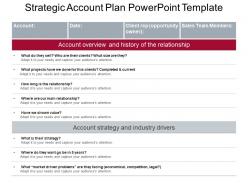
Are you planning to display strategic account planning strategies to meet your business requirements? We are offering our fully professional, business oriented, modern strategic account plan PowerPoint template PPT design to help you to do it. Use this amazing key account management presentation template to help account management team effectively prepare key account plan and let you focus on customer’s objectives to ensure that they are successfully able to achieve business goals. Use this awesome strategic account management plan template to create a consistent customer experience. Sales and business professionals use this wonderful PPT template in strategic account planning, designing, executing sales and business plan that will facilitate business expansion. With the help of this powerful key account management presentation template, you can easily assess customer’s requirements and keep track to ensure that those are being fulfilled. So, keeping your business requirements in mind, just download this wonderful PPT template to display account management and strategies for your business. Address any indication of fear with our Strategic Account Plan Powerpoint Template. It helps handle the jitters.
People who downloaded this PowerPoint presentation also viewed the following :
Strategic account plan powerpoint template with all 5 slides:
Love your job but hate presentations? Strategic Account Plan Powerpoint Template can have them ready without effort.


FAQs for Strategic account
Okay so you need five main things for a decent strategic account plan. Customer intelligence is huge - their goals, pain points, who makes decisions, all that stuff. Relationship mapping comes next (seriously such a pain but you gotta do it). Revenue targets and realistic growth opps are third. Competitive analysis is fourth - where do you actually stack up? Then tactical action plans with real deadlines. Honestly, I'd start by looking at what you already know. Figure out your biggest blind spots first and go from there. The relationship mapping part will probably take way longer than you think.
Pull your customer data first - revenue, growth rates, profit margins. That's where the gold is. Map accounts by deal size potential, how well they fit your solutions, expansion likelihood. Honestly, a simple scoring spreadsheet works better than any fancy tool I've tried. Factor in relationship stuff too - executive access, are they growing, how embedded are you? Target accounts where you can realistically hit 25%+ growth yearly. Your top 10-15 should jump out once you score everything. Those winners get detailed account plans first, obviously.
Honestly, you can't build any decent account strategy without digging into the data first. Look at their buying patterns, how long decisions take, who they're competing with - all that stuff shows you what actually moves the needle for them. Transaction history is gold, plus grab some recent industry reports. That combo usually shows you the best ways in. Short sentences work too. You'll spot which people control budgets and what their real problems cost them. It's like... you wouldn't drive somewhere new without GPS, right? Same logic applies here when you're planning your approach.
Map your big account goals straight down to what each rep actually needs to hit - revenue numbers, relationship stuff, how deep they're getting into each product line. Most teams totally blow this part, honestly. They'll set these huge strategic targets but then reps are just... doing random activities? Connect the dots for them. Daily tasks should clearly tie back to your bigger account strategy. Oh, and don't just set it and forget it - you've got to check in regularly and tweak things when they're not working.
Look, you need regular check-ins but make them about THEIR goals, not your sales pitch. Build relationships with multiple people there - your main contact might leave tomorrow, happens all the time. The accounts that actually stick around? Those are where they see you as someone who gets their business, not just another person trying to sell stuff. Share useful industry info, connect them with other contacts who could help them out. Always do what you say you'll do. Oh and set up some kind of regular communication schedule this quarter. Even if it's just monthly calls.
Track revenue stuff first - growth, deal speed, account expansion. But honestly, the relationship metrics matter just as much. How engaged are your stakeholders? Meeting frequency with key contacts? Champions you've built inside the account? Do quarterly reviews against your original goals. Monitor competitive win rates too. The accounts that feel like actual partnerships always perform better than the transactional ones. Oh, and here's my litmus test - if you can predict their next big move before they mention it, you're doing it right.
Honestly? Most people just pitch whatever they're selling without actually understanding what the company needs. Big mistake. The CFO and IT director care about completely different stuff, so you can't use the same approach for everyone. Also, if your team isn't on the same page, you'll look like amateurs. I've seen that happen too many times. Don't set crazy deadlines either - you need to figure out how they actually make decisions first. My advice? Do way more listening upfront. Research their specific situation and adapt everything to match their process.
Look, CRM platforms are honestly a lifesaver for this stuff. You can track all your customer engagement patterns and spot renewal risks before they become problems. The AI sentiment analysis thing is actually pretty neat - it flags accounts that need attention automatically. What really changed things for me was having those real-time dashboards. No more digging through spreadsheets for hours. You'll see upsell opportunities you'd totally miss otherwise, plus account health metrics at a glance. Oh, and don't go crazy adding new tools right away - start by connecting what you already have first.
Dude, you absolutely need their feedback - it's like your GPS for account planning. Without it, you're just guessing what they want. I've watched so many people build these elaborate plans that totally bomb because they never actually asked the client what mattered to them. Regular check-ins and QBRs are gold for spotting problems early. You'll catch churn risks before they explode and figure out where they're planning to spend next year. Surveys work too, but honestly the casual conversations tell you more. Just don't collect feedback and then ignore it - I see that mistake way too often.
Make a one-page visual that hits the main points - objectives, outcomes, who's doing what. Nobody's reading your 20-page strategy doc, trust me. Put it in shared drives and bring it up in cross-team meetings regularly. The "why" matters way more than the details - connect it back to what the company actually cares about. I'd do quarterly check-ins to keep people engaged. Here's the thing though: your strategy is useless if half your team forgets about it by next week. You'll need to repeat yourself a lot, but that's how you get everyone on the same page when they're making decisions.
Honestly, you've gotta dig deeper than just your gut feeling on these accounts. Pull sales data, customer feedback, competitive intel - hell, I even creep their executives on LinkedIn sometimes for insights. Here's the thing though: focus strengths/weaknesses on your actual relationship dynamics, while opportunities/threats cover market shifts and what competitors are doing. Be brutally honest about where you really stand versus where you think you stand. Update quarterly since things move fast. Most important part? Turn findings into real actions like "build stronger ties with procurement" instead of vague "improve partnership" nonsense.
Quarterly reviews are the sweet spot - I learned this the hard way after letting a plan collect dust for like 8 months. Major waste of time. When you do review, hit the basics: goal progress, relationship updates, new opps, changes in their priorities. That said, don't wait for your scheduled review if something big happens. New stakeholder joins? Update it. Win a huge deal or lose one? Update it right away. The whole thing's pointless if it doesn't match what's actually happening. Oh, and actually put those quarterly reminders in your calendar now or you'll forget.
Dude, working with other teams is a total game changer for accounts. Marketing has all the campaign data and knows what actually works with your targets. Product teams? They'll tell you about cool new features before they drop - perfect timing for pitches. Customer success people are honestly the best - they know exactly which accounts are happy and ready to spend more. Finance helps structure deals so they don't fall apart later (learned that the hard way). Even legal makes contract stuff way smoother. Just don't wait until you're desperate to reach out. Loop everyone in from the start and you'll crush it.
So basically you can't treat every account the same - that's just burning time and money. Think about it like this: rank your accounts by revenue potential and how strategic they are to your business. Then create different tiers - maybe strategic, key, and transactional accounts. Your top-tier clients get your A-team and white-glove service. Smaller accounts still get served but more efficiently. Each segment needs its own playbook too - different messaging, service levels, the whole thing. Honestly, most companies mess this up by trying to give everyone the same experience. Focus your best resources where they'll actually move the needle.
Dude, most sales reps just show up and wing it - huge mistake. Do your homework on what competitors are gonna pitch before you walk in there. Figure out competitor X always talks price first, Y pushes their shiny new features, whatever. Then you can get your differentiators out there before they even bring up the competition. Map their strengths/weaknesses against what each stakeholder actually cares about. Makes your positioning way sharper. Oh, and definitely arm your internal champion with talking points - they need ammo to sell your solution when you're not around to do it yourself.
-
Excellent products for quick understanding.
-
Wonderful templates design to use in business meetings.