


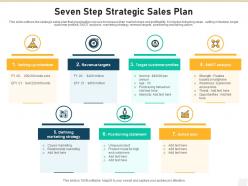
Seven step strategic sales plan





Try Before you Buy Download Free Sample Product
 Impress Your
 Audience
 100%
100% Editable
 Save Hours
 of Time


This slide outlines the strategic sales plan that organisation can use to increase their market share and profitability. It includes following steps setting milestone, target customer profiles, SWOT analysis, marketing strategy, revenue targets, positioning and taking action.
People who downloaded this PowerPoint presentation also viewed the following :
Seven step strategic sales plan with all 2 slides:
Use our Seven Step Strategic Sales Plan to effectively help you save your valuable time. They are readymade to fit into any presentation structure.
FAQs for Seven step
Honestly, start with figuring out exactly who you're selling to - that's the foundation everything else builds on. Then you'll need concrete sales goals (actual numbers, not vague stuff), your unique selling point that sets you apart, and a timeline with real milestones. Don't skip the budget part either - I swear half these plans crash because nobody thought about actual costs upfront. The customer piece is huge though. Once you nail down your ideal buyer and why they'd pick you over everyone else, the sales process and tactics basically write themselves. Map that out first, then work backwards from there.
Honestly, market analysis is just getting the intel to hit the right people with stuff they actually want. Look at your top competitors and how your best customers buy - that combo alone will sharpen everything. You'll spot pricing gaps and figure out which customer segments are worth chasing. Also helps you avoid that cringe moment where you're pushing features nobody gives a shit about anymore. Seasonal patterns matter too, like knowing when people actually have budget to spend. I'd start small though - pick your 3 biggest competitors and really dig into what makes your current customers tick. That's where the real insights are.
So customer segmentation is just splitting your market into different groups - by industry, company size, how they buy stuff, whatever works. Honestly, most people skip this step but it's a game changer. You can actually tailor your pitch instead of using the same boring approach for everyone. Different pricing, messaging, the whole thing. I'd start with your existing customer data and pick maybe 3-4 segments that aren't too crazy to manage. Way better than spraying and praying with your sales efforts.
Start with your company's big goals this year - revenue targets, new markets, product launches, whatever. Work backwards from there to figure out what sales activities actually matter. Don't just copy-paste last year's quotas (guilty as charged on that one). Map everything - targets, territories, resources - directly back to those company priorities. Your reps need to see how their numbers connect to the bigger picture. Makes quotas feel way less random and more like something worth hitting. Honestly, half the battle is just having goals that make sense instead of pulling numbers out of thin air.
Here's what I'd focus on: revenue growth, conversion rates, and sales cycle length first - those show what already happened. Pipeline velocity and lead quality scores are your crystal ball metrics. Activity stuff like calls per rep matters too. Honestly, so many people sleep on tracking customer acquisition cost and it's huge. Individual quota attainment tells you who's crushing it vs struggling. Don't go crazy though - pick maybe 5-7 metrics that actually change how people work, not just vanity numbers. Weekly reviews keep everyone honest.
So CRM systems are basically your sales command center - they track every lead and customer interaction so stuff doesn't slip through. You can automate follow-ups based on your strategy and score leads to focus on the hot ones. Real-time dashboards show what's actually moving the needle. Honestly, running sales without decent tech is like driving cross-country without GPS (been there, not fun). The trick isn't just buying software though. Pick tools that play nice together and actually train your team to use them consistently.
Here's what works for me - grab your last 2-3 years of sales data and spot the patterns. Seasonal stuff, customer habits, all that. Then throw in industry reports and what competitors are doing. Pipeline analysis is clutch since it shows real deals coming down the line. Build out three scenarios: best case, realistic, and the "oh shit" version. Trust me on this one - you don't want to get blindsided. Set monthly check-ins to tweak things as new info comes in. Oh, and pick 3-4 metrics that usually signal changes early. Way better than scrambling to react later.
Honestly, you've gotta know your competition inside and out. Your sales team will get hit with "how are you different from X company?" constantly - trust me on this one. Start simple though. Map out your top 3-5 competitors and figure out their pricing, what they're good at, where they suck, and how they talk about themselves. Don't overthink it with some fancy report. Just have your reps write down what they're hearing from prospects. That real-world feedback is pure gold and way more useful than whatever's on their websites.
Honestly, skip the boring PowerPoint stuff and go straight to hands-on workshops. Let your team actually practice with real scenarios - that's where the magic happens. Don't dump everything on them at once though. Spread the training over a few weeks so it actually sticks. Role-playing different customer situations is clutch for building confidence. Oh, and make sure everyone gets the reasoning behind these changes, not just the steps. The buddy system thing works surprisingly well too - pair people up for support after the formal training wraps. Way less overwhelming that way.
Customer feedback is basically your roadmap for what to change. Sort it into buckets - pricing complaints, feature requests, service problems - then actually do something with it. Most companies just collect this stuff and forget about it, which drives me nuts. Use those insights to tweak your pitch, coach your team on handling objections better, or completely overhaul how you sell. Speed matters here since customer expectations change fast. I'd set up monthly reviews with the sales team to stay on top of trends. Don't just collect feedback - act on it.
Honestly, digital marketing changes everything about how you approach sales. You get actual data on what's working instead of just guessing. Your leads come in warmer too since campaigns can nurture people before they hit up your sales team. The coolest part? You can pivot strategies super fast – like within days instead of waiting forever to see results. Plus tracking every step of the customer journey means no more throwing money at campaigns that aren't doing anything. I'd start by matching your digital stuff to whatever sales funnel stages you're already using.
Dude, the difference is crazy when sales and marketing actually talk to each other. Your lead quality shoots up because marketing can tackle the real objections sales hears every day. Plus sales feeds back what actually works with prospects - not just what sounds good in theory. Most companies suck at this though, there's always some weird turf war happening. But seriously, when you align on who you're targeting and share data regularly? Your pipeline becomes way more predictable. Try having both teams crash each other's weekly meetings for like a month.
Honestly? Misaligned teams are your worst enemy. Marketing and sales will fight constantly if you don't manage it. Then leadership drops these crazy unrealistic targets that sound great in meetings but make zero sense in practice. Everyone gets distracted by the latest shiny tactics too - I've definitely been guilty of that myself. Budget cuts hit out of nowhere, key people quit at the worst times. It's chaos sometimes. Regular check-ins help a lot though. Stay flexible but don't scrap your whole strategy every time something goes sideways.
Honestly, diving into your CRM data is where the magic happens. Pull reports on your top 20% of customers first - see what they actually have in common. Track conversion rates by channel and figure out which sales tactics aren't just busy work. I mean, nobody likes spreadsheets, but you'll spot patterns in customer behavior that'll blow your mind. Which leads close fastest? What messaging works for different types? Your team's probably wasting energy in all the wrong places. The insights from analyzing customer segments and sales cycles will show you exactly where to focus instead.
Honestly, seasonal trends are like your cheat sheet for timing everything right. Pull up last year's sales data first - you'll spot the obvious peaks and valleys pretty quickly. If you're selling holiday stuff, obviously February's gonna be dead, so don't waste energy there. Ramp up your inventory and marketing before the busy seasons actually hit. During slow periods, maybe pivot to different products or strategies? I learned this the hard way when I got caught with too much winter gear in March. Map out when your customers actually spend money, then align your staffing and resources around those patterns. Pretty straightforward once you see it laid out.
-
It saves your time and decrease your efforts in half.
-
Perfect template with attractive color combination.
-
Excellent Designs.
-
The Designed Graphic are very professional and classic.