

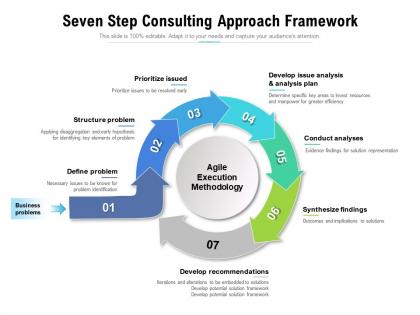
Seven step consulting approach framework




Try Before you Buy Download Free Sample Product
 Impress Your
 Audience
 100%
100% Editable
 Save Hours
 of Time


Our Seven Step Consulting Approach Framework are topically designed to provide an attractive backdrop to any subject. Use them to look like a presentation pro.
People who downloaded this PowerPoint presentation also viewed the following :
Seven step consulting approach framework with all 2 slides:
Use our Seven Step Consulting Approach Framework to effectively help you save your valuable time. They are readymade to fit into any presentation structure.
FAQs for Seven step
Okay so you'll need six main things: problem statement, your solution, scope of work, timeline, pricing, and why your team rocks. Honestly? Nail the problem statement and everything else just clicks into place. Your solution has to actually fix their headaches - sounds obvious but you'd be surprised how many people miss this. Get super specific with scope so you don't end up doing free work later (been there). Throw in real deliverables and timelines that won't make you look like an idiot when you inevitably hit delays. Show off your team's wins, then wrap it up with next steps that are so simple they can't help but say yes.
Dude, you've gotta do your homework on their specific industry first - like, really dig into their pain points and weird jargon before touching those slides. I totally crashed and burned on a healthcare pitch once because I used generic tech examples (still cringe thinking about it). Switch out your case studies for ones from their world. Retail folks obsess over customer acquisition costs while manufacturing is all about operational efficiency. Oh, and ditch the business buzzwords for their actual terminology. Start with challenges they're dealing with right now, then show how you fit into their reality.
Look, data analytics turns your consulting advice from "this seems right" into actual proof. You'll spot patterns showing what's really broken, not just what looks obvious on the surface. When you can point to specific numbers showing where they're losing cash or missing chances? That hits different. Analytics also lets you run what-if scenarios and predict outcomes - so your suggestions come with projected returns. The trick (and honestly where most people mess up) is focusing on metrics that actually connect to their goals, not just whatever data is sitting there waiting to be crunched.
Start by grabbing baseline numbers before you do anything - revenue, costs, whatever makes sense. Then track how things change after your work. Most of us measure through cost savings, revenue bumps, or efficiency improvements. The annoying part? Separating your impact from everything else happening (clients always want credit for the good stuff). Document like crazy: before/after data, timelines, results. ROI formula's pretty straightforward - gains minus your fees, divided by your fees. Don't just focus on hard numbers either. Employee happiness and smoother processes count too. Oh, and set up regular check-ins throughout the project to catch this stuff as it happens.
Honestly, the worst thing you can do is cram way too much onto your slides. Start with your big recommendations right away or you'll lose everyone. Don't just read everything word-for-word either - that's painful to sit through. They hired you for insights, not to be a human teleprompter. Oh, and definitely prep for pushback questions. Nothing's more awkward than getting stumped on something obvious. I always keep extra data handy but won't throw it at them unless they specifically ask. Clear story wins over data dumps every time.
Honestly? Just do what you say you'll do, when you said you'd do it. Show up with real insights about their business - not some cookie-cutter consulting bullshit. I've watched so many people crash and burn because they promised the moon upfront. Don't be that person. If you don't know something, just say so and ask smart questions instead. Quick wins are your friend here - nail the small stuff first. Oh, and this might sound obvious but actually listen to what they're telling you. Follow through on everything, even the random little things they mention in passing.
Figure out your main point first, then work backwards from there. Lead with your big conclusion, not a bunch of setup - that's the pyramid thing consultants always talk about. Clean slides are everything. One clear message per slide, and please don't be that person who shoves 47 bullet points on one screen. I literally cringe every time. Charts and visuals will save you way more than walls of text. Practice those transitions between slides too - nothing kills momentum like awkward pauses. Oh, and always tie it back to what the client actually cares about. They don't want theory, they want to know how this impacts their business.
Dude, document everything upfront - scope, timeline, the works. I swear most client headaches happen because nobody actually wrote down what they agreed to. Don't save problems for weekly meetings. Text quick updates and flag issues early with potential fixes, not just "hey this is broken." Push back on scope creep immediately or you'll hate yourself later. After big conversations, send a recap email like "so we agreed on X, Y, Z..." Trust me, people remember things differently than you do. Oh and be realistic about timelines from the start - overpromising is the worst.
Oh man, where do I even start? Asana's been a lifesaver for project management - way better than sticky notes everywhere. Slack beats email chains any day for client stuff. Excel and PowerPoint are still the bread and butter, though Tableau's worth learning if you're into heavy data crunching. Calendly will save your sanity from all that "when works for you?" back-and-forth. HubSpot's solid for tracking clients and deals too. Honestly though, don't go crazy downloading everything at once - I made that mistake. Pick like two tools first and actually use them.
Honestly? Start by figuring out who's gonna be impacted and what they actually care about. Most pushback happens when people feel left out of the loop. Get your key players involved early - like, when you're still designing things, not just when you're ready to launch. Communication is everything here. Set up different ways for people to ask questions and complain (because they will). I'm a big fan of pilot runs so you can mess up small before going big. Oh, and don't make change management an afterthought - that's where most projects crash and burn. Build it right into your timeline from the start.
Honestly, the biggest thing is getting them involved in actually building the solutions with you - don't just hand over finished recommendations. Make your check-ins into real working sessions where you're both problem-solving together. I always share my thought process openly, shows them I'm not trying to be some mysterious consultant guru. And here's the thing - tell them straight up that they know their business way better than you do. Set up shared docs where everyone can jump in and contribute ideas. Oh, and skip the formal "client-vendor" vibe entirely. You want it to feel like you're teammates working toward the same win.
Honestly, I always brainstorm everything that could blow up first - like scope creep, budget issues, team drama, tech disasters, you name it. Get your whole team involved because they'll spot stuff you totally missed. Rate each risk by how likely it is and how much damage it'd do. Then figure out your game plan for each one. The real trick is checking in weekly - some risks vanish, others just appear out of thin air (which is always delightful). Weekly risk chats with your client are clutch too. Trust me, it beats dealing with surprise meltdowns later.
Look, never share client secrets with anyone - that's like rule
-
Best way of representation of the topic.
-
Great quality slides in rapid time.
-
Easily Understandable slides.
-
Amazing product with appealing content and design.
-
Unique and attractive product design.