7 Step Framework Of Consulting Process

Rating:
80%
7 Step Framework Of Consulting Process
Slide 1 of 6
Favourites Favourites

Try Before you Buy Download Free Sample Product

Audience Impress Your
Audience
Editable 100%
Editable
Time Save Hours
of Time
The Biggest Sale is ending soon in
0
0
:
0
0
:
0
0
Rating:
80%
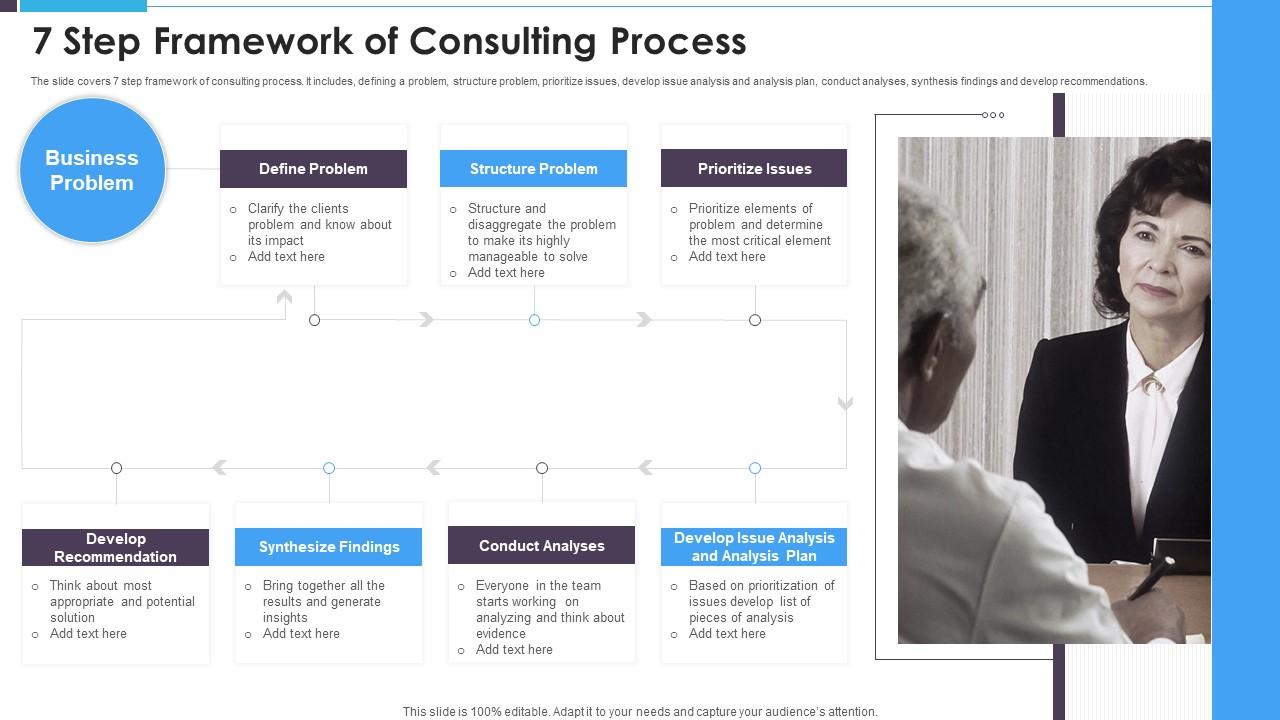
The slide covers 7 step framework of consulting process. It includes, defining a problem, structure problem, prioritize issues, develop issue analysis and analysis plan, conduct analyses, synthesis findings and develop recommendations. Introducing our premium set of slides with 7 Step Framework Of Consulting Process. Elucidate the seven stages and present information using this PPT slide. This is a completely adaptable PowerPoint template design that can be used to interpret topics like Synthesize Findings, Recommendation, Conduct Analyses. So download instantly and tailor it with your information.

Content of this Powerpoint Presentation

Frameworks are important for businesses to progress. A seven-step framework process is crucial for consultants to meet complex challenges and achieve impactful results. The framework will streamline the process, help analyze your client’s current situation, and gather data and insights to inform your clients of your recommendations. Using the broad tenets of the framework process, a consultant develops solutions to meet the needs and resolve challenges of clients.

If you are looking for a framework to solve business problems, download our seven-step consulting methodology templates!

The seven-step consulting methodology templates then act as the major part of the solution you can provide.

This PPT slide will help a consultant differentiate between approvals of proposed solutions, help the client execute the strategies, and evaluate the project's outcomes.

Download the PPT templates for seven consulting methodology processes!!  

Template 1: 7-Step Framework of Consulting Process

The consulting process is multi-step, complex and dynamic. This ready-to-use template provides you the opportunity to demonstrate steps in the consultation process, such as defining the problem, structuring the problem, prioritizing issues, developing recommendations, systemizing findings, conducting analysis, and developing an issue analysis and analysis plan. Through this template, you can ease the consulting process.

In conclusion, the process is complex, and you need ready-to-use PPT Templates to rectify the problem. By having an outline of steps involved in the consultation process, you can easily keep a hold on the whole process, deliver value-added services and provide long-term success to the clients.

P.S. Download ready-to-use PPT template for seven step consulting approach framework!

FAQs for 7 Step Framework

Honestly, most people skip the obvious stuff and wonder why their framework sucks. Define your problem first - like, actually write it down. Break everything into separate buckets so you're not analyzing a giant mess. I always start with a hypothesis instead of just collecting random data (way more efficient). Your final recommendations can't be wishy-washy either. Make them specific. Oh, and here's what changed everything for me - sketch out your whole framework before you start. Sounds extra but it'll save you hours of backtracking later. Trust me on that one.

Honestly, just swap out the industry stuff while keeping your basic structure. So like, healthcare focuses on patient outcomes and compliance, while tech is all about user engagement and growth metrics. The core logic doesn't change - you're just switching your data sources and what counts as "winning." I've watched people try to jam the same framework into every situation and it's painful to see. Research their specific pain points first, then figure out what KPIs actually matter to them. Oh, and don't forget the regulatory stuff - that can totally derail things if you miss it. Once you nail their language, you're golden.

Dude, you absolutely have to get stakeholders involved from day one - seriously, this can make or break everything. Map out who matters first, then actually sit down with them in working sessions. Don't just present some polished framework you made in isolation (been there, total disaster). Co-create it together so you understand their real pain points and how they actually work. The theoretical stuff sounds great on paper but if it doesn't fit their reality, they'll just ignore it. Plus getting their input early builds the buy-in you'll desperately need later when you're trying to roll this thing out.

Consulting frameworks are honestly game-changers - they give you a clear roadmap so you're not constantly wondering what comes next. Your team works way more efficiently because everyone knows their role and deadlines. The best part? They're like guardrails against scope creep, which trust me, will save your sanity when clients start changing everything mid-project. Everyone stays aligned on priorities instead of running in circles. My advice: pick one that fits your project's complexity and actually stick to it. Don't overthink it too much.

Don't force every single problem into whatever framework you picked - total waste of time and your client will be confused as hell. I've watched people turn into complete framework robots, honestly it's painful to see. You can't just ignore the actual industry context either. Here's what works better: use frameworks as your behind-the-scenes thinking tool, then talk to clients in normal language they'll actually do something with. And yeah, don't act like it's some magical cure-all solution. Critical thinking still matters more than following steps blindly.

Don't just slap data analysis on at the end - weave it through everything. Use it upfront to check if your initial ideas actually make sense, then let the numbers guide your research. Here's what really works: stress-test your recommendations with data before you present them. Trust me, it'll save you from those brutal "wait, but what if..." questions later. Oh, and start tracking the right stuff from day one so you can tell if anything you're doing actually moves the needle. Data should be the spine of your whole approach, not some afterthought.

Honestly depends what you're building! Excel and Tableau are solid for data stuff, or Python if you're into that. Asana keeps projects from going sideways - though I personally think Monday's interface is cleaner. For visuals, Miro and Lucidchart are clutch when you need those fancy process maps. But real talk? I've seen consultants crush it with just PowerPoint and a wall of sticky notes. Don't overthink the tools - use what your team actually knows first. You can always upgrade later when things get messier.

Honestly, frameworks are total game-changers for this stuff. Pick something like Kotter's 8-step or ADKAR - they break everything down so it's not this massive overwhelming mess. Each step shows you exactly where people might push back and what to do about it. Super helpful when everyone's panicking about changes (which, let's be real, always happens). The structure thing is huge too. Makes it way easier to update your boss and keep teams on the same page. Just match whatever framework to your company's vibe and how complex the change actually is. Trust me on this one.

Look, track the obvious stuff first - how fast people solve problems, decision quality, client satisfaction. But honestly? The soft metrics matter just as much. Are people actually using your framework or just pretending to in meetings? Revenue impact is what everyone wants to see, though that takes forever to show up clearly. I'd focus on whether you're cutting down analysis paralysis and making meetings less painful - those are underrated wins. Oh, and don't try measuring everything at once. Pick 2-3 things that actually matter for your situation and start there. You'll drive yourself crazy otherwise.

Dude, visual templates are a game changer. You know how people's eyes glaze over when you hit them with paragraph after paragraph? Diagrams and flowcharts fix that instantly. I've watched amazing frameworks totally flop because someone dumped them in boring bullet points. When you're forced to map things out visually, you naturally get more concise and show how pieces connect. Clients can actually follow what you're saying instead of getting lost. Even basic boxes and arrows work - honestly, it'll probably make YOUR thinking clearer too. Way better than text walls.

Honestly, just draw it out first - one page with boxes and arrows showing how everything connects. People need to grasp it in like 30 seconds or they'll tune out. After that, build detailed playbooks for each step. Include the actual questions to ask, what tools to use, all that stuff. Oh, and throw in real examples! Abstract frameworks are pretty much worthless without them. I learned that the hard way. Document why you're doing each step, not just what you're doing - makes it way easier when someone needs to tweak things later. Stick everything somewhere your team can actually access and update it.

So here's what works for me - set up regular check-ins from the start. Weekly client calls, mid-project reviews, that whole thing. Schedule them upfront or they'll disappear when deadlines hit (trust me on this). Make simple templates to capture what bombed, what killed it, what you'd change. The trick is being systematic about it instead of just winging feedback whenever. Collect both client happiness stuff and internal process notes. Then - and this is huge - actually USE that info on your next project. Otherwise you're just doing feedback theater, which honestly drives me nuts.

Honestly, frameworks actually help with creativity - weird but true. Think of it like writing a sonnet. The rules don't kill creativity, they channel it. When you're not burning brain power figuring out HOW to approach something, you can focus on the actual problem. They force you to look at angles you'd probably skip otherwise. Everyone's on the same page too, so building on ideas gets way easier. Next time you're totally stuck (happens to all of us), try MECE or an issue tree. I was skeptical at first, but man, it really does clear up your thinking fast.

Dude, build cultural stuff right into your project phases from day one. Map out who actually makes decisions in each region - it's wild how different that can be. Then adjust your communication style based on local preferences. Seriously, I've watched so many teams crash and burn assuming NYC tactics work everywhere. Tokyo operates completely differently than São Paulo, you know? Keep your process flexible too because rigid frameworks just don't translate well. Maybe start with adding a cultural assessment step to whatever you're using now and go from there.

Honestly, you gotta nail the fundamentals first - MECE thinking, hypothesis-driven stuff, basic data analysis. Case studies are where it's at though. Like, do a million of them until patterns start clicking. Most people bomb this part initially but whatever, that's normal. Learn frameworks like issue trees and market sizing - they're clutch. Grab some case prep books or hit up those online platforms. Oh and definitely find someone who's been there to mentor you through real scenarios. Their feedback on how you structure problems is worth its weight in gold, trust me.

Ratings and Reviews

80% of 100
Review Form
Write a review
Most Relevant Reviews
  1. 80%

    by Donte Duncan

    SlideTeam just saved my project! Thank you so much. The variety of templates helped me showcase multiple perspectives easily.
  2. 80%

    by David Wright

    Great designs, Easily Editable.

2 Item(s)

per page: