

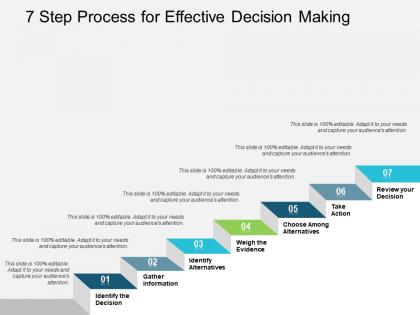
7 step process for effective decision making




Try Before you Buy Download Free Sample Product
 Impress Your
 Audience
 100%
100% Editable
 Save Hours
 of Time


Our 7 Step Process For Effective Decision Making are like a warm breeze. Your thoughts will soar on the strength of their lift.
People who downloaded this PowerPoint presentation also viewed the following :
7 step process for effective decision making with all 5 slides:
Charge your talk with our 7 Step Process For Effective Decision Making. Fast track yourself on the road to success.

FAQs for 7 step process for
Honestly, your brain plays so many tricks on you when making decisions. Emotions are huge - like when you're scared you become way too careful, or when you're pumped up you might do something stupid. Then there's all these mental biases messing with your head. Confirmation bias makes you only notice stuff that backs up what you already believe. Anchoring bias is annoying too. Your past experiences create shortcuts that help you decide faster, but they can also make you miss new opportunities. Oh and don't get me started on social pressure - that'll make you do things you normally wouldn't. Just try to catch yourself when this stuff happens and slow down for the big choices.
Honestly, visuals are a game-changer because people's brains just process pictures way faster than text. Charts and graphs turn those mind-numbing data dumps into actual stories that stick. Your audience will thank you - nobody wants to stare at spreadsheets all day. The trick is keeping them laser-focused on whatever decision you need. Don't just throw in random pretty graphics (though I'm totally guilty of this sometimes). Make sure each visual directly supports your point. I usually figure out my main conclusion first, then build backwards with visuals that prove it.
Oh man, group dynamics are such a pain but super important. You know how some teams just agree with everything to avoid drama? That's groupthink and it kills good decisions. Then you've got the loud people who talk over everyone else - honestly drives me nuts. The quiet ones usually have the best ideas but never share them. People also just follow whatever seems popular instead of thinking it through. Try switching up who runs meetings and maybe do some anonymous brainstorming. Oh, and always have someone argue the opposite side, even if they don't believe it.
Dude, emotions and logic aren't enemies like everyone thinks. Your feelings tell you what actually matters to you - that's valuable info you can't get from spreadsheets alone. Logic helps organize those messy thoughts into something workable. I've seen too many "perfect" decisions fall apart because they ignored the human element entirely. Works best when you listen to your gut first, then crunch the numbers. Don't try to be a robot about big choices. Next time you're torn on something, pay attention to that initial reaction - it's probably telling you something important your brain hasn't caught up to yet.
Honestly, just match the framework to how big the decision is. Daily stuff? Pros/cons lists work fine, or that 10-10-10 thing where you think about how you'll feel in 10 minutes vs 10 years. Bigger choices need more structure - SWOT analysis or decision matrices where you score each option. I'm weirdly obsessed with "pre-mortems" where you imagine everything went wrong and figure out why. Sounds dramatic but it actually helps catch blind spots. Pick something that fits your timeline though. Maybe try one framework this week on whatever medium-stakes thing you're wrestling with?
Honestly, data's pretty great for catching stuff you'd totally miss just winging it. Plus it keeps you from making those facepalm decisions based on hunches. But here's the thing - you can easily get stuck analyzing forever instead of actually deciding anything. Numbers also miss the whole story sometimes, like office politics or customer mood shifts. And yeah, crappy data = crappy choices, obviously. I'd say use what you've got but don't overthink it. Give yourself a cutoff date or you'll be researching until next year. Your gut still matters too.
So basically your brain takes these mental shortcuts that can totally mess with your judgment. Like confirmation bias - you'll just notice stuff that backs up what you already think. Pretty annoying tbh. When you've got a big decision coming up, slow down and actually look for viewpoints that challenge yours. Ask yourself what would prove you wrong? I use this thing called the 10-10-10 rule too - will this decision matter in 10 minutes, months, and years? Honestly just catching yourself making snap judgments is huge. Once you start noticing it, you can't unsee it.
Your gut's actually pretty smart when you're under pressure or dealing with people stuff. Like, your brain picks up on patterns you can't consciously process fast enough. Emergency situations? Trust it. Reading someone's mood or navigating office politics? Definitely go with intuition. Also works great when you've got tons of experience in something - your subconscious knows more than you think. Career pivots, relationships, creative projects... these don't have neat formulas anyway. Too many moving pieces to analyze everything. I'd say if it involves human emotions or you're in your wheelhouse, listen to that inner voice.
Start with psychological safety - people won't share ideas if they're scared of getting shot down. Ask the quiet ones what they think (they usually have the best insights, honestly). Model decision-making by talking through your process out loud. Don't be that leader who kills every idea before it gets oxygen. Give your team the info they need and set actual deadlines so things don't drag forever. Here's the key part: celebrate good decisions AND smart failures. That's how you build a team that isn't paralyzed by fear of making the wrong call.
Honestly, the biggest game-changer is getting different viewpoints before you commit to anything. Don't just go with your gut or whoever's being loudest. Give yourself actual deadlines though - otherwise you'll overthink forever (guilty of this myself). Break big decisions down into chunks and make those pro/con lists. They actually help more than you'd think. Oh, and write down why you chose what you chose so you can see later if you were right. Lower stakes stuff is perfect for practicing this whole thing. It's about being thorough without getting paralyzed by options.
Oh man, this used to trip me up constantly until I started paying attention. People from different cultures make decisions totally differently - some need the whole group to agree first, others just go with their gut. In meetings, you'll see colleagues from more hierarchical backgrounds waiting for the boss to speak up while everyone else is already arguing. Time's a big factor too. Some want answers yesterday, others need weeks to think it through. Honestly? Just ask your team how they like to make decisions instead of trying to guess.
So scenario planning is basically thinking through different "what if" situations before you decide anything. You map out a few realistic possibilities - best case, worst case, maybe something in between. It's like having backup routes planned before you hit traffic, you know? This way you won't get totally blindsided by surprises. You can spot risks early and have backup plans ready. Don't go crazy with too many scenarios though - I learned that the hard way. Just focus on the ones that would actually change what you'd do.
Look, AI's pretty solid for churning through tons of data and catching patterns you'd miss. Takes the emotion out of it too, which is nice. But here's the thing - it's absolutely clueless about context and those weird situations that always come up. You know how every company has its own quirks and politics? Yeah, AI doesn't get any of that. I'd say use it to do the heavy lifting on analysis, but don't let it make the actual decision. That's still on you. Trust me, you'll want your gut involved in the final call.
Dude, first thing - think about who actually gets screwed over or benefits from whatever you're deciding. Your team, customers, the whole community matter here. Obviously follow the legal stuff and industry rules, but honestly? Sometimes things are technically legal but still feel sketchy as hell. Would you be cool seeing this splashed across social media tomorrow? That's always my gut check. Document everything though - you'll thank yourself later when someone asks why you made that call. Oh and don't just chase profit, the long-term fallout can bite you.
Think of feedback loops as your personal reality check system. You make a decision, see what actually happens, then figure out where you went right or wrong. The brutal honesty part is key – nobody wants to admit they screwed up, but that's honestly where you learn the most. I used to hate tracking this stuff, but now I catch myself making the same dumb mistakes way less often. You'll start noticing patterns in how you think and hopefully avoid those mental traps. Just pick something you decide on regularly and track it for a month or so.
No Reviews