


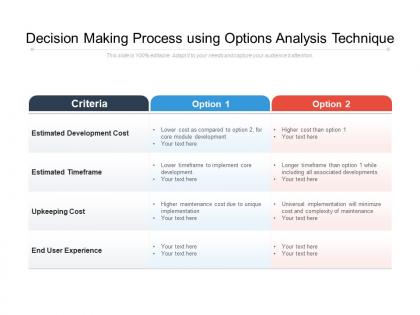
Decision making process using options analysis technique




Try Before you Buy Download Free Sample Product
 Impress Your
 Audience
 100%
100% Editable
 Save Hours
 of Time


Elaborate on the importance of etiquette with our Decision Making Process Using Options Analysis Technique. Clearly explain how everyone benefits.
People who downloaded this PowerPoint presentation also viewed the following :
Decision making process using options analysis technique with all 2 slides:
Explain how everyone benefits by following etiquette with our Decision Making Process Using Options Analysis Technique. Give it the importance it deserves.
FAQs for Decision making process using
Okay so for options analysis, you've got five main things to nail down. Start by figuring out what problem you're actually trying to solve - sounds obvious but people skip this step all the time. Then brainstorm every possible alternative, not just the first ones that come to mind. Map out costs, benefits, risks and timelines for each option. Here's where I usually mess up - the feasibility check. Can you actually do this with what you have? Be honest about your resources and constraints. Finally, throw it all into a decision matrix to compare objectively. Oh and tackle your options list first, then work through everything else systematically.
So basically, instead of just going with whatever feels right, you actually map out all your options side by side. List the pros, cons, what each thing costs, probable outcomes - yeah it's kinda boring but seriously helps. I always miss stuff when I just wing it. You'll catch risks you didn't think about and maybe spot some opportunities too. Honestly the best part is feeling confident about your choice afterward, plus you can actually explain why you picked it if someone asks. Next time you're torn between a few things, just make a simple chart comparing them.
So regular cost-benefit analysis just looks at upfront costs vs expected returns - pretty straightforward. Options analysis is different though. It's about keeping your choices open for later when you actually know what's happening. Think of it like buying insurance against uncertainty, I guess? Markets shift, tech changes, and you might want to expand or pivot your project down the road. Traditional CBA assumes you'll make one decision and stick with it forever. But honestly, that's not realistic anymore. If you're in a volatile industry, build in some flexibility from the start so you're not locked into something that doesn't make sense later.
Honestly, I'd go with cost-benefit analysis first - just map out the money stuff for each option. Decision matrices are clutch when you've got like 5 different things to weigh (score each choice against your must-haves). SWOT analysis sounds fancy but it's just listing strengths, weaknesses, opportunities and threats for each path. Pro-con lists work fine too, though they're pretty basic. Start with whatever clicks for you first. If it's a huge decision, you can always do multiple methods - I sometimes go overboard with this stuff when I'm stressed about choosing wrong.
Options analysis is literally about dealing with uncertainty - you're choosing a path when you can't see what's coming. Map out different scenarios for each choice. Think about how likely each outcome is and what it'd mean for your goals. What could go wrong? What could go really well? Focus on the risks you can actually do something about (some you just can't control, honestly). I always start by listing potential upsides and downsides for each option, then figure out which vulnerabilities worry me most. It's basically organized guessing, but way better than just winging it.
Look, stakeholder analysis is just figuring out who actually cares about your decision and who has the power to kill it. Map out everyone who's affected by each option - what pisses them off, what gets them excited, that sort of thing. I swear, people always skip this step then act shocked when their brilliant idea gets torpedoed in the meeting. Rate each person's influence and how much they care. This way you'll know who to win over first and what arguments will actually work on different people. Plus you can spot potential roadblocks before they wreck everything.
Okay so first thing - figure out exactly what problem you're solving and what success looks like. Brainstorm every option you can think of, even the weird ones. Don't judge yet, just dump it all out. Then make a list of what matters: cost, timing, how risky it is, whatever applies to your situation. I always think I have like 3 criteria but end up with 8, which is honestly fine. Score each option against your list and see what comes out on top. The math usually points you in the right direction, but if your gut's screaming something different, pay attention to that too. Write it all down so you can explain your thinking later.
Start with whatever your broker gives you - most have decent basic tools for pricing and Greeks. ThinkorSwim is honestly the best if you can get it, super comprehensive. OptionsPlay and OptionNet Explorer are solid too for strategy stuff and seeing your risk visually. I mean, you could use Yahoo Finance or MarketWatch for simple things but they're pretty meh. Oh and if you're getting serious about this, paying for good software is worth it - you'll spot things you'd totally miss otherwise. Just begin with your broker's tools first, then upgrade when you know what you actually need.
So basically, you're not putting everything on one choice, right? You map out different moves - maybe expanding markets, buying out competitors, or just focusing harder on what you already do well. Way smarter than just winging it (though honestly, gut instinct isn't always wrong). The cool part is comparing everything side-by-side. You can actually see the risks and returns for each path instead of just guessing. I'd start simple - write down 3 or 4 realistic options for whatever big decision you're facing and rank them against what matters most to you.
Honestly, rushing through it is the worst thing you can do. I always get way too attached to my first idea and then just look for data that backs it up - super bad habit. You gotta actually think about what it'll cost to implement stuff too, not just whether it sounds good on paper. Oh, and make sure you're comparing similar things. Sounds obvious but I've screwed that up before. My go-to move is setting up some kind of scoring system right at the start. Keeps me from flip-flopping or going with whatever feels right in the moment. Makes the whole thing way less messy.
Options analysis is basically your "what if" toolkit for projects. Instead of jumping on the first decent idea (guilty of this myself!), you map out 3-4 different approaches. Then score each one on stuff like cost, timeline, and risk. Sounds boring but it's actually pretty smart - gives you solid backup when your boss inevitably questions everything. I learned this the hard way after a project went sideways because we didn't consider alternatives. Now I always compare options before committing resources. Makes decisions way less stressful and more defensible.
So I always break this down into three things: impact, feasibility, and strategic fit. Impact is basically your potential ROI - will this actually matter for your business? Feasibility is the reality check - do you have the time, money, and team to make it happen? Strategic fit means it won't mess with your other goals. Honestly, most people skip the feasibility part and get burned later. Try scoring each option 1-5 on all three, then just work through them from highest to lowest score. Works pretty well in my experience.
Your company's setup totally dictates which options make sense to even consider. Risk tolerance, budget, goals - all that stuff filters what's actually doable. Startups usually go for fast and scrappy moves, while big corps want the safe, tested route. (God, the red tape at some places is insane.) Culture matters too - some teams love experimenting, others need everything bulletproof first. Don't just copy what worked somewhere else. Your industry rules, stakeholders, and internal politics all change the game. Map your analysis to what actually fits your reality.
Netflix is probably your best bet to start with - their DVD to streaming transition is so well documented and shows how they weighed timing against market risks. Amazon's AWS story is solid too, where they had to decide between keeping cloud services internal or going big externally. Tesla's battery supply chain stuff is actually fascinating for scenario planning (even if Elon's... well, you know). Boeing's 787 development had issues but their technical analysis process was pretty thorough. Honestly, Netflix will give you the clearest picture of how they juggled different strategic paths and timelines.
Numbers tell you what's happening, but qualitative stuff explains why. Like, your data might say Option A beats Option B by 20%, but interviews could reveal that nobody actually trusts Option A. There's always some messy human element - office politics, cultural weirdness, whatever - that spreadsheets totally miss. I've watched so many "winning" options crash because we ignored the qualitative red flags. My approach? Use numbers to narrow things down first. Then dig into the human side to see if your choice will actually survive contact with reality.
No Reviews