

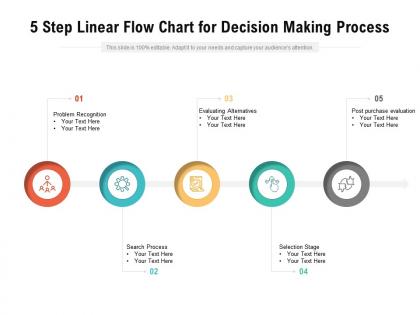
5 step linear flow chart for decision making process




Try Before you Buy Download Free Sample Product
 Impress Your
 Audience
 100%
100% Editable
 Save Hours
 of Time


Our 5 Step Linear Flow Chart For Decision Making Process are topically designed to provide an attractive backdrop to any subject. Use them to look like a presentation pro.
People who downloaded this PowerPoint presentation also viewed the following :
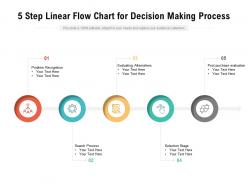
5 step linear flow chart for decision making process with all 2 slides:
Use our 5 Step Linear Flow Chart For Decision Making Process to effectively help you save your valuable time. They are readymade to fit into any presentation structure.
FAQs for 5 step linear flow chart for
Key factors influencing effective business decision-making include comprehensive data analysis, stakeholder input, risk assessment, resource availability, and strategic alignment with organizational goals. These elements work together by minimizing uncertainty, accelerating consensus-building, and ensuring sustainable outcomes, with many organizations finding that structured decision frameworks ultimately deliver faster execution and competitive advantage in increasingly complex markets.
Cognitive bias impacts decision-making by distorting information processing, limiting perspective evaluation, and creating systematic errors in judgment. These mental shortcuts can lead to overconfidence in financial planning, confirmation bias in hiring decisions, and anchoring effects in negotiations, with many organizations implementing structured decision frameworks and diverse team input to minimize bias influence and enhance strategic outcomes.
Data analysis enhances decision quality by transforming raw information into actionable insights, identifying patterns and trends, reducing uncertainty, and providing evidence-based foundations for strategic choices. Through predictive analytics and statistical modeling, organizations in healthcare, finance, and retail make more accurate forecasts, minimize risks, and optimize resource allocation, ultimately delivering faster responses and competitive advantages.
Group dynamics significantly influence collective decision-making through social pressure, groupthink tendencies, power imbalances, communication patterns, and role hierarchies within teams. While these dynamics can sometimes lead to conformity or delayed decisions, organizations increasingly leverage structured facilitation techniques, diverse perspectives, and collaborative technologies to enhance group decision quality, ultimately delivering more innovative solutions and stronger stakeholder buy-in across departments.
Emotional intelligence improves decision-making by enhancing self-awareness, managing stress responses, and recognizing emotional biases that cloud judgment. Through better emotional regulation, individuals make more balanced choices, accurately assess risks and opportunities, and consider long-term consequences rather than reacting impulsively, ultimately delivering more strategic and effective outcomes.
Common corporate decision-making models include rational decision-making, consensus building, delegation frameworks, data-driven analytics, and scenario planning approaches. These models streamline organizational choices by establishing clear processes, reducing bias through structured evaluation, and enabling faster responses to market changes, with many companies finding that combining multiple models delivers better outcomes and competitive advantage.
Risk assessment enhances decision outcomes by identifying potential threats, quantifying their impact, and evaluating likelihood of occurrence across different scenarios. Through systematic analysis, organizations streamline resource allocation, minimize unexpected losses, and optimize strategic planning, with many financial institutions and healthcare providers finding that structured risk frameworks ultimately deliver faster approvals and more confident investment decisions.
Techniques include rapid assessment frameworks, time-boxing decisions, leveraging cross-functional input, scenario planning, and establishing clear decision criteria beforehand. These approaches streamline choices by minimizing analysis paralysis, creating structured evaluation processes, and enabling faster consensus-building, with many organizations finding that pre-defined escalation paths and decision matrices ultimately deliver more confident leadership and improved operational responsiveness.
Decision-making frameworks enhance project management by providing structured approaches for resource allocation, risk assessment, timeline optimization, and stakeholder communication. Through methodologies like decision matrices and cost-benefit analysis, project managers streamline critical choices around scope changes, vendor selection, and priority setting, ultimately delivering faster project completion and improved outcomes across organizations.
Organizational culture significantly shapes decision-making practices by influencing communication patterns, risk tolerance, hierarchy structures, and collaborative approaches within teams. In hierarchical cultures, decisions flow top-down with limited input, while collaborative cultures encourage cross-functional participation, ultimately delivering faster innovation and enhanced employee engagement across diverse organizational levels.
Visualization tools aid decision-making by transforming complex data into clear charts, graphs, and dashboards that reveal patterns, trends, and insights at a glance. These tools enable executives to quickly identify opportunities and risks, compare scenarios effectively, and communicate findings to stakeholders, ultimately accelerating strategic decisions and improving organizational alignment across teams.
Ethical decision-making considerations include fairness and equity, transparency and accountability, stakeholder impact assessment, long-term consequences, and cultural sensitivity. These principles guide organizations by ensuring inclusive processes, minimizing harm to communities and employees, and building sustainable trust with customers, ultimately delivering competitive advantage through enhanced reputation and stakeholder loyalty.
AI reshapes traditional decision-making by automating routine choices, analyzing vast datasets in real-time, and providing predictive insights that human analysis alone cannot match. Through machine learning algorithms, organizations in healthcare, finance, and retail streamline operations, reduce human bias, and accelerate strategic responses, ultimately delivering faster, more accurate decisions while enabling leaders to focus on complex strategic initiatives.
Leaders can ensure stakeholder engagement through transparent communication, structured consultation processes, collaborative workshops, regular feedback sessions, and inclusive decision frameworks. These strategies enhance buy-in by involving stakeholders in problem definition and solution development, with many organizations finding that early engagement reduces resistance while accelerating implementation timelines and improving decision quality.
Scenario planning facilitates proactive decision-making by developing multiple future possibilities, identifying potential risks and opportunities, and creating flexible response strategies before uncertainty materializes. Organizations across sectors like healthcare, finance, and manufacturing use this approach to stress-test decisions, allocate resources more strategically, and maintain competitive advantage when market conditions shift unexpectedly.
No Reviews