

5 steps flow illustrating design thinking process




Try Before you Buy Download Free Sample Product
 Impress Your
 Audience
 100%
100% Editable
 Save Hours
 of Time


Our 5 Steps Flow Illustrating Design Thinking Process are topically designed to provide an attractive backdrop to any subject. Use them to look like a presentation pro.
People who downloaded this PowerPoint presentation also viewed the following :
Content of this Powerpoint Presentation
Businesses that incorporate design thinking into their processes are known to have an edge over the competition. Apple is a company that pioneered this kind of outlook to its products and created a record of success and the ability to wow customers.
Find an overview of the design thinking process flow with prototyping here.
At its core, design thinking is about giving customers more than a great, tangible product; it’s about the intangible, the design that is much more than mere functionality. For instance, Apple’s design and look give more pride than the actual functionality of a phone, which is a well-surveyed fact.
Yet, how businesses go on to make the most of design thinking is through a process flow.
The process flow will usually have variations and iterations based on the industry, the product, and other limitations related to the business structure.
Businesses want to master creative design but have the pain point of being unable to draw up and collate all the information in one place.
Here’s a five-stage design thinking process that makes you bright.
At SlideTeam, we have curated best-in-class templates with inputs from subject experts and designers into a clutter-free design for all to see and master.
Even better, each of the templates is 100% editable and customizable. You get structure, a starting point, and the capability to change each presentation to an audience profile.
Let’s explore!
Template 1 Five-step Flow Illustrating Design Thinking Process
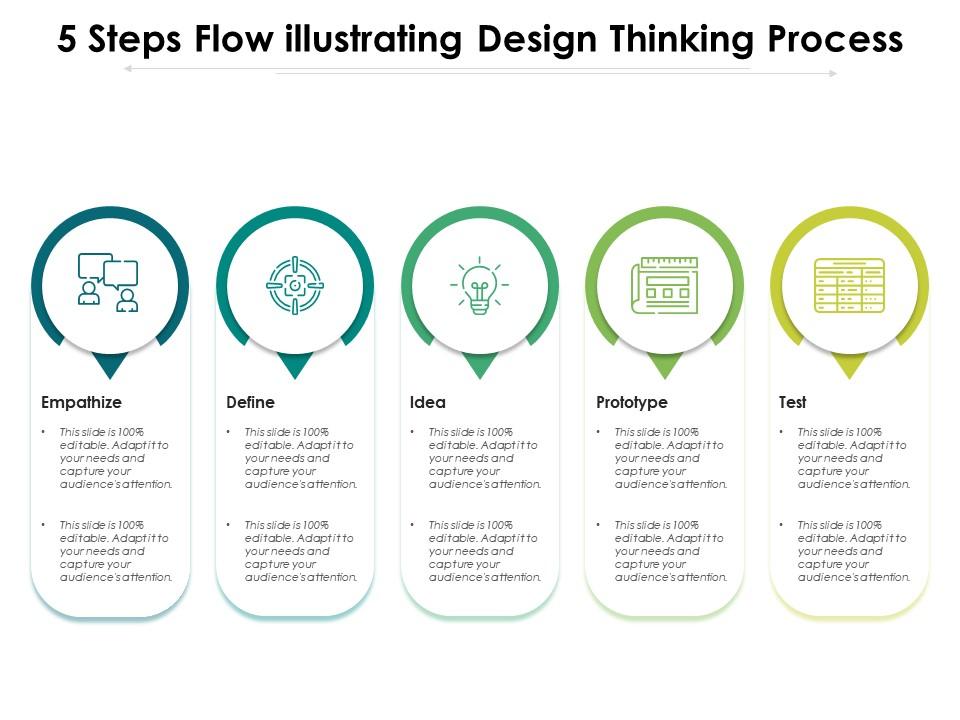
This PowerPoint Template helps companies and businesses understand the five-step flow that marks design thinking. The icons are thoughtful and help you see how the ideas gel together to create necessary magic around creating products and services that incorporate design thinking. Incorporate this professional and appealing PPT Slide to illustrate how Empathy or the ability to empathize is the first to design thinking. Also, look at the logo to understand how dialogue and continuous interaction with stakeholders, especially customers, facilitates this process. The slide touches upon the following four steps in design thinking: define, idea, prototype, and test. In Define, the target is essential as to how close you are to the center of the board; in idea, we have the feedback from Empathy combined with your definition of what you can do to give us practical, hands-on ideas.
Through the concept of prototype, this PPT Diagram showcases key ways to create a working model of the idea and outlines a process that combines the best of both worlds to create a blueprint that will win both investment and support. It is a pre-designed PowerPoint Slide exhibiting five domains in Design Thinking that play a pivotal role in ensuring your products and services get an edge in the market.
*****
DESIGN YOUR BUSINESS SUCCESS MODEL NOW!
With design thinking, companies can go beyond the mere functional and create models and prototypes that offer success in far more profitable ways. Ordinary gifting chocolate is okay, but what about adding a thoughtful note or another layer of eclairs to make the customer feel even more special? With these design interventions, business value goes up, and one embarks on the design adventure. Get even more details and ideas with a download of our template.
PS Get five stages of the design thinking process here.
5 steps flow illustrating design thinking process with all 2 slides:
Use our 5 Steps Flow Illustrating Design Thinking Process to effectively help you save your valuable time. They are readymade to fit into any presentation structure.
FAQs for 5 steps flow illustrating
So there are five main stages: Empathize, Define, Ideate, Prototype, and Test. First you research users through interviews to understand them. Define the actual problem clearly. Ideate is just brainstorming a bunch of solutions - honestly kind of fun once you get going. Build quick, messy prototypes to test ideas without spending tons of cash. Then test with real users to see what sucks and what doesn't. The process isn't really linear though, you'll jump around between stages constantly as you figure things out. I'd start with user research if it's something totally new.
Here's the thing about design thinking - most companies totally mess this up by jumping straight to solutions. Start with empathy instead. Talk to your actual customers, watch how they work, figure out what's really bugging them (not what you assume). Then define that core problem super clearly. Brainstorm a bunch of solutions without being picky. Build cheap, quick prototypes to test your ideas. Get real feedback from users throughout. I know it sounds obvious, but seriously - pick one small problem and just try this process. Your users should be driving every choice you make, not your gut instincts.
Dude, empathy is everything in design thinking. You've gotta actually talk to people and watch how they use stuff - not just assume you know what they want. Most teams hate this part because it feels touchy-feely, but trust me, it's what stops you from building complete garbage nobody needs. I've seen so many projects fail because they skipped straight to solutions. Without really understanding your users' problems first, you're basically throwing darts blindfolded. Next time, spend real time with actual users before you build anything.
Okay so first thing - everyone needs to feel safe throwing out crazy ideas without getting shut down. Rotate who runs the sessions so it doesn't get stale. Get some snacks too, honestly makes a huge difference in the vibe. Use sticky notes and whiteboards so people can brainstorm at the same time instead of waiting around. The big game-changer is getting everyone to say "yes, and" instead of immediately shooting things down with "but." Oh and define what you're actually trying to accomplish before you start - saves so much time later. Clear roles help too so people aren't talking over each other.
Brainstorming's great but honestly gets stale fast. Mix in mind mapping or try the SCAMPER technique - way more fun than it sounds. "How Might We" questions work too. My favorite though? Crazy 8s where you sketch 8 ideas in 8 minutes. Sounds awful but somehow pushes you past obvious stuff. After you've got a million scattered thoughts, affinity mapping helps sort the chaos. The whole point is making it okay to throw out terrible ideas alongside good ones. Switch between solo time and group sessions since not everyone thinks out loud. Pick one method you haven't tried yet for your next session.
So basically, most problem-solving jumps straight to solutions, right? Design thinking flips that - you start by really getting to know the people you're helping first. What actually bugs them? How do they behave? It's messier than traditional methods but way more human-focused. You prototype fast, test constantly, and pivot when stuff doesn't work. Honestly, failing early is kind of the point. The biggest difference? You're always checking your ideas with real users instead of just assuming you know what they want. Next time, try interviewing people before you brainstorm anything.
Honestly, the hardest part is getting people past the "touchy-feely" stigma - engineers especially hate the empathy exercises. Time's always an issue too since design thinking feels slow compared to just building stuff. Leadership thinks it looks chaotic and unproductive from their perspective. Oh, and if your team's all similar backgrounds, good luck getting truly different viewpoints. Start with just one small project though. Once you show real results, people stop rolling their eyes at the process. Then you can slowly spread it around without the whole "here's our new mandatory methodology" vibe.
Honestly, prototyping is where the magic happens. Gets your ideas out of your head so you can actually see what works. Testing early catches those weird blind spots we all miss - way better than endless brainstorming sessions (been there, done that). Real users will tell you stuff your team never thought of. Each round helps you fix things before you've blown your whole budget. Start super simple - I'm talking paper sketches if that's all you got. Test with actual people ASAP. The quicker you iterate, the less painful pivoting becomes.
So basically, design thinking flips everything around - you actually focus on what customers need instead of what you *think* they need. Start with empathy interviews to dig into their real problems. Then prototype and test stuff with them before you waste time building the wrong thing. I swear this approach has saved me from pursuing so many "brilliant" ideas that nobody actually wanted lol. The whole process is iterative, so you're constantly checking if you're on the right track. Seriously, just do one customer interview this week. You'll probably discover their pain points are totally different than what you assumed.
Look at the usual stuff first - user satisfaction scores, adoption rates, how fast you're shipping. Revenue from new solutions obviously matters too. But honestly? The softer metrics are where you'll see the real magic happen. Check if teams are collaborating more, if people have gotten more experimental. Are they actually using the methods day-to-day? Survey folks about their problem-solving confidence and how well they get their customers now. My favorite indicator though - when teams naturally start with user research instead of diving straight into building stuff. Quarterly pulse checks work great for tracking these shifts.
Dude, design thinking is literally everywhere now - healthcare, finance, retail, you name it. Hospitals use it to fix patient experiences. Banks finally figured out how to make their services less soul-crushing (honestly, about time). Even government agencies are jumping on board to help citizens navigate their mess of services. Manufacturing companies apply it for innovation too. Here's the thing - it works because every industry has human problems that need creative fixes. My advice? Find your biggest customer headache first. That's usually where you'll get the most bang for your buck when starting out.
Yeah, remote design thinking definitely works! I'd start with tools like Miro or Figma - they're lifesavers for brainstorming sessions. Break your workshops into shorter chunks though, because honestly, nobody can focus on Zoom for 4 hours straight. Video calls are great for user interviews, and you can still test prototypes through screen sharing. The tricky part is documentation since you can't peek at everyone's notes anymore. Record everything and set up shared folders where people can dump ideas as they come up. Maybe try digitizing just one part of your process first instead of going all-in immediately.
Honestly, start with getting your executives on board - they need to actually DO this stuff, not just preach it. Mix up your teams across departments and let people mess up without getting in trouble (failure's gotta be okay or nobody tries anything new). Skip the PowerPoint sessions and do real workshops instead. Your office setup matters more than you'd think - people need messy spaces to build prototypes and brainstorm. Oh, and definitely connect your wins back to actual business numbers so leadership sees it's not just fluffy creative nonsense. Begin with one small pilot project and let the good results speak for themselves.
Make feedback a constant thing, not something you save for the end. Circle back during those user interviews to double-check what people actually mean. When you're brainstorming ideas, bounce stuff off your team constantly - seriously, so many people screw this up by trying to work alone. Get your crappy first prototypes in front of users ASAP, even if they look terrible. I know it's scary but it's worth it. The trick is making feedback collection feel automatic. Schedule regular check-ins and actually block time to iterate on what you discover.
Honestly, empathy is where you gotta start - like actually getting what frustrates people day-to-day. Listen more than you talk. Don't worry if situations feel messy or unclear, that's kinda the whole point with design thinking. Visual stuff helps even if your drawings look like a 5-year-old made them (mine definitely do). Collaboration's huge since you're always working with different personality types. Oh, and question everything - sometimes the "problem" everyone's obsessing over isn't even the real issue. Just start watching how people struggle with random objects around you.
-
Use of different colors is good. It's simple and attractive.
-
Nice and innovative design.
-
Excellent template with unique design.