


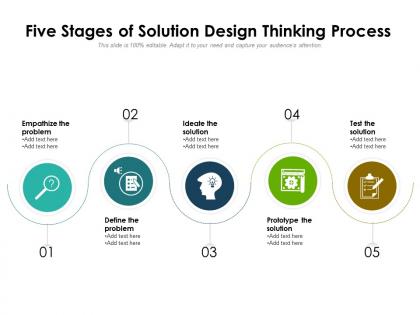
Five stages of solution design thinking process




Try Before you Buy Download Free Sample Product
 Impress Your
 Audience
 100%
100% Editable
 Save Hours
 of Time


Our Five Stages Of Solution Design Thinking Process are explicit and effective. They combine clarity and concise expression.
People who downloaded this PowerPoint presentation also viewed the following :
Five stages of solution design thinking process with all 2 slides:
Give your audience a fulfilling experience. They will find our Five Stages Of Solution Design Thinking Process elevating.
FAQs for Five stages of solution
So Design Thinking has these five stages: Empathize, Define, Ideate, Prototype, and Test. First you figure out what users actually need and where they're struggling. Then define the exact problem you're tackling. Brainstorming comes next - just throw out tons of ideas without judging them (honestly the messiest part but also kinda fun). Build quick prototypes of your favorites and test with real people. Here's the thing though - you don't have to go in order. You'll jump around based on what you discover. If your team's never done this before, maybe just pick one stage to start with?
Honestly, you've gotta flip your whole approach - put empathy first, not last. Actually sit down with your users and listen. Like really listen, don't just wait for them to agree with what you already think. Interview them, watch how they work, map out their whole experience. Document the frustrating stuff and how it makes them feel. When you're designing, keep asking "would Sarah from accounting actually want to use this?" I swear, having real user quotes visible during meetings changes everything. Your team will stop thinking like engineers and start thinking like humans. Oh, and try those role-playing exercises where people argue from different user perspectives - sounds cheesy but it works.
Okay so prototyping is where you stop overthinking and just build something rough to test your idea. Could be sketches, wireframes, even acting out scenarios - whatever gets your concept into the real world fastest. The goal? Fail quickly and cheaply so you can fix things before dumping serious money into it. Honestly, this is where most "genius" ideas either prove themselves or fall apart completely. Don't waste time making it pretty first - just get the bare minimum version working and show it to people. You'll learn way more from one messy prototype than hours of planning.
Dude, cross-disciplinary teams are seriously amazing for design thinking. You get engineers worried about feasibility, designers obsessing over user experience, marketers thinking about who'll actually buy this thing. It's wild how different people ask totally different questions about the same problem. I've seen some incredible breakthroughs happen when someone completely outside your field just goes "wait, why are we even doing it this way?" The trick is rotating who runs each phase - like let the designer lead user research, then hand it to the engineer for prototyping. Oh, and make sure everyone actually gets to talk during brainstorming. Nobody likes being the token [insert discipline here].
Honestly, stakeholder alignment is gonna be your biggest headache. Everyone thinks they know what the solution should be and you'll get yanked in ten different directions. Time's always against you too - never enough runway to actually research properly or test things out. Then there's the fun part where user needs clash with what's technically possible and what budget allows. Most projects die right there, in my experience anyway. Plus people hate changing how they already do things, even if it sucks. My two cents? Draw hard lines early on what you're solving for. When everything goes sideways (and it will), just keep coming back to that original problem you set out to fix.
Don't wait until the end to get user feedback - weave it throughout everything. Get users involved right when you're defining the problem so they can tell you what's actually broken. Quick concept tests during ideation are gold, or honestly just grab coffee with a user and chat. I've learned more from random conversations than formal sessions sometimes! Prototype with low-fi stuff first and get reactions before building anything expensive. The trick is keeping it casual, not some big intimidating process. Just set up regular check-ins with your user group and make it feel natural.
Miro and Mural are solid for digital collaboration - everyone can jump in at once. But honestly? Sometimes plain sticky notes and Sharpies work better for that initial energy when people are bouncing ideas around. Grab a timer to keep things moving and voting dots for when you need to prioritize stuff. Templates help too, like for journey mapping or whatever framework you're using. The tools don't really matter though. What matters is people feeling comfortable enough to throw out crazy ideas. I'd start with basic stuff first - you can always upgrade later based on what your team actually ends up using.
Honestly, design thinking is a game-changer because it makes you actually dig into what users need before you start building stuff. Your team ends up questioning all those "we've always done it this way" assumptions. The whole prototype-and-test thing? Yeah, it sounds annoying but you catch problems early instead of after you've already built the wrong thing. I've seen teams waste months on features that nobody even wanted. The workshops are pretty cool too - gets everyone from different departments actually talking to each other for once. Definitely try a design sprint next time you're stuck. You'll probably discover your "obvious" solution isn't so obvious after all.
So instead of starting with the problem and grinding toward a fix, Solution Design Thinking does the opposite. You picture your dream outcome first, then work backwards to figure out what actually needs solving. It's like planning a trip by picking where you want to end up, you know? The old way keeps you stuck thinking inside the box of whatever's broken right now. But this opens up way more creative possibilities - honestly, some of the best solutions I've seen came from this approach. Next time you're stuck on something, try sketching out what perfect looks like first.
So track both the hard numbers and the softer stuff. User adoption rates, how fast people complete tasks, fewer errors - that's your data side. But honestly? The qualitative feedback usually tells the real story. Get user experience insights, see if you actually solved the problem you set out to fix. Oh and check if your team feels more innovative afterward - that's weirdly a good indicator. I'd set up both types of tracking from day one. Sometimes those "unmeasurable" things matter way more than perfect metrics. Don't just tick boxes, you know?
Yeah, remote design thinking totally works! I actually think digital tools like Miro are sometimes better than physical whiteboards - everyone can jump in at once instead of waiting their turn. Set up video calls for each phase (empathize, define, ideate, etc.) but do async work between sessions so your teammates in weird time zones don't get screwed over. You'll need to document everything way more than usual since you can't just point at stuff on the wall. Oh, and start with shorter sprints first - builds momentum faster.
Dude, it basically works everywhere but you'll get the best results in healthcare, fintech, and education - those messy industries with complicated user problems. Tech companies are obviously all over it. Manufacturing and retail can crush it too if they're not just half-assing the process. The thing is, you need space to test stuff and iterate. Super regulated industries make it harder but whatever, still doable. Oh and honestly? Don't overthink it - just pick one annoying user problem in your field and run a quick design thinking sprint. That's how you'll actually see if it works for your situation.
Don't just loop stakeholders in at kickoff and launch - that's a recipe for disaster, trust me. Map out who actually uses your stuff first. Then drag them into workshops for brainstorming and problem-solving sessions. I've watched teams skip this and totally regret it later! Get them prototyping with you, not just watching from the sidelines. Test early concepts before you've gone too far down some rabbit hole. Regular check-ins keep everyone engaged and they'll tell you when you're heading off track. Honestly, treat them like actual partners instead of people you just present polished decks to.
Skip the theory completely - just show them quick wins on problems they're already dealing with. Call it "structured problem-solving" because "design thinking" sounds fluffy to analytical people (learned that the hard way). Most resistance? Bad memories of those awful forced innovation workshops that accomplished nothing. Be upfront about that. Leadership needs to actually participate, not just send supportive emails from their office. Here's the thing - let skeptics sit out at first. Focus on people who are curious. They'll become your biggest advocates once they see it actually works. Run short pilots only. Don't overthink it.
Honestly, tools like Miro or Figma are game-changers for remote teams. Everyone can jump in at the same time instead of waiting around for their turn with the metaphorical marker. Real-time collaboration works even when you're all in different time zones, which is pretty neat. You'll see ideas build on each other way faster than traditional methods. The automatic documentation is clutch too - no more lost sticky notes from that one brilliant session. I'd say pick one whiteboard tool and just start there. Your team will probably wonder how they survived without it once they get the hang of it.
No Reviews