

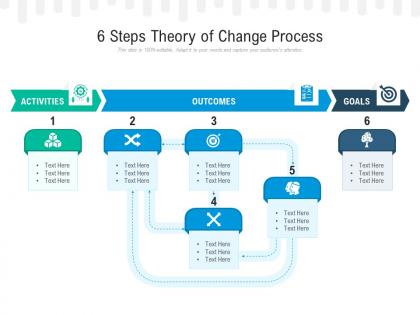
6 steps theory of change process




Try Before you Buy Download Free Sample Product
 Impress Your
 Audience
 100%
100% Editable
 Save Hours
 of Time


Our 6 Steps Theory Of Change Process are explicit and effective. They combine clarity and concise expression.
People who downloaded this PowerPoint presentation also viewed the following :
6 steps theory of change process with all 2 slides:
Give your audience a fulfilling experience. They will find our 6 Steps Theory Of Change Process elevating.
FAQs for 6 steps theory
You need a clear end goal first, then work backwards from there. Map out your assumptions about how change actually works - I used to skip this step and always regretted it later! Figure out what activities you'll do, expected outcomes at each stage, plus external stuff that might mess things up. Honestly, the best ones read like a story where you can follow the logic from "we do this" to "this happens because of that." Don't forget progress indicators and stakeholder mapping. It's basically building a roadmap that actually makes sense when you read it back.
Okay so first things first - you gotta nail down what success actually looks like way down the road, like 10-15 years out. Don't just say "we helped more people" because that's basically meaningless. Get specific about the real change you want to see happen. Then work backwards from there and ask what actually needs to happen to make that vision real. Oh and definitely loop in your stakeholders - they'll catch stuff you totally miss. The trick is finding that sweet spot where your goals are big enough to get people excited but not so crazy that you can't track if you're making progress.
Think of assumptions as the "what ifs" hiding in your Theory of Change - stuff you're betting will be true for your plan to actually work. Most people totally ignore this part, which is honestly why so many projects crash and burn later. You've gotta dig them out and test them somehow. Run a small pilot, talk to people who've tried similar things, or just do some quick research. Whatever's cheap and fast. Here's what I'd do: write down your biggest 3-5 assumptions first. Then figure out the easiest way to reality-check each one before you go all-in.
So Theory of Change is way more focused on the "why" - it maps out every assumption about how change happens, step by step. Logic models? More like basic flowcharts: inputs → activities → outputs. Strategic plans just tell you what you'll do and when. Here's how I think about it: strategic plans show your destination, logic models give you the basic route, but Theory of Change digs into all the messy human behavior stuff that actually makes things work. Or fail spectacularly. Use it when you need to reality-check whether your approach makes any sense from the ground up.
Look, your Theory of Change can't just live in a bubble with your team's assumptions. You need real voices from people who'll actually be affected by your work - beneficiaries, partners, whoever's implementing this stuff. They'll tell you about roadblocks you never saw coming and point out what solutions might actually stick. I learned this the hard way watching beautifully crafted ToCs crash and burn because nobody asked the right people what they thought. Get their buy-in early. Trust me, it saves so much headache down the road when you're trying to make things happen.
Don't just create your Theory of Change and forget about it - that's what most orgs do wrong. Set up quarterly check-ins to compare your assumptions with actual data. When new research drops or your approach isn't working, tweak the logic model. Write down what changed and why. Honestly, being too rigid kills progress. Your context will shift, and that's normal. The trick is staying flexible without scrapping your entire theory every time you hit a bump. Oh, and actually schedule these reviews or they'll never happen!
Honestly, it's all about knowing your audience. Visuals are your best friend here - infographics, simple flowcharts, before/after examples that actually show impact. Dense logic models will put people to sleep, trust me on that one. With funders, jump straight to outcomes and evidence. Community folks want relatable stories about their daily lives. Your staff needs the implementation details though. Oh, and try interactive workshops where people can poke holes in your thinking. Yeah it sounds scary, but the questions actually make your theory stronger and get everyone invested.
So basically track your short-term stuff against that Theory of Change you mapped out. Pick like 3-5 things you can actually measure - don't go crazy trying to track everything (I learned this the hard way). Mix up your data too - surveys and metrics, but also interviews and stories from people. Check in regularly to see if behaviors are actually shifting. The annoying thing? Some impacts won't show up for years, which sucks but it's just how it works. Are systems changing like you expected? That's the real question.
Don't make it too linear - like A always leads to B leads to C. Real life's messier than that. Also avoid being overly ambitious with timelines you can't actually hit. I see people copy-paste from other orgs all the time, but your situation is different. Actually talk to the people you're trying to help instead of guessing what they need (this seems obvious but you'd be surprised). Test your assumptions early because - and I can't stress this enough - your first draft will probably suck. But that's totally normal!
Honestly, going digital makes building your Theory of Change so much easier. I'd start with something like Kumu or Miro - they're great for creating visual logic models that actually make sense (way better than those boring static docs). Collaborative platforms are a game changer too since stakeholders can comment directly on outcome pathways. No more drowning in email threads, thank god. You can track progress against your assumptions in real-time with data viz tools, plus it's super easy to customize presentations for different audiences. Just pick a basic mapping tool first - you'll see the difference immediately.
Oh man, cultural context is HUGE for Theory of Change design. What works in one place totally bombs in another - I've seen this happen so many times. You can't just assume people think about power, time, or relationships the same way you do. Like, hierarchical approaches might fly in some cultures but completely backfire where things are more egalitarian. Honestly, I made this mistake once in Southeast Asia and it was embarrassing. Different cultures have totally different decision-making processes too. Best thing you can do? Get local people involved from day one when you're building your Theory of Change. They'll catch blind spots you'd never see coming.
So basically, nonprofits measure success by social impact while businesses focus on profit - pretty different end goals. Nonprofits map how their work creates social change, though honestly those outcomes can be super vague sometimes (like "community wellbeing" - what does that even mean?). Businesses have clearer metrics like revenue growth. Both follow the same basic flow though: inputs → activities → outputs → outcomes. The stakeholder thing's different too. Nonprofits juggle donors, communities, and the people they serve. Businesses mainly answer to shareholders and customers. Way less complicated. I'd start with your main success metric first, then work backwards from there.
Think of your Theory of Change like a GPS for evaluation - it shows you exactly what to measure and when. Maps out how your activities should connect to outcomes, so you can test if those links actually work in real life. Honestly, it's a lifesaver for catching problems early instead of wondering later why everything went sideways. You can pick key indicators at each step and build questions around your riskiest assumptions. Way better than just tracking random stuff and hoping it matters. Makes the whole evaluation thing actually strategic instead of just... busy work, you know?
Look, your Theory of Change needs actual activities and measurable milestones baked in from day one. Skip the abstract fluff—spell out exactly what actions drive each change and who owns them. I've watched so many beautiful ToCs just sit there collecting dust because nobody knew what to actually do with them. Set up regular check-ins to see what's working (spoiler: some stuff won't). Assign real people to each piece with realistic deadlines. Honestly, if someone can't glance at your ToC and figure out their next steps for this week, you're being way too vague. It should feel like directions, not some motivational poster.
Honestly, visuals are a game-changer for Theory of Change stuff. You can see how activities connect to outcomes instantly instead of digging through paragraphs of text. Flow charts work really well, or even those basic boxes-and-arrows things. I've literally seen people sketch something on a whiteboard that made more sense than a whole written report. Templates are super helpful too - they make you think through your assumptions step by step. Start with a basic template and just tweak it for whatever you're working on. Way less painful than starting from scratch.
No Reviews