


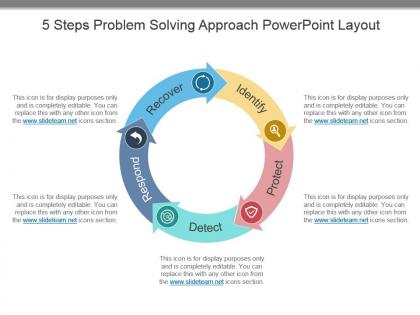
5 steps problem solving approach powerpoint layout




Try Before you Buy Download Free Sample Product
 Impress Your
 Audience
 100%
100% Editable
 Save Hours
 of Time


Bolster the demoralised with our 5 Steps Problem Solving Approach Powerpoint Layout. Give folks the confidence that you will back them to the hilt.
People who downloaded this PowerPoint presentation also viewed the following :
5 steps problem solving approach powerpoint layout with all 5 slides:
Focus on better development with our 5 Steps Problem Solving Approach Powerpoint Layout. Your ability to achieve gets enhanced.

FAQs for 5 steps problem solving
Okay so basically you want to define what you're actually dealing with first - don't just jump into fixing stuff. Then gather info, brainstorm a bunch of options, and weigh them out properly. Most people totally skip that evaluation part but it's where you compare pros/cons and think about what resources you'll need. After you pick something and try it, circle back to see if it worked. I learned this the hard way honestly - used to just throw solutions at problems without really understanding what was wrong first. Takes longer upfront but saves you so much hassle later.
Honestly, brainstorming works because it shuts up that inner critic that kills ideas before they even develop. You're literally forcing your brain to connect dots it wouldn't normally connect. The whole "no judgment" thing isn't just feel-good advice – it actually lets you explore those weird tangents that sometimes become genius solutions. I used to filter out the "dumb" ideas immediately. Big mistake. Those ridiculous thoughts often lead to breakthrough moments. Set a timer for like 10 minutes and just vomit everything onto paper, even stuff that sounds completely stupid. My handwriting gets terrible when I'm really in the zone, but whatever. You can clean it up later – right now you just need that messy creative foundation to work with.
Think of data analysis as your detective work - it helps you find the actual root cause instead of just fixing what's broken on top. Honestly, I've seen so many teams waste time on the wrong fixes because they didn't dig into the numbers first. Look for patterns and trends that show what really changed. The data usually tells a totally different story than what you'd expect. Grab metrics from before the problem started, during it, and after. Then work backwards from when things first went sideways. It's like having X-ray vision into what's actually happening versus what everyone assumes is wrong.
Dude, being emotionally smart is like having superpowers when you're problem-solving. You can actually sense when people are stressed or pissed off before they even say anything. That stops you from making dumb rushed decisions or missing obvious stuff because you're too focused on one thing. I've noticed quiet team members usually have the best insights - they're just waiting for the right moment to share. Honestly, half the time problems aren't even technical, they're just people being weird about speaking up. Next time you're stuck, take a second to feel out the vibe first. Works way better than just diving in headfirst.
Okay so first thing - make sure everyone's actually solving the same problem before you start. Give people specific roles otherwise it gets messy fast. Set up check-ins to catch problems early. Time-box your brainstorming sessions! Trust me on this one, they'll go on forever otherwise. Document your decisions as you make them, not after. The real key though? People need to feel safe throwing out crazy ideas or saying "I'm stuck." Maybe try having different people run meetings - I've seen that shake things up in good ways. Oh and definitely use contractions when you talk, makes everything feel less formal.
Dude, flowcharts are actually clutch for this stuff. They make you break down complicated problems into bite-sized steps, which honestly does most of the work for you. Once you've got everything mapped out visually, it's way easier to catch things like bottlenecks or redundant steps that you'd totally miss otherwise. Team meetings become less of a nightmare too - no more confusion about which part you're discussing. You can test different approaches and see what might blow up before actually doing it. I know it sounds kinda nerdy, but seriously try sketching one out next time you're stuck on something messy.
Oh man, confirmation bias is the worst - you only hunt for stuff that backs up what you're already thinking. Then there's anchoring bias where you get totally stuck on the first idea someone throws out. I do this ALL the time with availability bias too, basically giving way too much weight to whatever happened recently. Sunk cost fallacy is brutal though, like when you keep throwing good time after bad just because you've already invested so much. And analysis paralysis? Yeah, that's when you think yourself in circles instead of just trying something. Best fix is honestly getting someone else to look at it fresh, plus setting actual deadlines for yourself.
Basically, you test stuff fast and cheap so you don't waste months on something that sucks. Run quick experiments, get feedback, then bail if it's not working instead of being stubborn about it. I used to hate this concept because "failing" felt wrong, but honestly? It's way better than spending forever on the wrong thing. Each little test teaches you something useful - even the ones that flop. You'll actually find good solutions faster this way. Oh, and start with whatever assumption scares you most. That's usually where the real problems hide.
Honestly, there's so much stuff out there to help with this. Mind mapping tools like Miro are great for seeing connections you'd totally miss otherwise. I'm obsessed with spreadsheets though – Excel or Google Sheets with pivot tables work for almost any data problem. Trello keeps me sane when I'm juggling complicated stuff with tons of moving parts. AI tools can brainstorm with you or catch patterns you didn't notice. Oh, and pick whatever fits your style – are you more visual, numbers-focused, or need help staying organized? That'll point you in the right direction.
Okay so think of clear objectives like having GPS when you're driving - without them you'll just wander around forever. Write down exactly what you're trying to solve in one sentence before you even start brainstorming. That way you can actually judge if your ideas are any good instead of just hoping something sticks. I swear I've been in so many meetings where people just talk in circles because nobody defined the goal first. It's honestly painful to watch. When you know your target, you'll recognize when you've hit it instead of tweaking stuff endlessly. Trust me, this saves so much time.
Honestly, the best way is comparing your results to whatever goals you set upfront - pretty straightforward. Track the hard numbers like performance gains or cost cuts, but also grab feedback from actual users. Their opinions usually tell you more than spreadsheets do anyway. Set up check-ins at 30, 60, 90 days after launch. Oh, and start collecting baseline data now if you haven't already - you'll need something to compare against later. Before-and-after comparisons are what really show if your solution actually worked.
Dude, you really should try working with people outside your field. Like, a designer sees user problems differently than an engineer who's all about systems. Throw in a psychologist? Now you're catching stuff none of you would've spotted alone. It's honestly way more fun than just talking to the same people every day. The trick is actually listening to everyone's input - not just bringing them in to agree with what you already decided. Oh, and map out early which disciplines might help. Trust me, you'll get way better solutions.
Dude, feedback loops are what separate actual problem-solving from just throwing stuff at the wall. You implement something, then you watch what happens - kinda like debugging code (assuming you actually debug lol). Set up ways to measure if it's working. Check in regularly on your progress. The data will tell you when to pivot or double down. Without this, you're basically playing guesswork roulette and hoping for the best. I learned this the hard way on a project last year. Monitor, adjust, repeat - that's literally how you turn random attempts into real learning.
Honestly, scenario planning is just mental prep work - you dream up 3-4 different ways things could go wrong (or right) and figure out your game plan for each. Best case, worst case, maybe a couple realistic options in between. Think of it like... I dunno, planning different routes to avoid traffic? When stuff actually hits the fan, you're not scrambling because you've already thought it through. My old boss swore by this method. Pick something big that might happen to your team next year and just walk through how you'd handle it differently depending on the situation.
Dude, you should totally tell it like a story instead of just throwing data at people. Like, walk them through what was happening, how you figured it out, all that. People actually remember stories - way better than boring bullet points anyway. It connects with them emotionally or whatever. Plus they can picture how your solution would actually work in real life. I swear it's night and day compared to those dry case studies we had to read in school. Next time just start with "So here's the mess we were dealing with..." and take them through it step by step.
-
It saves your time and decrease your efforts in half.
-
Appreciate the research and its presentable format.