


8 problem solving model powerpoint slide ideas




Try Before you Buy Download Free Sample Product
 Impress Your
 Audience
 100%
100% Editable
 Save Hours
 of Time


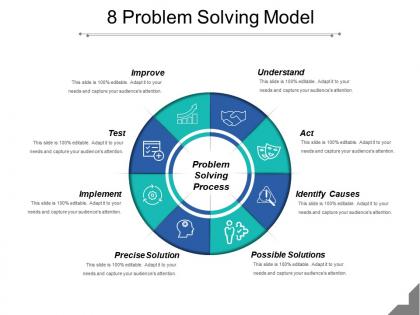
Irrespective of the size of your company or business, you will encounter business-related problems and so will need a problem-solving model. Our 8 problem-solving model PowerPoint slide ideas will allow you to get all your staff on the same page when it comes to implementing solutions that will work for everyone. You may choose our 8-step analysis PPT presentation graphic to track the solutions for the problems faced.This problem-solving process PowerPoint template covers several alternatives for sorting out your business concerns. These are categorized as identifying causes, possible solutions, precise solution, implement, test, improve, understand and act. The problem and solution wheel PPT presentation graphic allows you to present high-quality graphics slides designed by experts for multiple platforms. The ease of editing allows you to present your ideas in the context of your unique business culture. Disclose your plans on our 8 Problem Solving Model Powerpoint Slide Ideas. Ensure they understand every aspect.
People who downloaded this PowerPoint presentation also viewed the following :
8 problem solving model powerpoint slide ideas with all 5 slides:
Give folks cause to feel immensely elated with our 8 Problem Solving Model Powerpoint Slide Ideas. Inspire them to be joyful.


FAQs for 8 problem solving model
You need something systematic but not overly complicated. Break big problems into steps: define what's actually wrong, get the data, brainstorm solutions, then evaluate them. Don't try to solve everything solo - get input from people who'll be affected. Pick a framework your whole team can remember when everything's on fire (which happens more than it should, honestly). The key is consistency - don't switch methods every project. Simple beats sophisticated if people will actually use it. Most teams overthink this part.
Okay so basically treat your research like you're testing a theory. First figure out exactly what problem you're trying to solve, then do some background digging to make an educated guess about the answer. Design some experiments or studies to test it - honestly this part's pretty fun because you get to play detective. Collect data systematically and analyze everything objectively. Don't just go with your gut feelings, let the actual evidence guide you. If your theory bombs? No big deal, just revise and try again. The whole point is staying methodical instead of jumping to random conclusions.
So critical thinking is what actually makes problem-solving work in classrooms. Without it, kids just follow steps blindly - like giving someone car keys when they can't drive yet. You want students questioning assumptions and analyzing evidence at every step. The cool part? Pair it with structured methods like design thinking or scientific method. Students dig deeper and catch their own reasoning mistakes. Have them explain their thinking out loud during activities - honestly, that's where you'll see the biggest breakthrough moments. It's pretty satisfying when they start connecting the dots themselves.
Different industries just grab basic problem-solving methods and modify them for their specific needs. Healthcare uses root cause analysis but goes crazy with safety protocols - makes sense when people's lives are on the line. Tech companies are obsessed with agile because they need to move fast and change direction constantly. Six Sigma works great for manufacturing since they hate defects and waste (honestly, who wouldn't?). Financial services? They throw regulatory checkpoints into everything they do. Figure out what your industry absolutely can't mess up, then build your problem-solving approach around those must-haves.
So PDCA makes you think before jumping into fixes, which honestly saves so much time later. Plus it builds in that whole "let's keep making this better" mindset. Pretty solid for workplace stuff. But yeah, when everything's on fire and your boss wants results yesterday? Feels painfully slow. And some people hate all the checking and documenting - I get it. Also kinda ridiculous to use for super basic problems. I'd say save it for the messy, complicated issues that keep coming back. That's where it really shines.
Honestly, design thinking is a game changer because it makes you actually talk to users first instead of guessing what they want. The empathy phase feels slow at first but saves you from building crap nobody needs. Quick prototyping is where it gets fun - you can test ideas fast and ditch the bad ones early. My favorite part? It gets different teams working together instead of staying in their bubbles. Next time you're stuck on a product problem, just walk through those five steps (empathize, define, ideate, prototype, test). Sounds basic but it works.
Here's what I'd do - start by mapping out who might push back before you even dive into solutions. Like, literally list the people who could hate your idea and why. After big decisions, do a quick "conflict check" where you hunt for opposing views. I learned this the hard way on a project last year - wish I'd done it sooner! Think of disagreements as useful info, not annoying obstacles. Next time you're pitching something, ask yourself: "who's gonna fight me on this and what would actually change their mind?"
Data analysis is honestly a game-changer for marketing problem-solving. You're basically shooting in the dark without it. I used to guess at everything and wondered why campaigns flopped - turns out real data beats gut feelings every time. Now I build data checkpoints into each step of my process instead of just checking results afterward. It helps you spot the actual problem faster and prove whether your fix worked. Short sentences work better sometimes. Look at what data you're already collecting but probably ignoring when making decisions. That's usually the easiest place to start improving your approach.
Okay so the 5 Whys thing basically forces you to stop being lazy about problems. Most people see something broken and just patch it up - huge mistake. You gotta keep asking "why did this happen?" after each answer. Usually takes about five rounds before you hit the actual root cause instead of just symptoms. Honestly, it's kind of annoying at first because your brain wants the quick fix. But think about it - how many times have you "fixed" the same stupid problem over and over? That's because you never dug deep enough. Next time something breaks, spend those extra few minutes going through the whys. Way better than dealing with the same headache again next month.
Look, RCA works great for simple stuff, but complex systems? Not so much. It assumes there's one neat cause-and-effect chain, when really you've got like 5 different things all feeding into each other. Traffic jams are perfect examples - was it the weather, that one slow driver, bad road design, or just crappy timing? Probably all of them. You'll go crazy trying to find THE root cause because there isn't one. Plus RCA gets stuck looking backward instead of seeing bigger patterns. Honestly, mix it with some systems thinking and you'll actually understand what's happening.
Honestly, collaboration can totally make or break how well diverse teams solve problems. Without it, you're just a bunch of people talking past each other instead of actually using everyone's different perspectives. The key is making sure everyone feels heard - not just whoever talks the loudest (we all know that person). Try rotating who leads discussions and set up some structured brainstorming. Oh, and actually listen to build on ideas rather than just waiting for your turn. It takes effort but it's worth it when you can attack problems from angles nobody would've thought of alone.
Honestly, drawing stuff out changed everything for me. You'll catch patterns and connections that just don't pop when you're staring at walls of text. Mind maps work great for brainstorming - I'm obsessed with them now. Flowcharts show you exactly where things get stuck. Even messy sketches help your team understand complex problems way faster than explanations do. Last week I literally saved a project by mapping out all the stakeholder drama on a whiteboard (what a mess that was). Next time you're spinning your wheels, grab some markers and start sketching the problem instead.
Break your problem into bite-sized pieces instead of wrestling with the whole thing. Those Agile folks are onto something - tackle stuff in short bursts and check in with yourself daily to catch roadblocks early. When you learn something that changes everything, just pivot. Don't overthink it to death (I'm guilty of this too). After each mini-sprint, ask yourself what actually worked and what was garbage. Honestly, the "fail fast" thing sounds cheesy but it's legit better than spinning your wheels. Start by figuring out the smallest thing you can test first.
Your cultural background totally shapes how you approach problems - like whether you go for quick personal fixes or take time building group consensus. I've noticed this so much working with different teams! Some cultures are all about the data while others trust gut instincts more. Hierarchy matters way more in certain places too. The trick is getting diverse perspectives when you're building these models. Otherwise you'll miss obvious stuff that seems normal to you but doesn't work for everyone else. It's honestly pretty fascinating how different we all think about the same challenges.
So basically, feedback loops stop you from just throwing solutions at the wall and hoping something sticks. You try something, see what breaks (or doesn't), then adjust for round two. Without that reality check, you're stuck repeating the same dumb mistakes - trust me on this one. The trick is figuring out what to measure before you start. Don't just collect random data or ask people how they "feel" about it. Pick metrics that actually matter. Otherwise you'll have tons of feedback but none of it useful.
-
Thanks for all your great templates they have saved me lots of time and accelerate my presentations. Great product, keep them up!
-
Presentation Design is very nice, good work with the content as well.