


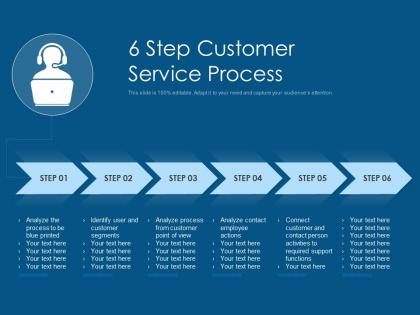
6 step customer service process




Try Before you Buy Download Free Sample Product
 Impress Your
 Audience
 100%
100% Editable
 Save Hours
 of Time


Our 6 Step Customer Service Process are topically designed to provide an attractive backdrop to any subject. Use them to look like a presentation pro.
People who downloaded this PowerPoint presentation also viewed the following :
6 step customer service process with all 2 slides:
Use our 6 Step Customer Service Process to effectively help you save your valuable time. They are readymade to fit into any presentation structure.


FAQs for 6 step
So basically you've got five main stages to nail down. Start with that initial greeting - make it count. Then really listen to what they're saying, dig into the problem, and give them a solid solution with clear next steps. Oh, and don't forget to circle back later - that's honestly where most teams screw up, but it's huge for keeping customers happy. Document everything as you go (yeah I know, paperwork sucks but you'll thank me later). Map out your current process first and see where the gaps are. The whole thing should flow naturally from one stage to the next.
Honestly, focus on response times first - that's what pisses customers off most. Resolution time matters too, obviously. CSAT scores will tell you if people actually like dealing with your team (sometimes the feedback is brutal but useful). First-call resolution is clutch since no one wants to call back and re-explain everything. Net Promoter Scores are solid for the bigger picture. Oh, and average handle time helps you see if agents are being efficient or just trying to get people off the phone. Pick like 3-4 of these that actually matter for your situation. Tracking everything gets overwhelming fast.
Honestly, tech can totally transform how you handle customer service. Chatbots are great for basic questions around the clock. CRM systems save your sanity - customers won't have to repeat their whole saga every time they call. AI routing gets tickets to the right people faster, which is clutch. Oh, and analytics help you catch complaint patterns early before they become disasters. Here's the thing though - don't get distracted by fancy features you'll never use. Pick one headache your team actually has and find software that fixes it. We made that mistake once and ended up with way too many bells and whistles.
Honestly, just grab feedback from everywhere - surveys, social media, even when customers randomly complain during calls. But here's the thing that most companies mess up: actually using it. Don't just dump everything into some database nobody looks at. My team does monthly reviews where we spot patterns and tackle the biggest issues first based on how often they come up. Oh, and definitely tell customers when you fix something they complained about - they love that. Start with one annoying complaint this week and get everyone brainstorming solutions.
Honestly, role-playing scenarios work best - have them practice dealing with angry customers and weird return situations. Get them shadowing your experienced reps too. Call reviews are brutal but so worth it (nobody wants to hear themselves stumble through explanations, but man does it help). Keep updating product knowledge regularly since that stuff changes constantly. Cross-training is clutch so they actually understand what other departments do. Monthly practice sessions where everyone shares tips? Perfect. The biggest mistake I see is treating training like a one-and-done thing when it really needs to be ongoing.
Look, it really comes down to knowing what your customers actually deal with day-to-day. Healthcare companies have to nail the empathy thing and stay HIPAA compliant - no choice there. Tech support? They're all about quick fixes through chat, email, whatever works. Retail is mostly "where's my package" complaints and handling returns without making people jump through hoops. Banks and finance get tricky since everything needs bulletproof security. I'd say figure out what pisses off your customers most, then build everything around fixing those headaches first. The rest kinda falls into place once you get that right.
Ugh, the worst mistakes? Taking forever to get back to people, having your team give different answers to the same question, and - this drives me crazy - not actually listening to what customers are saying. We always rush to fix stuff before we even understand what's broken! Set response time goals that you can actually hit. Build a knowledge base so everyone's on the same page. Train people to ask more questions instead of guessing. And here's something most companies skip - follow up after you "solve" things. Shows you're not just trying to close tickets as fast as possible.
Dude, start with the boring stuff - chatbots for basic questions and systems that automatically sort tickets. Build clear escalation rules so your team isn't guessing when to pass things up. Self-service is where it's at though. Knowledge bases, video tutorials, whatever works. I swear most support tickets happen because people can't find the right info easily. Map out your current workflow first and spot where things jam up. Oh, and tackle your worst bottlenecks first - you'll see results way faster that way.
Oh totally, good customer service is huge for keeping people around. When someone actually fixes your problem fast and doesn't make you feel stupid, you'll definitely come back. Plus you'll probably tell your friends about it too. Honestly, I think it's way better than spending tons on ads - like, just train your people to actually help instead of reading scripts. Research backs this up too - customers will literally pay more for brands they trust. My friend works in customer service and says the companies that let them solve problems on the spot always have happier customers.
Honestly, hire people who genuinely give a damn about helping others - way too many places mess this up from the start. Give your team real power to fix problems instead of making customers wait around forever. Leadership has to walk the walk though, like actually choosing customer happiness over quick cash grabs (easier said than done, I know). Training's fine but it's mostly about removing the stupid barriers that stop your people from doing good work. Just ask them what's in their way and then actually fix it. Short bursts work better than long meetings about it.
Track response time and resolution time first - those are your bread and butter. Customer satisfaction surveys matter way more than people think since they actually predict who's gonna stick around. First-call resolution is huge too because bouncing customers around departments just pisses everyone off. Oh, and escalation rates - nobody wants those trending up. I'd probably check these monthly unless you're swamped with volume, then maybe weekly. Honestly, satisfaction scores are what I'd watch closest since they tie straight to your bottom line. Start simple with these basics, you can get fancy later.
Honestly, using someone's name and remembering what they bought before makes such a difference. Nobody wants to be treated like just another ticket number, you know? The worst part is when customers have to repeat their whole story to every single agent - that's when people get really annoyed. Good CRM notes are clutch here. If your team can actually pick up where the last person left off, customers feel heard. They'll trust you way more. It's pretty simple but most companies still mess this up somehow.
Okay so here's the thing - when departments actually work together, customers stop getting ping-ponged around and stuff gets fixed faster. Sales knows what support is dealing with, support understands what product is building. Way less "sorry, wrong team" nonsense. You'll spot problems before they blow up, and honestly? It makes everyone's day smoother. The customer gets their answer without three transfers, which they obviously love. I'd start small though - maybe just grab coffee with whoever you usually dump cases on and see what they're seeing on their end. Trust me, those regular check-ins are worth it.
Stay calm and actually listen to what's really bugging them, not just the obvious complaint. First thing - acknowledge they're pissed off with something like "yeah, that sounds super frustrating." People mostly want to feel heard anyway! Focus on what you CAN do instead of rattling off what you can't. Give them choices if possible. Write everything down so the next person isn't starting blind. And honestly? Know when to pass it up the chain - some battles aren't worth fighting at your level.
So from what I've been seeing, customer service is getting wild with AI right now. Chatbots do all the basic stuff, which honestly makes sense - why waste human agents on password resets? Meanwhile people expect everything connected seamlessly. Like, start a complaint on Twitter, finish it over the phone without repeating yourself. Companies are also getting crazy good at fixing problems before you even notice them. Oh, and personalization is huge too - they want every interaction tailored to you specifically. It's cool tech but man, don't lose that human element completely, you know?
-
Excellent Designs.
-
Excellent work done on template design and graphics.