


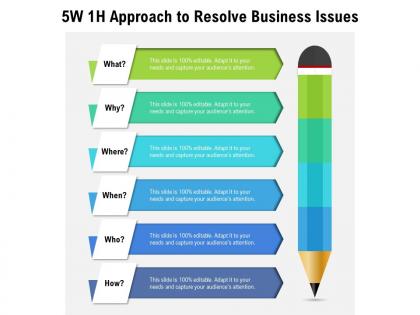
5w 1h approach to resolve business issues




Try Before you Buy Download Free Sample Product
 Impress Your
 Audience
 100%
100% Editable
 Save Hours
 of Time


Our 5W 1H Approach To Resolve Business Issues are topically designed to provide an attractive backdrop to any subject. Use them to look like a presentation pro.
People who downloaded this PowerPoint presentation also viewed the following :
5w 1h approach to resolve business issues with all 2 slides:
Use our 5W 1H Approach To Resolve Business Issues to effectively help you save your valuable time. They are readymade to fit into any presentation structure.
FAQs for 5w 1h approach to
You know that 5W1H thing from journalism class? Who, what, when, where, why, how - it's actually perfect for presentations too. I always run through those six questions when I'm putting slides together. Keeps me from forgetting obvious stuff that'll make people confused later. Most questions you get afterward are gonna fall into one of those buckets anyway. It creates this natural flow that's way easier to follow than just random info dumps. Like, once you answer the "what" you naturally want to explain "why" next, right? Honestly, it's become my go-to mental checklist now. Try it next time - just go through each one and see what gaps pop up in your story.
People naturally want answers to who, what, when, where, why, and how - so just give them what they're already thinking about! You'll see way less of those blank stares when you structure things this way. Your audience won't get lost trying to piece everything together because you're answering their questions before they even form them. I usually start each section with one of those questions - creates this natural hook that keeps people actually listening. Plus it flows better than just randomly throwing information at them. Works every time, honestly. The whole thing just feels more conversational and less like you're reading from a script.
Okay so the 5Ws and 1H thing - it's like a mental checklist before you send anything important. Who are you talking to, what's your actual point, when does this matter, where is it happening, why should they care, and how will it work? Sounds super basic but I swear it works. Like yesterday I almost sent this vague project update and then went through the list real quick. Ended up catching that I forgot to mention the deadline entirely - would've been awkward. Try it next time you're writing something that matters, especially if it's going to your boss or team.
Honestly, 5W1H is like a cheat code for presentations. Map out your content first - what's your main thing, why should people care, who's your audience, when/where does it happen, how do you pull it off? For business stuff, your "what" becomes the product pitch, "why" is market need, etc. Academic presentations work the same way, just swap in research questions and methodology. The trick is hiding that you're using a framework at all. Don't literally go "First, what..." - just make sure those elements show up naturally as you tell your story. It's basically mad libs once you get it down, which sounds dumb but actually works.
You know that 5W1H thing? It's basically just asking who, what, when, where, why, and how about whatever you're trying to explain. Super simple but it works. When I use it, I don't miss important stuff because I'm literally going through a checklist. Your brain just follows the questions naturally. Plus people can actually follow what you're saying instead of getting lost in all the technical BS. Honestly, it's kinda funny how something so basic makes such a difference. Next time you're writing an email or doing a presentation, just run through those six questions first. Makes everything way clearer.
Honestly, storytelling just makes the 5W1H thing way less boring. People zone out when you're like "who: customer, what: problem, when: Q3" - ugh, right? But wrap those same facts in an actual story and suddenly they're paying attention. Start with the "why" to hook them, then let everything else play out naturally. Your framework keeps you organized while the story keeps them awake. It's like... instead of rattling off bullet points, you're painting a picture of how your customer dealt with this mess last quarter. Way more engaging than a checklist.
Okay so for persuasive speeches, try flipping that 5W1H thing into a weapon. Make your "What" the urgent problem people can't ignore. "Who" gets personal - show them how it affects real people they care about. Timing and location create that now-or-never feeling. Here's the thing though - "Why" is where you either nail it or totally bomb. That's where consequences and benefits hit hardest. Then "How" gives them exact steps to take action. Basically you're building this logical path that just... leads right to what you want them to do. Way more focused than just dumping info on people.
Mind maps are honestly my go-to for this - stick your main topic in the middle, then branch out each W and H question around it. Flowcharts work really well too if you're dealing with processes. Oh, and try using little icons for each element! Like a clock for "when" or person silhouette for "who." Makes scanning way faster. Grid layouts are solid too, or just color-code each question throughout your slides. I'd probably avoid getting too fancy though - pick one approach and roll with it. The icon thing might sound cheesy but it actually helps people follow along better.
Okay so this 5W1H thing actually works really well for meetings. Basically you just go through who's involved, what the problem is, when it happened, where, why it matters, and how you'll fix it. Sounds boring but trust me - it stops those awful meetings where everyone talks in circles for like 45 minutes. My old team used to do that constantly. Now when someone brings up an issue, we just run through each question together. You'll spot the gaps fast and get everyone aligned before diving into solutions. Honestly just try it as your go-to checklist next time.
Don't try cramming all six questions into your slides - your audience will zone out from information overload. I've seen this happen so many times! Also, avoid answering stuff superficially. Like, don't just say "who" without explaining why that person actually matters to your point. Here's what works better: use 5W1H as your behind-the-scenes checklist when you're prepping. Make sure you've got the important stuff covered, then just weave those answers naturally into your story. Oh, and don't force the framework if it feels awkward - sometimes it just doesn't fit the flow you're going for.
Honestly, the 5W1H thing is a lifesaver when you're staring at a blank doc. Just go through each one: Who's listening? What's your point? When/where does this matter? Why should they give a damn? How do you fix their problem? It's like having a cheat sheet - sounds dorky but it works. You won't ramble or forget important stuff because you're covering all the bases they actually need. I started doing this after bombing a presentation last year (learned the hard way). Map out your next one using these questions first and you'll probably save yourself hours of rewriting.
So the 5W1H thing is super helpful when you're dealing with complicated stuff that people need to get fast. I always use it for onboarding new people or explaining processes to stakeholders who don't know the technical side. Project kickoffs too - keeps everyone on the same page, which honestly saves me so many headaches later. The structure makes you hit all the important points without drowning people in details they don't need. Oh, and it's great for training materials. Next time you need to explain something messy, try it. You'll actually be shocked how much clearer you sound.
Yeah, this stuff totally matters! Japanese and Korean audiences want you to build rapport first - diving straight into facts feels rude to them. Germans though? They love that direct, structured approach. Hierarchical cultures get weird about questioning authority figures too, which makes the "who" part tricky. Honestly, timing is probably the biggest thing I've noticed. What seems thorough to Americans might feel super rushed to other cultures. You really gotta research your audience beforehand and adjust how fast you move through everything. Oh, and don't be afraid to spend more time on relationship stuff upfront - it's not wasted time.
So I'd definitely start with a mind mapping tool like Miro or XMind - they're great for getting all your 5W1H questions laid out visually. You won't miss anything that way. For the actual slides, Canva and PowerPoint are obvious choices. But honestly? Sometimes I just use a basic Google Doc to list everything out first. Works perfectly fine and it's simple. Milanote's also solid for quick brainstorming if you're into the sticky note thing. The main point is nailing down all six elements before you even think about design. Map it out first, then worry about making it look pretty.
Honestly, just throw together a quick Google Form after your presentation - way more people actually fill those out than the generic feedback stuff. Ask if the 5W1H thing helped clarify everything and what felt confusing. During Q&A, notice which parts (who, what, when, etc.) get the most follow-up questions. That's your weak spot right there. If everyone keeps asking "but why?" then your reasoning probably sucked. I always forget to do this, but actually look at the responses before your next presentation - otherwise what's the point?
-
It saves your time and decrease your efforts in half.